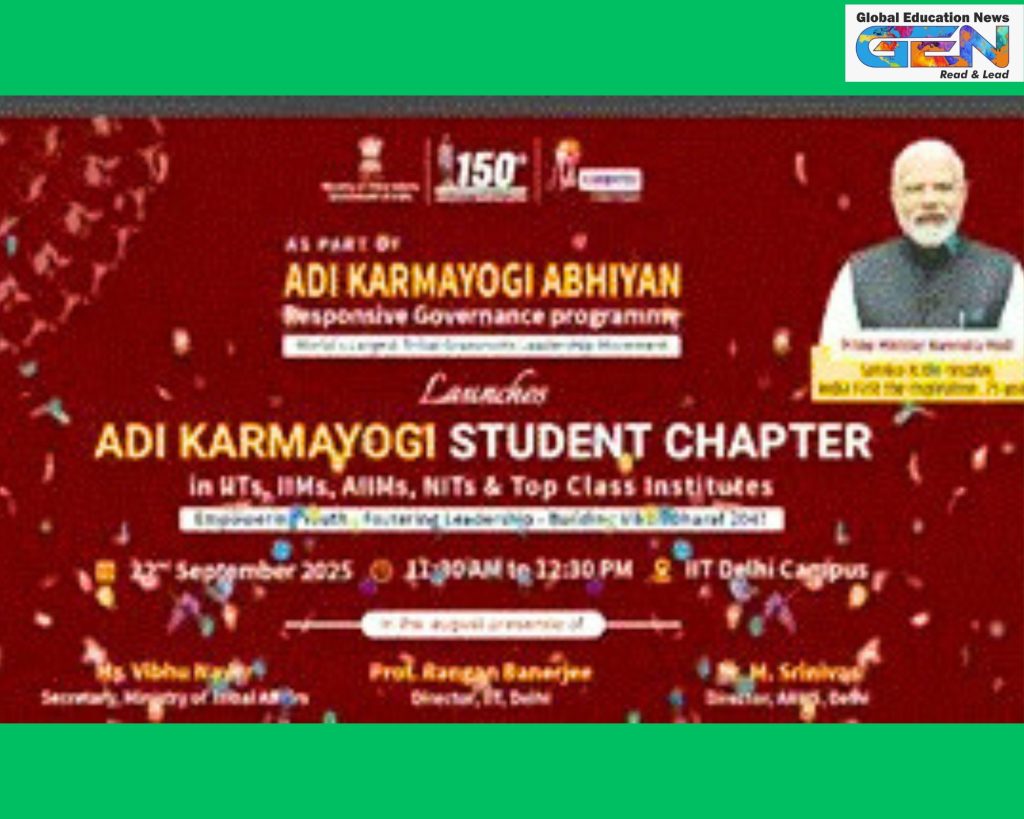
India’s premier institutions are stepping up to empower tribal youth like never before. On September 22, 2025, the Ministry of Tribal Affairs officially launched the Adi Karmayogi Student Chapters at IIT Delhi, marking a pivotal moment in the world’s largest tribal leadership movement. Anchored by IIT Delhi’s Bhagwan Birsa Munda Cell as the national hub, this initiative connects elite education with grassroots tribal communities, fostering a cadre of future leaders, innovators, and entrepreneurs.
Key Points:
- Launched as part of the Adi Karmayogi Abhiyan, unveiled by Prime Minister Narendra Modi on September 17, 2025, during Janjatiya Gaurav Varsh (November 2024–2025).
- Aims to nurture 20 lakh change leaders across 1 lakh tribal villages, covering 11 crore tribal citizens in 30 states/UTs.
- Focuses on responsive governance, youth participation, and community-led planning to align with Viksit Bharat@2047 vision.
The Vision Behind Adi Karmayogi Abhiyan: A People’s Movement for Tribal Pride
Hailed as a flagship program under Janjatiya Gaurav Varsh, the Adi Karmayogi Abhiyan is more than governance reform—it’s a bottom-up revolution rooted in tribal values. Prime Minister Modi launched it from Dhar, Madhya Pradesh, emphasizing its role in connecting tribal communities directly to government schemes like PM-JANMAN and Dharti Aaba Janjatiya Gram Utkarsh Abhiyan. The Abhiyan equips Adi Karmayogis (government officers) and Adi Sahyogis (youth, teachers, doctors) to drive service delivery, innovation, and welfare in remote areas.
Key Points:
- Envisions Tribal Village Vision 2030 plans, Adi Sewa Kendras (single-window service centers), and AI-based Adi Vaani App for native language communication.
- Builds on Behavioral Process Labs hosted by Tribal Research Institutes for field learning and scheme convergence.
- Promotes voluntary Adi Sewa Samay (weekly community service) to foster participatory development.
Participating Institutions: A Pan-India Network of Excellence
The first phase ropes in over 30 top-tier institutions, creating a robust ecosystem for tribal upliftment. From engineering powerhouses to medical marvels, these chapters bridge urban academia with rural tribal realities, ensuring diverse expertise reaches underserved communities.
Key Points:
- Engineering & Management: IIT Delhi, IIT Kharagpur, IIT Dharwad, IIT Hyderabad, IIM Sirmaur, IIM Nagpur.
- Medical Institutes: AIIMS Nagpur, AIIMS Gorakhpur, AIIMS Bhatinda, VMMC-Safdarjung Hospital, AIIMS Delhi.
- Science & Research: IISER Mohali, SVNIRTAR, Indian Institute of Space Science and Technology (IIST) Trivandrum.
- Technical & Law: DTU Delhi, NITs (Delhi, Patna, Raipur, Puducherry, Meghalaya), IIITDM Kurnool, BIT Mesra, NERIST Arunachal Pradesh, RGNUL Patiala.
- Hospitality: IHM Kufri, IHM Tharamani, IHM Pusa, IHM Bhopal, IHM Bhubaneswar.
- Open to all students and institutions for expansion—apply to establish new chapters nationwide.
Core Activities: From Mentorship to Innovation – What Students Will Do
These chapters aren’t just symbolic; they’re action-oriented platforms sparking real change. Students from IITs, IIMs, and AIIMS will mentor tribal peers, launch startups, and tackle community challenges through hands-on projects, turning knowledge into impact.
Key Points:
- Mentorship & Education: Pair elite students with Eklavya Model Residential Schools (EMRS) and Ashram schools to boost learning outcomes for ST students from Class 6-12.
- Entrepreneurship Boost: Access a ₹50 crore Venture Capital Fund for Scheduled Tribes (VCF-ST), offering investments from ₹10 lakh to ₹5 crore at 4% concessional rates (3.75% for women/disabled).
- Innovation Drives: Host hackathons, workshops, and skill training in semiconductors and frontier tech with IISc Bangalore.
- Village Transformation: Develop Vision 2030 plans, SWOT analyses, and sustainable strategies for tribal villages.
- Internships & Awards: Opportunities with Ministry of Tribal Affairs, state governments, and districts; recognition for top student leaders and mentors.
Spotlight on Eklavya Model Residential Schools: The Backbone of Tribal Education
At the heart of the mentorship efforts are Eklavya Model Residential Schools (EMRS), flagship residential institutions for Scheduled Tribe (ST) students. Established under Article 275(1) of the Constitution, EMRS aim to provide quality education comparable to Jawahar Navodaya Vidyalayas, empowering tribal youth in remote blocks with over 50% ST population.
Key Points:
- Over 440 EMRS sanctioned nationwide, with 284 operational as of 2018; target one per eligible block by 2022 (extended).
- Offer free tuition, boarding, and holistic development from Class 6-12, including computer education, sports, and vocational skills.
- Recent recruitment: 7,267 teaching/non-teaching posts announced in September 2025 to strengthen staffing.
- Aligned with national goals: Focus on higher education access, professional courses, and community change agents.
Why It Matters: Driving Tribal Entrepreneurship and Viksit Bharat
Leaders like Tribal Affairs Secretary Vibhu Nayar and IIT Delhi Director Prof. Rangan Banerjee hail the chapters as bridges to a “new generation of leaders shaping India’s landscape.” With a ₹50 crore VCF-ST managed by IFCI Venture, tribal startups gain equity-free funding to innovate in sectors like agri-tech, handicrafts, and eco-tourism. This initiative counters urban-rural divides, boosts 93% employment for EMRS alumni, and aligns with PM Modi’s vision of self-reliant tribal economies.
Key Points:
- Addresses extinction of traditional knowledge by blending it with modern tech for sustainable solutions.
- Projected impact: 20 lakh empowered youth contributing to flagship missions like National Sickle Cell Elimination.
- Broader ripple: Enhances Indo-tribal ties, with 92% growth in tribal education access since 2016.
Published on September 24, 2025, at 2:15 PM IST.