September 15, 2025
Delhi, India
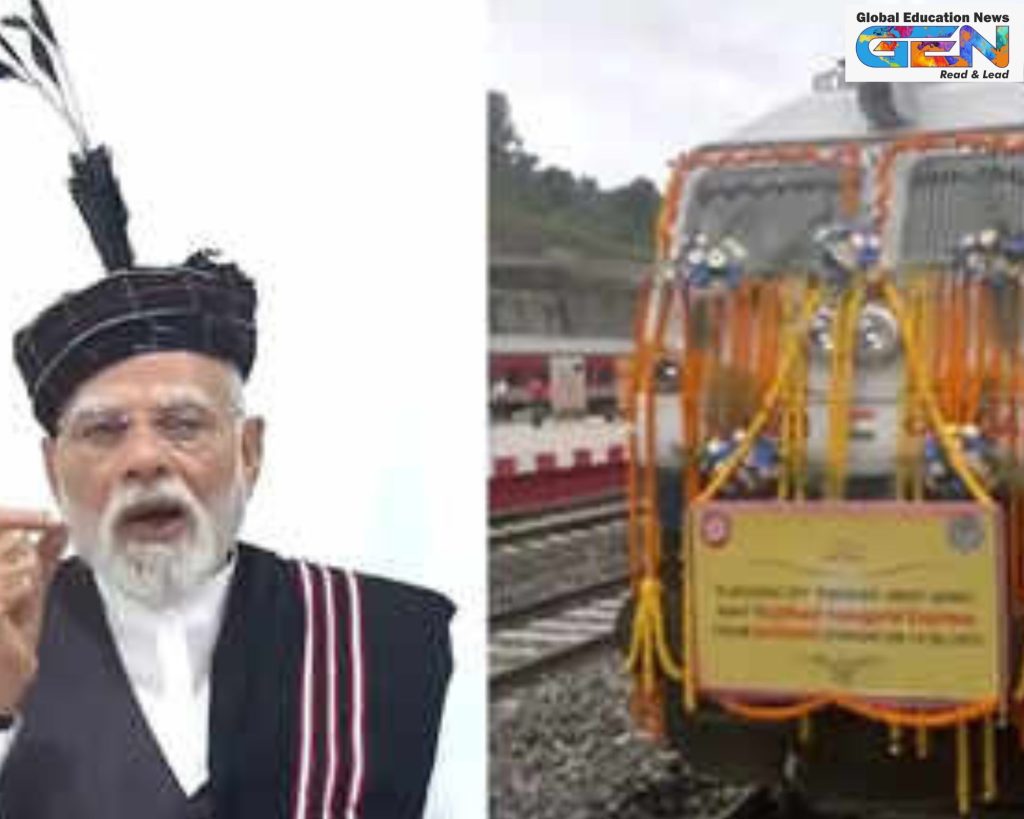
On September 13, 2025, Prime Minister Narendra Modi inaugurated Mizoram’s first-ever railway line, the Bairabi-Sairang broad-gauge project, marking a pivotal moment in India’s Northeast infrastructure development. Spanning 51.38 km through challenging hilly terrain, this Rs 8,070 crore initiative connects the state capital Aizawl to the national railway network for the first time, fulfilling a long-standing dream conceptualized as early as 1999. Aligned with the government’s Act East Policy, the project enhances logistics, tourism, and economic integration, while also flagging off three new express trains, including Mizoram’s maiden Rajdhani Express to Delhi. This development not only reduces travel times but also promises to boost employment and regional growth.
Key Points:
- Inaugurated by PM Modi at Sairang station, 20 km from Aizawl, on September 13, 2025.
- Sanctioned in 2008-09 as a National Project; construction started in 2015 and commissioned in June 2025.
- Features four new stations: Hortoki, Kawnpui, Mualkhang, and Sairang, plus the existing Bairabi station.
- Expected to cut travel time from Bairabi to Aizawl from 6-7 hours by road to under 2 hours by train.
Project Overview: Engineering Marvel in Hilly Terrain
The Bairabi-Sairang railway line is an engineering feat, navigating Mizoram’s rugged Himalayan geology with 45 tunnels (totaling about 10 km) and 142 bridges (55 major and 87 minor). Approximately 54% of the route passes through tunnels and bridges, addressing challenges like landslides, heavy rainfall, and unstable soil. A standout feature is Bridge No. 144 near Sairang, India’s tallest pier railway bridge at 114 meters (though some reports note 104 meters for a key pier). The project required stabilizing loose sand into rock for tunnel safety and acquired 28 hectares of land. Despite a tragic bridge collapse in August 2023 that claimed 26 lives, the line was completed, showcasing resilient infrastructure planning.
Key Points:
- Total length: 51.38 km from Bairabi (Assam-Mizoram border) to Sairang.
- Cost escalation: From initial Rs 619 crore estimate in 2008 to final Rs 8,071 crore due to terrain complexities.
- Includes five road overbridges and six underpasses for seamless road-rail integration.
- Eco-friendly aspects: Incorporates sustainable practices in Mizoram’s ecologically sensitive landscape.
Strategic Importance: Linking Aizawl to the Nation
This railway makes Aizawl the fourth northeastern state capital with direct rail connectivity, after Guwahati, Agartala, and Itanagar. It integrates Mizoram into India’s vast railway network, facilitating easier transport of essentials like food grains and fertilizers, and reducing dependency on roads prone to disruptions. The line supports cross-border trade via the Kaladan Multimodal Transit framework and future extensions, such as to Zokhawthar and Myanmar’s Kalay, as part of the Trans-Asian Railway. For locals, it means affordable, safe travel options, benefiting students, traders, medical patients, and tourists.
Key Points:
- Enhances Act East Policy by improving Northeast’s links to mainland India and neighboring countries.
- Reduces commodity costs by at least 20%, making essentials more affordable for Mizoram’s 12 lakh residents.
- Potential for future spurs: 223 km Zochachhuah-Sairang line and 111 km Imphal-Moreh extension.
- Boosts all-weather connectivity, crucial in a region with frequent landslides and heavy rains.
New Train Services: Direct Links to Major Cities
PM Modi flagged off three inaugural trains from Sairang station, revolutionizing passenger and freight movement:
- Sairang-Delhi Rajdhani Express: Weekly service connecting Mizoram to Anand Vihar Terminal, Delhi—Mizoram’s first premium train to the capital.
- Sairang-Guwahati Express: Daily service for seamless regional connectivity.
- Sairang-Kolkata Express: Thrice-weekly service linking to eastern India’s economic hub.
These services, including vistadome coaches for scenic views, are expected to spur tourism and business travel.
Key Points:
- Rajdhani Express: Covers long-distance travel, integrating Mizoram with urban centers.
- Guwahati and Kolkata Express: Daily/thrice-weekly operations for frequent commuters.
- Freight benefits: Timely supply of goods, supporting agriculture and manufacturing.
- First glimpse for locals: Elderly residents like 85-year-old Satwna from Darlawng village experienced their first train ride during trials.
Complementary Infrastructure Projects: A Rs 9,000 Crore Boost
Alongside the railway, PM Modi announced projects worth over Rs 9,000 crore to holistically develop Mizoram. Key initiatives include the 45-km Aizawl Bypass Road to ease urban traffic, and regional roads like Thenzawl-Sialsuk and Khankawn-Rongura for better market access. The Chhimtuipui bridge enhances cross-border trade, while an LPG bottling plant ensures reliable fuel supply. Additional developments feature sports facilities, educational institutions under government schemes, and smart infrastructure to promote inclusive growth.
Key Points:
- Aizawl Bypass Road: 45 km to improve intra-state mobility and reduce congestion.
- Regional roads and bridges: Focus on farmers’ access to markets and all-weather connectivity.
- LPG plant and facilities: Supports daily needs and promotes clean energy.
- Educational and sports projects: Align with schemes like PM-USP and Khelo India for youth development.
Economic and Social Benefits: Unlocking Mizoram’s Potential
The Bairabi-Sairang line and associated projects are set to generate thousands of jobs, stimulate tourism, and facilitate the transport of agricultural produce and goods. By lowering logistics costs and improving access, it will foster economic activity in sectors like bamboo processing and horticulture. Socially, it promotes inclusivity by connecting remote communities, reducing isolation, and enabling better healthcare and education access. The initiative embodies unity and progress, bridging geographical divides in India’s diverse Northeast.
Key Points:
- Employment generation: Direct and indirect jobs in construction, operations, and related industries.
- Tourism surge: Scenic routes attract visitors, boosting local economies.
- Cost reduction: 20% drop in commodity prices; easier freight for essentials.
- Social impact: Empowers women, youth, and traders; aligns with Viksit Bharat @2047 vision.
Challenges Overcome and Future Prospects
Construction faced immense hurdles, including a 2023 bridge collapse, geological instability, and environmental concerns, yet was completed on time. Future plans include extensions to southern Mizoram and Myanmar, further integrating the region. Political parties in Mizoram, including ZPM, MNF, and BJP, welcomed the project, highlighting its non-partisan significance.
Key Points:
- Overcame tragedies: 26 lives lost in 2023 incident; safety measures enhanced post-event.
- Environmental focus: Sustainable construction in biodiversity hotspots.
- Future extensions: Links to Imphal, Moreh, and Trans-Asian Railway.
- Community support: Locals’ patience and cooperation key to success.