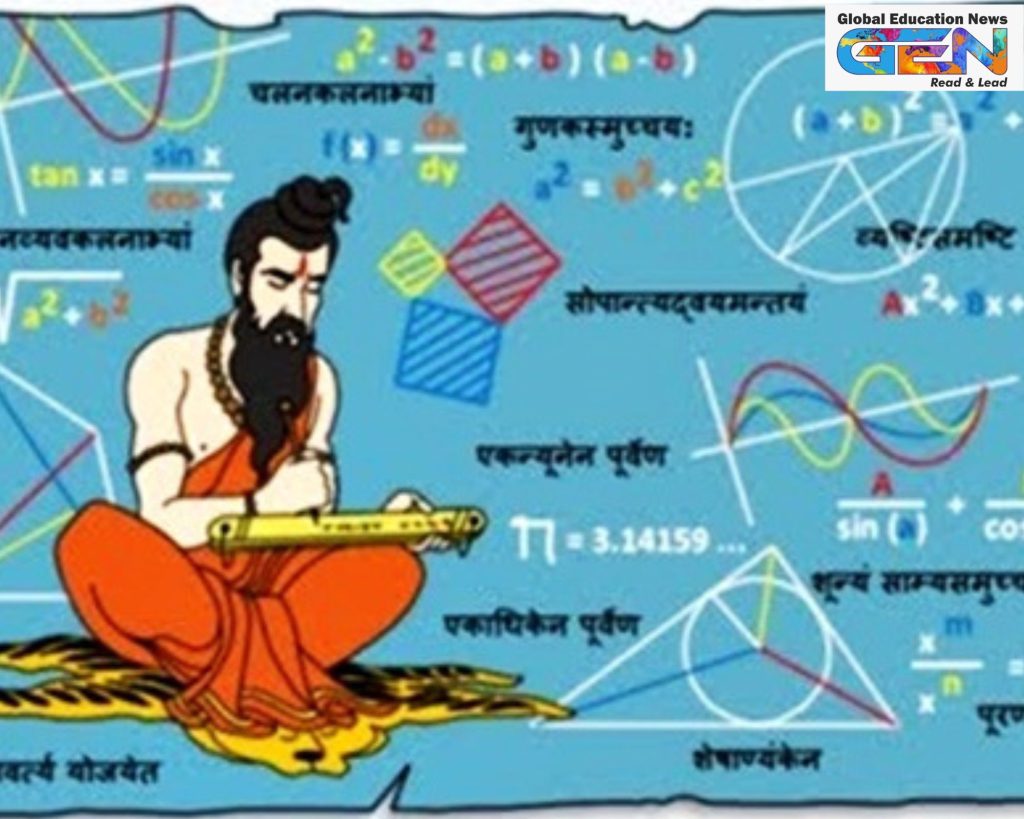
On August 24, 2025, the University Grants Commission (UGC) released a draft curriculum under the Learning Outcomes-based Curriculum Framework (LOCF), aligned with the National Education Policy (NEP) 2020, proposing the integration of ancient Indian mathematical and timekeeping concepts into undergraduate programs. The curriculum introduces Kala Ganpana (traditional Indian timekeeping), Bharatiya Bijganit (Indian algebra), and mathematical references from the Puranas, aiming to enrich mathematics education with India’s cultural and scientific heritage.
Key Points:
- Kala Ganpana and Bharatiya Bijganit to be taught in UG mathematics.
- Aligned with NEP 2020 for holistic, culturally rooted education.
- Emphasizes India’s mathematical heritage alongside modern principles.
Mathematics Rooted in Indian Tradition
The draft curriculum recommends courses on the history and growth of Indian algebra, incorporating techniques like the Paravartya Yojayet Sutra from Vedic Mathematics, which facilitates polynomial division by “transposing and applying.” Students will explore:
- Panchanga (Indian calendar): Understanding muhurtas (auspicious timings) for rituals and festivals.
- Ancient observatories: Studying the Ujjain prime meridian and its historical significance.
- Traditional time units: Learning Ghatis and Vighatis, compared with modern standards like Greenwich Mean Time (GMT) and Indian Standard Time (IST).
- Ancient texts: Drawing from Surya Siddhanta and Aryabhatiyam to study cosmic time cycles, including Yugas, Kalpas, and divine cycles like Vishnu Varsa, Shiva Varsa, and Brahma Varsa.
These elements combine astronomy, mythology, and cultural practices, offering students a multidisciplinary perspective on mathematics.
Key Points:
- Paravartya Yojayet Sutra enhances algebraic skills.
- Panchanga and Ujjain meridian connect math to cultural practices.
- Surya Siddhanta and Aryabhatiyam introduce cosmic time cycles.
Beyond Mathematics: A Broader Vision
The UGC’s LOCF extends beyond mathematics to disciplines like political science, proposing 20 core courses that include:
- Tradition of Political Thinking in Bharat: Covering Vedic traditions, Buddhist and Jain texts, Upanishads, Ramayana, Mahabharata, Thirukkural, and works by thinkers like Bhasa, Kalidasa, and Kalhana.
- Modules on India’s freedom movement, the Constitution, public policy, and Panchayati Raj governance.
The curriculum is structured into three categories:
- Discipline Specific Core (DSCs): Mandatory courses for the chosen discipline.
- Discipline Specific Electives (DSEs): Optional courses within the discipline.
- Generic Electives (GEs): Multidisciplinary courses for broader exposure.
This structure aligns with NEP 2020’s emphasis on flexibility, interdisciplinary learning, and cultural rootedness, impacting over 4 crore undergraduate students across India.
Key Points:
- Political science includes 20 core courses on Indian thought.
- LOCF structure: DSCs, DSEs, and GEs for flexible learning.
- Impacts 4 crore students with culturally rooted education.
Academic Rigor and Practical Relevance
Professor Sushil K. Tomar, chair of the curriculum committee, stated that the framework was developed after extensive consultations with stakeholders, including the Indian Mathematical Society and NCERT. The curriculum aims to produce graduates who can contribute to research, innovation, and nation-building, particularly in areas where sciences, economics, environment, and sustainability intersect. By blending ancient Indian knowledge with modern academic standards, the UGC seeks to foster critical thinking and global competitiveness.
Key Points:
- Developed with stakeholder consultations for academic rigor.
- Focuses on research, innovation, and sustainability.
- Enhances global competitiveness through cultural integration.
Context and Challenges
The initiative comes amid broader educational reforms, including the NEP 2020 push for holistic education and digital equity through platforms like DIKSHA (40 crore+ users). However, challenges like infrastructure gaps (e.g., Rajasthan’s 86,934 unsafe classrooms ordered closed by the High Court) and 45% rural internet penetration may hinder implementation. The UGC plans to address these through teacher training under the National Professional Standards for Teachers (NPST) and Digital India initiatives to ensure effective delivery of the new curriculum.
Key Points:
- Aligns with NEP 2020 and DIKSHA for digital education.
- Faces challenges like infrastructure gaps and low rural internet access.
- Supported by NPST and Digital India for implementation.
Recommendations
The UGC’s draft curriculum is a bold step toward integrating India’s scientific heritage with modern education, but stakeholders must:
- Pilot the curriculum in select universities to assess student engagement with concepts like Kala Ganpana and Bharatiya Bijganit.
- Train faculty through NPST to effectively teach ancient and modern concepts, targeting 50 lakh teachers by 2027.
- Leverage digital platforms like DIKSHA to make KATBOOK-style resources accessible, especially in rural areas.
- Collaborate with NCERT to ensure seamless integration across disciplines, supporting over 4 crore students.
- Students should explore these courses to gain a unique blend of cultural knowledge and global skills, enhancing their academic and career prospects.