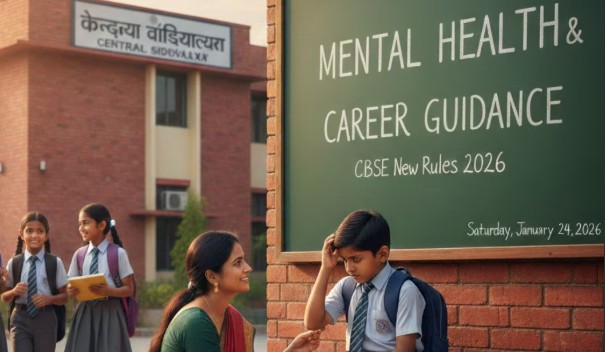
In a landmark policy shift aimed at addressing rising student stress and emotional challenges, the Central Board of Secondary Education (CBSE) has made the appointment of specialised counsellors mandatory in all affiliated schools starting January 2026. Through revised Affiliation Bye-Laws, CBSE has moved beyond the earlier generalist model to require two distinct roles: a Counselling & Wellness Teacher (Socio-Emotional Counsellor) for mental health support and a dedicated Career Counsellor for future planning. This separation marks a significant evolution in how Indian schools approach holistic student development.
The move comes against the backdrop of alarming national data, including 13,892 student suicides recorded in 2023, highlighting the urgent need for proactive emotional and career support in schools.
Key Mandates in CBSE’s 2026 Counselling Guidelines
- Mandatory Appointment: Every CBSE-affiliated secondary and senior secondary school must appoint both a Socio-Emotional Counsellor and a Career Counsellor.
- Student-Counsellor Ratio: 1 counsellor per 500 students (primarily for Classes IX to XII). Smaller schools (under 300 students) can share resources or hire part-time qualified professionals.
- Distinct Roles:
- Socio-Emotional Counsellor: Focuses on socio-emotional learning (SEL), early identification of distress, crisis intervention, and maintaining confidentiality.
- Career Counsellor: Provides aptitude assessments, guidance on higher education pathways (including global options), industry linkages, and informed career decision-making.
- Training Requirement: Both roles require completion of at least 50 hours of CBSE-approved capacity building programmes.
- Timeline: Effective from January 2026, with temporary provisions for trained teachers in career counselling (must meet full qualifications within two years).
Who Can Become a School Counsellor? Qualifications and Competencies
For Socio-Emotional Counsellors (Wellness Teachers):
- Bachelor’s or Master’s degree in Psychology (clinical, counselling, applied, or educational psychology) or Master’s in Social Work with a mental health focus.
- Candidates from other disciplines need a diploma or certification in school counselling or child guidance.
For Career Counsellors:
- Degree in humanities, science, management, education, or technology.
- Emphasis on skills like interpreting career assessments and guiding students through complex academic and professional pathways.
The policy stresses that qualifications alone are not enough — counsellors must demonstrate competencies in building trust, delivering SEL modules, and creating a safe space where students feel comfortable seeking help.
Current Challenges: Implementation Gaps and Ground Realities
While the mandate is widely welcomed as a “critical step forward,” experts caution that success hinges on execution rather than mere compliance. Key challenges include:
- Severe Shortage of Trained Professionals: India has a limited pool of qualified mental health experts, with most concentrated in urban areas. The Rehabilitation Council of India recognises few institutions for specialised training.
- Risk of Tokenism: Schools may appoint staff just to meet norms, leading to reactive rather than preventive support. As psychologist Dr. B. Damodaran notes, “If counselling only begins after distress escalates, we are already too late.” Schools need learning psychologists who can make education engaging and reduce stress at its root.
- Infrastructure and Cultural Barriers: Many schools lack dedicated counselling spaces, and mental health stigma persists among students and parents. Building trust cannot happen overnight.
- Resource Constraints: Smaller or rural CBSE schools may struggle with hiring and training costs. Capacity building for thousands of schools across India remains a massive logistical challenge.
- Broader Systemic Issues: High academic pressure, exam-centric culture, and inconsistent enforcement of earlier guidelines have limited the impact of past initiatives.
Mental health researcher Dr. Anant Bhan emphasises that schools are now positioned as the first line of mental health support — but are they truly equipped for this responsibility?
Analysis: Strengths, Opportunities, and the Road Ahead
CBSE’s 2026 directive represents a progressive shift aligned with the National Education Policy (NEP) 2020’s vision of holistic education. By separating mental health from career guidance and fixing a clear 1:500 ratio, the board acknowledges that one person cannot effectively handle both roles in large schools.
Positive Aspects:
- Clear separation of roles prevents dilution of focus.
- Mandatory training ensures minimum professional standards.
- Emphasis on prevention, SEL, and confidentiality strengthens the ecosystem.
Areas Needing Attention:
- Scaling up training programmes rapidly to meet demand.
- Providing financial support or incentives for smaller schools.
- Integrating counselling with curriculum reforms to reduce root causes of stress.
- Monitoring and evaluation mechanisms to ensure meaningful implementation rather than box-ticking.
If implemented thoughtfully, this policy could significantly lower student distress, improve retention, and help young Indians make better-informed career choices in an increasingly complex world.
Implications for Schools, Parents, and Students
For schools: The mandate demands budget allocation, dedicated spaces, and a cultural shift toward prioritising well-being alongside academics.
For parents: It opens opportunities to engage in structured career counselling sessions and recognise early signs of emotional distress.
For students: Access to professional support can reduce exam anxiety, prevent crises, and empower confident decision-making about their future.
CBSE’s move signals a growing national recognition that academic success cannot come at the cost of mental health. However, turning this policy into reality will require collaboration between the board, schools, training institutions, and mental health experts.