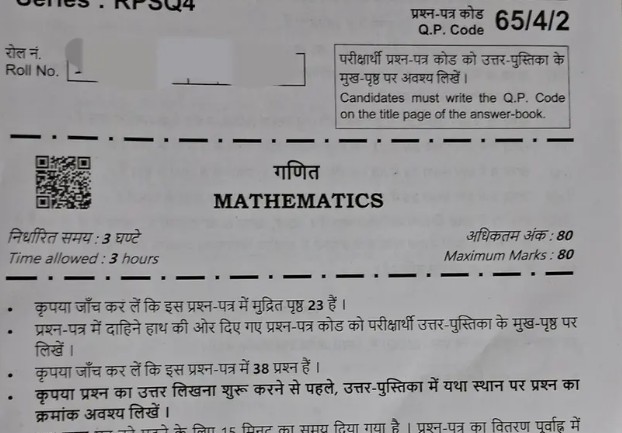
The CBSE Class 12 Mathematics board exam 2026 unexpectedly became a viral topic online after students claimed that a QR code printed on the question paper redirected users to a “Rickroll” video—a famous internet prank.
What began as a curious discovery quickly turned into a nationwide discussion about exam security, digital features in question papers, and how social media amplifies unexpected incidents.
Below is a detailed breakdown of the event, its implications, and the official response from the examination authority.
1. The Incident: How a QR Code Triggered a Viral Moment
The Class 12 Mathematics board exam was conducted on 9 March 2026 as part of the ongoing CBSE board examination schedule.
Soon after the exam ended, images of the question paper began circulating online. Some students reported that when they scanned the QR code printed on the paper, it redirected them to the music video of “Never Gonna Give You Up” by Rick Astley—a classic internet prank known as rickrolling.
The revelation spread rapidly across social media platforms, including X, Reddit, and Instagram. Many students shared videos demonstrating the scan result, turning the moment into a viral meme.
Key Highlights
- The QR code was printed on certain sets of the CBSE Class 12 Mathematics question paper.
- Scanning the code allegedly opened a YouTube link to the Rick Astley song.
- The discovery went viral shortly after the exam concluded.
- Students reacted with a mix of confusion, humor, and concern.
2. What Is ‘Rickrolling’ and Why It Became Viral
Rickrolling is one of the most famous internet pranks that originated in the mid-2000s.
In this prank, a link disguised as something interesting redirects users to the 1987 song “Never Gonna Give You Up.”
Because of its long history in meme culture, the prank has become instantly recognizable across the internet.
When students discovered that a QR code on a high-stakes national exam paper led to this prank, the irony quickly captured public attention and fueled widespread online discussions.
3. Confusion Among Students and Parents
Initially, the viral posts created confusion among students and parents.
Since QR codes in question papers are typically used for security verification, some people wondered whether the paper had been tampered with or leaked before the exam.
However, reports suggested that the situation was not consistent across all exam papers. Some students who scanned the QR code said it simply displayed alphabet markers like “A” or “Q” instead of opening a website, indicating that the issue may have occurred only in certain sets.
This inconsistency added to the speculation about whether it was:
- A technical glitch
- An incorrect QR code link
- Or misleading screenshots circulating online
4. Why QR Codes Are Printed on Board Exam Papers
In recent years, CBSE has integrated several digital security features in board examinations to prevent paper leaks and ensure authenticity.
QR codes were introduced in 2018 as part of this initiative.
Purpose of QR Codes in Exam Papers
- Authenticity Verification
Authorities can verify whether the question paper is genuine. - Leak Detection
If a paper leak is suspected, the QR code helps identify the source. - Distribution Tracking
Each paper set can be traced back to its printing or distribution location. - Security Monitoring
Multiple digital identifiers help maintain the integrity of the examination system.
These measures are part of CBSE’s broader strategy to strengthen exam security in India’s largest school examination system.
5. CBSE’s Official Clarification
Following the viral discussions, the Central Board of Secondary Education (CBSE) issued a clarification addressing the concerns.
According to the board:
- The question papers were genuine.
- The security and confidentiality of the exam were not compromised.
- The QR code issue appeared only in a few question paper sets.
- The matter is being reviewed to prevent similar incidents in future exams.
CBSE also emphasized that multiple security features are embedded in question papers, and the QR code is just one of several verification mechanisms.
6. Exam Analysis: Difficulty Level and Student Feedback
Apart from the QR code controversy, the mathematics exam itself received typical academic evaluation from teachers and students.
Education experts described the paper as balanced and aligned with the CBSE syllabus, with questions covering major topics such as:
- Matrices and Determinants
- Differentiation and Integration
- Applications of Derivatives
- Vector Algebra and 3D Geometry
Many students reported that long-answer questions in Section D were the most challenging, while the MCQ section tested conceptual clarity.
Overall, the exam was considered moderately difficult but fair.
7. The Larger Issue: When Technology Meets Examination Systems
The incident highlights an important challenge in modern education systems: integrating digital technology into traditional exam processes.
While tools such as QR codes enhance security, tracking, and verification, even small technical errors can quickly become viral issues in the era of social media.
Key Takeaways
- Digital tools are increasingly used in education administration and exam management.
- Minor technical glitches can quickly escalate into public controversies online.
- Transparency and quick clarification from authorities are essential to maintain trust in examination systems.