Published on October 13, 2025
Delhi, India
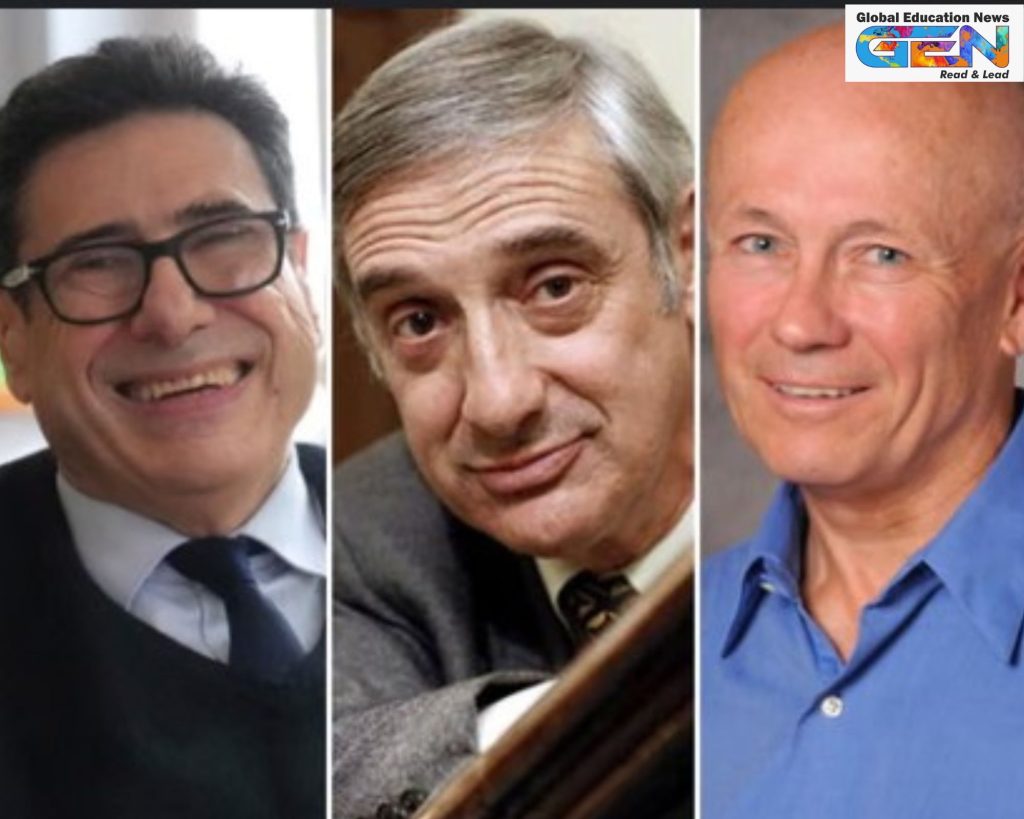
On October 13, 2025, the Royal Swedish Academy of Sciences unveiled the recipients of the Sveriges Riksbank Prize in Economic Sciences in Memory of Alfred Nobel 2025: Joel Mokyr, Philippe Aghion, and Peter Howitt. Awarded for “having explained innovation-driven economic growth,” the prize recognizes their pioneering work on how technological breakthroughs and the relentless churn of “creative destruction” have propelled humanity from eras of stagnation to sustained prosperity over the past two centuries. Mokyr receives half the 11 million Swedish kronor (approximately $1.05 million) award, while Aghion and Howitt share the other half. This year’s honor, blending historical insight with mathematical rigor, arrives amid global debates on AI, automation, and policy hurdles to innovation—reminding us that economic vitality demands constant reinvention.
Background: The Nobel Tradition and the Innovation Imperative
The Nobel Memorial Prize in Economic Sciences, established in 1968, often spotlights ideas shaping real-world policy, from behavioral economics (Daniel Kahneman, 2002) to poverty alleviation (Abhijit Banerjee et al., 2019). This 2025 award fits a recent trend toward growth dynamics, echoing Paul Romer’s 2018 prize for integrating technology into macroeconomics. Announced annually on the second Monday of October (October 13 this year) in Stockholm, the prize draws from nominations by thousands of experts worldwide.
- Historical Shift Spotlighted: For millennia, economies stagnated with sporadic inventions rarely sparking chains of progress. The Industrial Revolution marked a turning point, enabling self-sustaining innovation that lifted global living standards—a puzzle the laureates have decoded.
- Announcement Highlights: The Royal Swedish Academy’s press conference emphasized how these works reveal growth’s fragility: “Economic growth cannot be taken for granted; we must uphold the mechanisms of creative destruction to avoid stagnation,” said committee chair John Hassler.
- Global Relevance: In 2025, with AI disrupting industries and protectionism rising, their research underscores why fostering innovation is crucial for navigating geopolitical tensions and climate challenges.
This trio’s interdisciplinary approach—history meets theory—bridges academia’s silos, influencing policymakers from the EU’s Green Deal to U.S. CHIPS Act subsidies.
Key Contributions: Decoding the Drivers of Enduring Growth
The laureates’ collective oeuvre demystifies why innovation isn’t random but a structured force for progress. Their work, spanning decades, integrates empirical history with formal models to explain growth’s mechanics.
- Joel Mokyr’s Historical Lens: A Dutch-born economic historian (born 1946) at Northwestern University and Tel Aviv University, Mokyr’s books like A Culture of Growth (2016) trace the Industrial Revolution’s roots to Europe’s “Republic of Letters”—a 17th-18th century network of open-minded intellectuals. He argues sustained growth requires not just inventions but a cultural ecosystem: scientific literacy, tolerance for experimentation, and institutions that reward novelty. Pre-modern societies, Mokyr shows, saw breakthroughs fizzle without these enablers, leading to Malthusian traps.
- Philippe Aghion and Peter Howitt’s Theoretical Framework: Aghion (born 1956, French, at Collège de France, INSEAD, and LSE) and Howitt (born 1946, Canadian, at Brown University) revolutionized growth theory with their 1992 Econometrica paper, formalizing Joseph Schumpeter’s 1942 “creative destruction” concept. Their Schumpeterian model posits innovation as a zero-sum race: New firms and technologies displace incumbents, boosting productivity but sparking conflicts (e.g., job losses, lobbying against change). They quantify how competition, patents, and R&D incentives accelerate this cycle, explaining why economies grow exponentially post-1800.
Table: Laureates’ Milestones and Impacts
| Laureate | Key Work/Year | Core Idea | Real-World Echoes |
|---|---|---|---|
| Joel Mokyr | Lever of Riches (1990); Culture of Growth (2016) | Cultural openness + scientific mindset = self-sustaining tech progress | Explains why Enlightenment Europe outpaced Asia/Africa in industrialization |
| Philippe Aghion | 1992 paper with Howitt; The Power of Creative Destruction (2021) | Innovation displaces old tech, but needs policy to manage fallout | Informs EU antitrust vs. Big Tech; U.S. debates on worker retraining |
| Peter Howitt | 1992 paper with Aghion; Endogenous Growth Models (1990s) | Mathematical proof: Creative destruction drives long-run GDP gains | Guides IMF/World Bank advice on R&D subsidies for developing nations |
Their synergy—Mokyr’s “why now?” with Aghion-Howitt’s “how exactly?”—has reshaped macroeconomics, cited in over 10,000 papers.
Challenges Addressed: Navigating Innovation’s Double-Edged Sword
The laureates don’t romanticize growth; they expose its tensions. Mokyr warns of “anti-modern” backlashes, like 19th-century Luddite riots, mirroring today’s resistance to AI-driven job shifts. Aghion and Howitt’s models highlight “incumbent curses”: Established firms innovate less, stifling progress unless competition is fierce. Their research reveals:
- Policy Pitfalls: Weak IP protection or excessive regulation can halt creative destruction, as seen in stagnant Soviet-style economies.
- Equity Concerns: Growth benefits aggregate but displace workers; Aghion’s recent work advocates “inclusive innovation” via education and safety nets.
- Global Disparities: Why did growth “happen” in the West? Mokyr credits Enlightenment values, urging emerging markets like India to invest in human capital.
In interviews, Aghion stressed: “I can’t find the words… I’ll invest in my lab,” while Mokyr, reached mid-coffee, quipped about his vinyl-to-Spotify journey as “astonishing” unmeasured progress.
Implications: Policy Blueprints for a Disruptive Future
This Nobel arrives as nations grapple with 2025’s realities—U.S.-China tech wars, Europe’s green transition, and AI’s productivity boom (projected 7% global GDP lift by 2030). Key takeaways:
- Foster Ecosystems: Policymakers should prioritize R&D tax credits, open science, and cultural shifts toward risk-taking, per Mokyr.
- Manage Destruction: Aghion-Howitt inspire “Schumpeterian policies”—antitrust enforcement, universal basic skills training—to ease transitions.
- Future Research Avenues: Their frameworks extend to climate tech (e.g., displacing fossil fuels) and digital economies, influencing 2025 G20 agendas on innovation equity.
- Broader Nobel 2025 Trends: Following physics’ quantum computing nod and chemistry’s sustainable materials, economics’ focus on growth aligns with humanity’s push against stagnation.
As Hassler noted, upholding these mechanisms is vital: “We must not fall back into stagnation.”