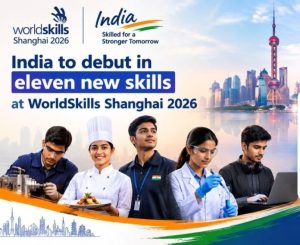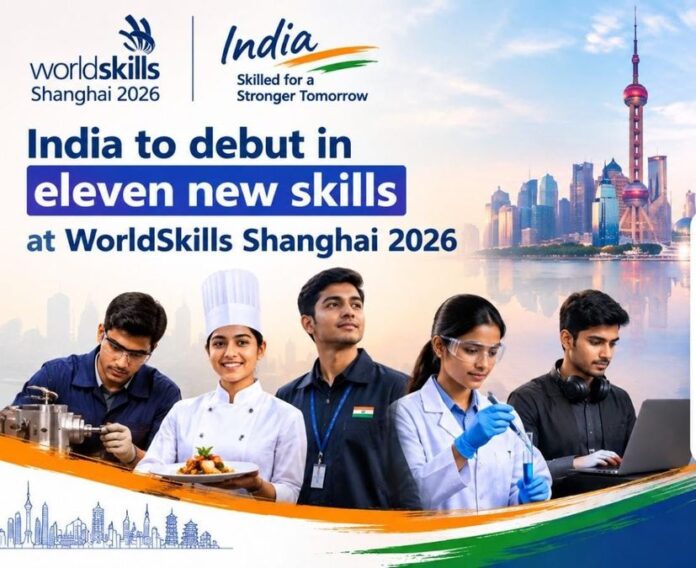
India is preparing for one of its most expansive appearances at the global skills championship, with Team Skill India set to compete in 63 of the 64 skill categories at the 48th WorldSkills Competition in Shanghai, China, from September 22 to 27, 2026.
The country’s participation will also mark a significant expansion into 11 skill categories in which India has not previously competed at WorldSkills. With nearly 70 competitors, the contingent represents a broader push to showcase Indian talent in advanced technology, specialised services, healthcare, digital design, mobility and emerging industrial sectors.
The development comes as India’s skills ecosystem increasingly moves beyond conventional vocational trades towards occupations shaped by automation, digital technology and changing industry requirements.
India’s Biggest-Ever Skills Push Includes 11 New Categories
The 11 categories in which India will participate for the first time are:
- Dental Prosthetics
- Digital Interactive Media Design
- Intelligent Security Technology
- Landscape Gardening
- Optoelectronic Technology
- Retail Sales
- Unmanned Aerial Systems
- Industrial Mechanics
- Software Testing
- Heavy Vehicle Technology
- Aircraft Maintenance
The diversity of these categories is significant. They span healthcare, digital and creative industries, intelligent technologies, aviation, advanced manufacturing, mobility, retail and specialised technical services.
India’s expanded participation therefore reflects more than a larger competition team. It indicates a widening definition of what constitutes a globally relevant vocational skill.
WorldSkills has itself expanded its competition portfolio in response to changing industries and emerging occupations. The 2026 competition features new disciplines reflecting digital transformation, smart technologies, advanced health services and other evolving areas of work.
From Traditional Trades to Future-Ready Skills
For decades, vocational education was often associated with traditional trades such as carpentry, welding, electrical work and mechanical repair.
The current WorldSkills landscape tells a different story.
Software testing, interactive digital design, intelligent security technology, drone systems and optoelectronics are now part of the skills conversation alongside conventional technical occupations.
This transition has important implications for India’s education and employment strategy.
A young person entering the workforce today may require a combination of:
Technical expertise + digital literacy + problem-solving + practical experience + industry-specific skills.
The 11 new categories chosen by India broadly reflect that shift.
For example, Unmanned Aerial Systems connects vocational training with the expanding drone ecosystem, while Software Testing reflects the growing importance of quality assurance in digital products. Digital Interactive Media Design sits at the intersection of technology and creative industries.
Similarly, Aircraft Maintenance and Heavy Vehicle Technology point towards specialised technical capabilities required by increasingly sophisticated transport systems.
Nearly 70 Competitors to Represent India in Shanghai
Team Skill India will field nearly 70 competitors across 63 of the 64 skills being contested at WorldSkills Shanghai.
The participation is being led by the Ministry of Skill Development and Entrepreneurship (MSDE), with the National Skill Development Corporation (NSDC) coordinating India’s preparation in collaboration with training institutions, industry partners and domain experts.
The preparation ecosystem for the new categories includes specialised institutions and companies supporting training and mentoring.
This industry-linked model is important because WorldSkills competitions do not test theoretical knowledge alone. Competitors are expected to demonstrate practical ability against international benchmarks.
That makes the competition a useful test of whether training programmes are producing skills that match real workplace requirements.
Why WorldSkills Matters for India’s Skill Development Strategy
WorldSkills is more than an international competition.
It provides countries with an opportunity to benchmark the practical capabilities of their young workforce against peers from around the world.
For India, participation has several potential benefits.
Global benchmarking
Competitors get an opportunity to measure their performance against international standards. This can reveal where India’s training systems are strong and where additional investment or curriculum changes may be required.
Industry exposure
Preparation involves training institutions, companies and technical experts. Such collaboration can help narrow the gap between classroom or workshop training and workplace expectations.
Recognition of vocational careers
Large international competitions can also help change perceptions around vocational education.
A skills-based career increasingly involves advanced technology, precision, creativity and specialised knowledge. Recognition at a global event can strengthen the message that vocational and technical pathways can lead to high-value careers.
Identifying emerging occupations
The addition of new categories provides an early signal about industries where specialised skills are becoming increasingly important.
India’s WorldSkills Performance Has Been Improving
India’s expanding participation comes against a backdrop of improving performance in international skills competitions.
The country ranked 29th at WorldSkills in 2015 and rose to 13th in 2024. India also secured eighth place in Asia at WorldSkills Asia 2025 and won five medals at the Taipei Capital Cup 2026.
The trajectory is significant because the objective is not simply to send larger contingents.
Improved rankings and medals can indicate stronger preparation systems, better mentoring, more industry involvement and greater exposure to international standards.
The next challenge is to convert that progress into a sustainable skills-development pipeline rather than relying only on competition-specific preparation.
What the 11 New Skills Say About India’s Future Workforce
The new categories provide an interesting snapshot of where the global labour market is heading.
Healthcare and specialised services
Dental Prosthetics demonstrates how vocational skills increasingly overlap with healthcare technology. Such occupations require precision, technical knowledge and familiarity with specialised equipment.
Digital economy
Software Testing and Digital Interactive Media Design reflect the growing need for professionals who can work across technology and digital products.
Intelligent systems
Intelligent Security Technology points towards an increasingly technology-driven security environment where technical and digital capabilities are closely connected.
Drones and advanced mobility
Unmanned Aerial Systems represents a rapidly developing technology area, while Heavy Vehicle Technology and Aircraft Maintenance highlight the demand for specialised technicians in sophisticated transportation systems.
Advanced manufacturing
Industrial Mechanics and Optoelectronic Technology connect skills training with modern manufacturing and technology-intensive industrial applications.
Together, these categories suggest that India’s skilling agenda is increasingly being shaped by technology convergence—where mechanical, digital, electronic and service skills overlap rather than existing as isolated disciplines.
The Industry-Academia Link Will Be Crucial
One of the most important aspects of India’s preparation is the involvement of industry partners and specialised training institutions.
The government has identified organisations and institutions supporting preparation across the new categories, including the Government Tool Room and Training Centre in Karnataka and companies operating in areas such as retail, jewellery, heavy industry, software and dental technology.
This model addresses one of the longstanding challenges of vocational education: keeping training aligned with rapidly changing industry requirements.
Curricula can become outdated quickly in technology-intensive fields. Industry participation can help trainers understand the equipment, processes, standards and competencies actually expected in workplaces.
The WorldSkills preparation process therefore has value beyond the competitors travelling to Shanghai. It can also contribute to knowledge transfer among trainers and institutions.
Can WorldSkills Help Change the Perception of Vocational Education?
India’s large youth population creates both an opportunity and a challenge.
A growing workforce requires pathways into employment that extend beyond traditional academic degrees. Skill-based education can provide alternative routes, particularly in sectors where employers need technicians and specialised professionals.
However, vocational education has historically struggled with perceptions that academic degrees are inherently more valuable.
International achievements can help challenge that assumption.
A competitor demonstrating advanced skills in aircraft maintenance, software testing, drone technology or dental prosthetics is participating in a professional pathway that demands discipline and expertise.
The larger policy objective should therefore be to ensure that skills training leads not only to certificates but also to quality employment, career progression and opportunities for continuous upskilling.
WorldSkills Shanghai 2026: What to Watch
The Shanghai competition will provide an important test of India’s expanding skills strategy.
The key areas to watch include:
Performance in the 11 debut categories: India’s first appearance will establish an initial international benchmark in these disciplines.
Overall medal tally: A broader contingent creates more opportunities for medals, but sustained improvement will matter more than a single competition result.
Industry participation: Continued employer involvement could determine whether competition preparation translates into stronger training ecosystems.
Emerging skills: The categories gaining prominence at WorldSkills can provide signals about future workforce requirements.
Global ranking: India’s previous improvement from 29th in 2015 to 13th in 2024 provides a useful benchmark for measuring progress.
A Larger Test for Skill India
The expansion at WorldSkills Shanghai comes under the broader Skill India Mission, which has sought to strengthen vocational training through industry partnerships, structured training, expert mentoring and greater exposure to international standards.
The government’s stated objective is increasingly focused on making India’s workforce competitive not just domestically but globally.
That ambition matters in a world where technology is changing occupations rapidly. Employers increasingly need workers who can operate sophisticated machinery, manage digital systems, interpret data, solve technical problems and adapt to new technologies.
India’s participation across 63 of 64 skills reflects an attempt to position its workforce within that changing landscape.