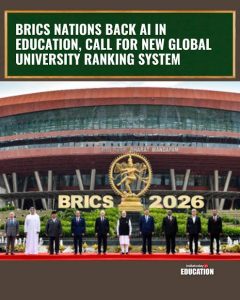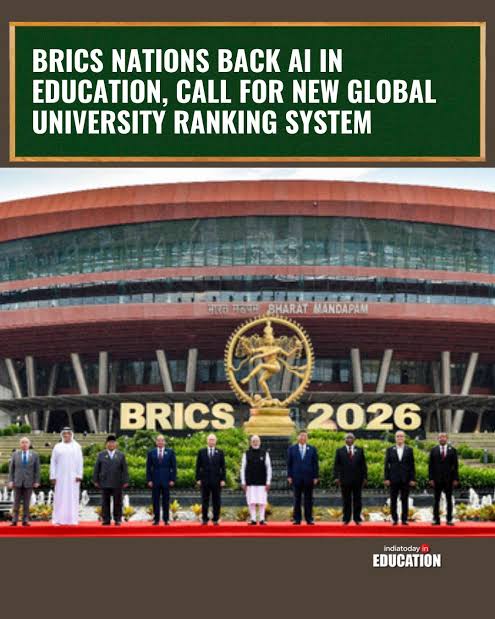
The 18th BRICS Summit in New Delhi has placed education, artificial intelligence and higher-education cooperation at the centre of a broader effort to prepare emerging economies for a rapidly changing global economy.
Leaders endorsed greater cooperation on the safe, ethical and human-centred use of artificial intelligence in education, encouraged countries to share technology and policy practices, and backed stronger academic partnerships. At the same time, the bloc agreed to explore the development of a BRICS University Global Ranking and Evaluation System, potentially creating a new framework for assessing universities that reflects the priorities and development realities of emerging economies.
The agenda is significant because global higher education remains heavily influenced by established international rankings. Systems such as QS and Times Higher Education have considerable influence over how universities are perceived by students, academics and employers.
The proposed BRICS approach could therefore become more than an education initiative. It could represent an attempt to give the Global South a greater voice in defining what counts as university excellence.
But the New Delhi Declaration goes beyond rankings and AI. It also covers foundational literacy and numeracy, technical and vocational education, mutual recognition of qualifications, academic mobility, digital skills, research collaboration and university-industry partnerships.
BRICS New Delhi Declaration: What Has Been Agreed on Education?
Education forms an important part of the wider New Delhi Declaration adopted at the September 12–13 BRICS Summit.
The declaration identifies education as a driver of sustainable development, inclusive growth and people-to-people exchanges. It also builds on the work carried out during India’s 2026 BRICS chairship, including meetings of education ministers, senior officials and the BRICS Network University.
Major education priorities
| Area | BRICS focus |
|---|---|
| Artificial intelligence | Safe, ethical and human-centred use of emerging technologies |
| Digital literacy | Expanding digital capabilities and preparing future-ready workers |
| University rankings | Exploring a BRICS University Global Ranking and Evaluation System |
| Academic mobility | Mutual recognition of qualifications and greater student/professional mobility |
| Research | Greater institutional and cross-border collaboration |
| STEM | More exchange and scholarship opportunities |
| TVET | Stronger links between technical education and industry |
| Foundational learning | Cooperation on early childhood education, literacy and numeracy |
| Traditional knowledge | Greater recognition of traditional, indigenous and local knowledge systems |
| Youth | Skills, entrepreneurship, innovation and international cooperation |
The declaration also supports continued cooperation through the BRICS Network University and encourages collaboration in undergraduate and postgraduate education, particularly in STEM and technical and vocational fields.
This makes the agenda broader than a technology programme.
It is effectively a proposal for a more integrated BRICS education ecosystem.
AI in Education: From Experiment to Strategic Priority
Artificial intelligence has moved rapidly from being an emerging classroom technology to becoming a central education-policy issue.
BRICS leaders have now explicitly backed cooperation around the safe, ethical and human-centred use of AI in education. The emphasis on “human-centred” use is important because it indicates that technology is being positioned as a tool to support learners and teachers rather than replace them.
AI can potentially transform several areas of education.
Potential applications include:
- personalised learning pathways;
- AI-assisted tutoring;
- language translation;
- accessibility tools for students with disabilities;
- automated administrative support;
- learning analytics;
- teacher assistance;
- educational content development;
- early identification of learning gaps;
- research support.
For developing economies, these applications could be particularly valuable because AI-enabled tools may help extend educational resources to students and institutions that cannot easily access specialist teachers or advanced learning materials.
However, the BRICS emphasis on safety and ethics recognises an important reality.
Putting AI into a classroom is easier than putting responsible AI into a classroom.
Questions remain around student data, algorithmic bias, intellectual property, misinformation, academic integrity and the possibility of students becoming excessively dependent on automated systems.
The New Delhi Declaration specifically calls for cooperation on AI that is safe, secure, inclusive and reliable while recognising both the opportunities and risks associated with the technology.
Why a BRICS Global University Ranking System Matters
Perhaps the most strategically significant education proposal is the call to explore a BRICS University Global Ranking and Evaluation System.
University rankings have become powerful instruments in global higher education.
They influence:
- student choices;
- international applications;
- faculty recruitment;
- research partnerships;
- university branding;
- government policy;
- institutional funding;
- international visibility.
But the existing global ranking ecosystem is dominated by methodologies developed largely around established research-intensive universities and indicators that may not fully capture the development priorities of emerging economies.
The BRICS proposal could offer an alternative.
The New Delhi Declaration specifically calls for further exploration of a BRICS University Global Ranking and Evaluation System, while also supporting stronger institutional governance, quality, accessibility and academic cooperation.
What could a BRICS ranking measure?
A new ranking system could potentially give greater weight to areas such as:
Research impact:
Not simply the number of publications, but the practical and social impact of research.
Regional development:
How effectively universities contribute to local economic and social development.
Affordability and access:
Whether institutions provide high-quality education to students from diverse socioeconomic backgrounds.
Employability:
How successfully graduates transition into productive employment.
Innovation:
University contributions to start-ups, patents, technology transfer and entrepreneurship.
Digital inclusion:
Institutional capacity to provide high-quality digital learning.
Sustainability:
Contribution to environmental and sustainable-development goals.
Traditional and indigenous knowledge:
Recognition of knowledge systems that are often underrepresented in conventional global rankings.
The exact methodology has yet to be established. Therefore, it would be premature to treat the proposal as a fully operational alternative ranking system.
For now, it is better understood as a policy direction that BRICS countries have agreed to explore.
Can BRICS Create an Alternative to Existing Global Rankings?
The proposal raises a difficult question: what exactly should a university ranking measure?
Most established ranking systems already use combinations of:
- academic reputation;
- research citations;
- faculty-student ratios;
- internationalisation;
- employer reputation;
- research income;
- international faculty and students;
- sustainability indicators.
These measures have value.
But no ranking methodology is neutral.
Every ranking reflects assumptions about what makes a university successful.
A BRICS ranking could therefore be useful if it does not simply reproduce existing methodologies under a different name.
Instead, it could measure different dimensions of institutional success.
For example, a university serving a large rural population may have a major social impact without producing the same volume of internationally cited research as a wealthy research university.
Similarly, an institution may make an enormous contribution to vocational education or local innovation without scoring highly on conventional internationalisation metrics.
A successful BRICS ranking would need to make these contributions visible.
The credibility challenge
However, creating an alternative ranking system is easier than creating a trusted one.
For a BRICS ranking to influence students and universities globally, it would need:
- transparent methodology;
- independently verifiable data;
- consistent definitions;
- credible quality assurance;
- protection from political interference;
- regular methodological review;
- clear treatment of different types of universities.
Without these safeguards, a new ranking could become another reputational exercise rather than a genuinely useful global benchmark.
Academic Mobility and Mutual Recognition of Qualifications
The BRICS education agenda also addresses a practical problem facing students: whether qualifications earned in one country are recognised in another.
The New Delhi Declaration encourages mutual recognition of qualifications and greater academic and professional mobility. It also supports exchange and scholarship programmes, including in STEM fields.
This could eventually make it easier for students to:
- study in another BRICS country;
- transfer academic credits;
- pursue postgraduate education;
- participate in research programmes;
- undertake internships;
- seek professional opportunities.
For students, this could be one of the most tangible consequences of BRICS education cooperation.
A student does not experience international cooperation through diplomatic declarations.
They experience it through whether a degree is recognised, whether credits transfer and whether an overseas institution accepts their qualification.
That makes mutual recognition agreements particularly important.
BRICS Network University Gets a Bigger Role
The education declaration also reaffirms support for the BRICS Network University, an existing mechanism for collaboration between universities in member countries.
India has been actively developing this platform during its 2026 BRICS chairship.
In July, the Ministry of Education hosted a BRICS Network University conference and International Governing Board meeting, where universities and experts discussed cooperation in higher education, research and innovation. Traditional and indigenous knowledge systems were proposed as an additional thematic area.
The network could become increasingly important if BRICS moves towards:
- joint research;
- faculty exchanges;
- student mobility;
- shared courses;
- collaborative laboratories;
- interdisciplinary programmes;
- joint publications;
- innovation partnerships.
It could also serve as an institutional foundation for any future BRICS ranking or evaluation system.
Skills, TVET and the Link Between Education and Jobs
Another major theme is the growing emphasis on Technical and Vocational Education and Training (TVET).
The BRICS Technical and Vocational Education and Training Cooperation Alliance is intended to facilitate information exchange, resource sharing and joint development of vocational education.
This reflects a wider shift in education policy.
A university degree alone is no longer sufficient preparation for rapidly changing labour markets.
AI, automation, robotics, renewable energy, advanced manufacturing and digital services are changing the skills employers need.
The BRICS declaration therefore calls for stronger links between training programmes and evolving market requirements and encourages greater connections between TVET institutions and industry.
Why this matters
A skills-oriented education system can help address a persistent problem:
the gap between what students learn and what employers need.
Universities and colleges can strengthen this connection through:
- industry-designed curricula;
- apprenticeships;
- internships;
- applied research;
- entrepreneurship programmes;
- practical digital skills;
- micro-credentials;
- continuous professional learning.
For emerging economies with large young populations, improving this transition from education to employment has major economic implications.
Research Collaboration: A Shared Knowledge Infrastructure
The BRICS agenda is also moving towards greater sharing of research and knowledge.
The New Delhi Declaration welcomes the proposed BRICS Science and Research Repository, designed as a structured platform for knowledge storage and sharing while respecting national laws, data security and intellectual property requirements.
This could help address a long-standing problem in global research: knowledge is often distributed unevenly across institutions and countries.
A shared research infrastructure could facilitate:
- discovery of research outputs;
- cross-border collaboration;
- access to datasets;
- joint projects;
- scientific networking;
- technology transfer;
- interdisciplinary research.
But intellectual-property rules and data governance will be critical.
Researchers need to know who owns jointly developed intellectual property, how sensitive data can be shared and which national regulations apply.
The declaration recognises these concerns by explicitly referring to data security, intellectual property rights and national policies.
Traditional and Indigenous Knowledge Enters the Education Agenda
One of the more distinctive aspects of the BRICS education agenda is the recognition of traditional, indigenous and local knowledge systems.
India has promoted the inclusion of such knowledge within BRICS academic cooperation, and the declaration encourages the BRICS Network University to consider traditional and indigenous knowledge as an additional thematic group.
This has implications far beyond cultural preservation.
Traditional knowledge can contribute to research and teaching in areas such as:
- agriculture;
- biodiversity;
- medicine;
- environmental management;
- architecture;
- water conservation;
- crafts;
- food systems.
However, integrating traditional knowledge into modern education requires careful documentation, academic validation and protection against unauthorised commercial exploitation.
It should not become either romanticisation or token inclusion.
The opportunity is to establish rigorous academic frameworks through which different knowledge traditions can be studied, preserved and responsibly connected to contemporary research.
The Digital Divide Could Determine Whether the AI Agenda Succeeds
The BRICS countries are highly diverse in infrastructure and economic development.
That creates a major challenge for AI-enabled education.
A university with high-speed connectivity, modern computing facilities and specialised AI faculty can adopt advanced educational technology rapidly.
A school or college without reliable internet access cannot.
The New Delhi Declaration therefore links digital education with broader digital-skilling and connectivity efforts. It calls for scalable and context-responsive approaches to digital skills, capacity-building and workforce preparation.
This is an important principle.
AI in education cannot be treated purely as a software problem.
It also requires:
- connectivity;
- electricity;
- devices;
- teacher training;
- technical support;
- digital literacy;
- accessible content;
- cybersecurity.
Without these foundations, AI could actually widen educational inequality rather than reduce it.
What the BRICS Education Push Means for Students
For students, the summit’s education agenda could eventually translate into several practical changes.
More international opportunities
Greater academic mobility could expand opportunities for students to study, research and train in other BRICS countries.
More AI-enabled learning
Students are likely to encounter AI-powered educational tools more frequently, from personalised tutoring to research assistance.
Greater emphasis on employability
Curricula may increasingly incorporate digital, technical and industry-relevant skills.
New university benchmarks
A BRICS ranking system could give students another way to compare universities, particularly institutions that may be underrepresented in established global rankings.
Wider recognition of qualifications
Mutual recognition initiatives could make cross-border study and professional mobility easier.
More collaborative research
Students may gain access to joint research networks, exchange programmes and international academic projects.
These changes will not happen overnight.
Most require further negotiations, implementation mechanisms and institutional participation.
But the direction is becoming clear: BRICS wants education cooperation to become a practical instrument of economic development, innovation and international mobility.
Broader Perspective: Can BRICS Build a Different Model of Higher Education?
The significance of the New Delhi Declaration extends beyond AI.
It reflects an emerging argument that developing and emerging economies should have a greater role in defining global education standards.
For decades, many global higher-education benchmarks have been developed around institutions in North America, Western Europe and other established research ecosystems.
BRICS countries now collectively represent a huge share of the world’s population and include some of its largest higher-education systems.
A BRICS education framework could therefore provide an opportunity to address questions that conventional global rankings may not fully capture:
How much does a university contribute to social mobility?
How effectively does it support regional development?
Does it prepare students for local as well as global labour markets?
How accessible is high-quality education?
Does research address the problems faced by emerging economies?
These questions could produce a richer definition of university excellence.
But BRICS must also avoid creating a purely geopolitical alternative to existing systems.
The objective should not be to replace one hierarchy with another.
It should be to broaden the definition of educational excellence and improve the quality of available evidence.
Challenges Ahead: From Declarations to Implementation
The summit has established an ambitious agenda, but implementation will determine its real impact.
Several challenges stand out.
1. Different education systems
BRICS countries have very different curricula, qualification structures and regulatory frameworks.
2. Unequal technological capacity
AI cooperation cannot produce equal results if digital infrastructure remains uneven.
3. Data and privacy
Cross-border educational data sharing will require robust safeguards.
4. Recognition of qualifications
Mutual recognition can be legally and administratively complicated.
5. Ranking methodology
A BRICS university ranking will need to establish credible, transparent and internationally respected indicators.
6. AI governance
Countries will need compatible approaches to academic integrity, student data, AI safety and responsible use.
7. Geopolitical differences
BRICS includes countries with different political systems, strategic priorities and approaches to technology governance.
Education cooperation will therefore require sustained institutional engagement rather than relying solely on summit-level commitments.
Conclusion: BRICS Is Trying to Shape the Education System of the AI Era
The education agenda emerging from the 2026 BRICS Summit represents a significant shift from conventional student-exchange diplomacy towards strategic cooperation in technology, skills, research and higher education governance.
AI is at the centre of that transformation, but it is only one component.
The bloc is also pursuing stronger academic mobility, mutual recognition of qualifications, vocational education, research cooperation, digital literacy, traditional knowledge and potentially a new global university evaluation system.
For India, the agenda offers an opportunity to use its BRICS chairship to shape international conversations about how emerging economies should approach AI and higher education.
The proposed BRICS university ranking system could become especially significant if it develops transparent indicators that measure social impact, accessibility, innovation and regional contribution alongside research excellence.
But the success of the entire programme will depend on execution.
A declaration can establish principles.
Universities, governments and educators must turn those principles into classrooms, laboratories, exchange programmes, research collaborations and employment opportunities.
The most important question for the coming years will therefore not be whether BRICS supports AI in education.
It already does.
The real test will be whether the bloc can build an education ecosystem in which AI expands opportunity without deepening inequality, internationalisation improves mobility without weakening local priorities, and university excellence is measured by the value institutions create for students and society—not simply by their position on a global league table.