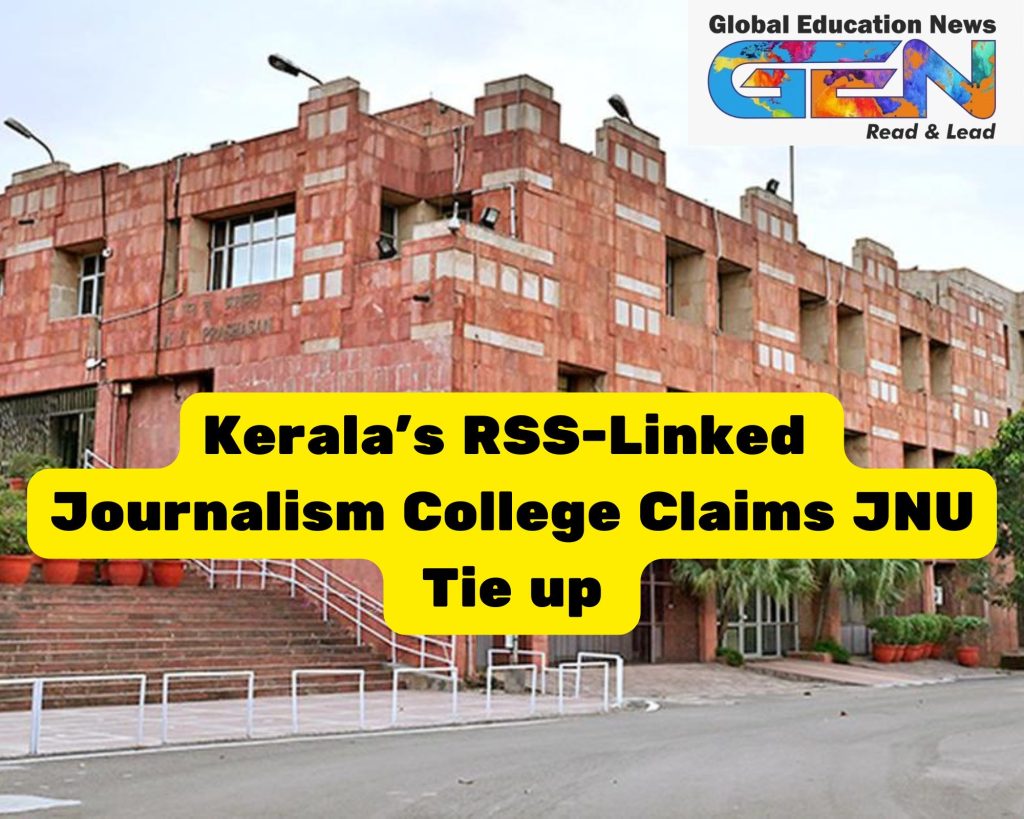
Kozhikode: A new journalism college in Kerala, tied to the Rashtriya Swayamsevak Sangh (RSS), has stirred controversy by branding itself as “India’s first JNU-affiliated journalism college.” The Mahatma Gandhi College of Mass Communication (MAGCOM), based at Kesari Bhavan—the headquarters of the RSS-affiliated publication Kesari—is set to hold its inaugural convocation on April 17, 2025, with Jawaharlal Nehru University (JNU) Vice-Chancellor Santishree Dhulipudi Pandit slated to attend. However, JNU officials have distanced themselves, clarifying that the connection is limited to an academic collaboration rather than full affiliation, raising questions about the institute’s claims and its mission to foster “nationalistic journalism.”
A Bold Claim of JNU Affiliation
Key Points:
- MAGCOM touts itself as JNU-affiliated
- JNU lists it as a recognized research institution
- Varsity insists it’s only an MoU for academic exchange
MAGCOM’s assertion of being JNU-affiliated stems from a 2024 postgraduate diploma in mass communication, reportedly approved after a year-long process. JNU’s website does list the college as a “recognised research institution,” a status granted to various institutes nationwide for academic collaboration. Yet, senior JNU officials emphasize there’s no formal affiliation—only a Memorandum of Understanding (MoU) for sharing expertise and resources. This discrepancy has fueled debate over the college’s use of JNU’s prestigious name to bolster its credibility.
The Rise of ‘Nationalistic Journalism’
Key Points:
- Aims to counter “anti-national” media narratives
- Offers PG diplomas in journalism and technical writing
- Plans expansion with a full journalism postgraduate course
Founded with a mission to promote “nationalistic journalism,” MAGCOM operates from Kozhikode under the guidance of director A K Anuraj and academic head N R Madhu. The institute seeks to train journalists who align with a nationalist ethos, a goal articulated amid claims of “anti-national elements” in mainstream media. Currently offering two postgraduate diploma programs—one in journalism and another in content and technical writing—the college has ambitions to launch a full-fledged postgraduate journalism course, signaling its intent to shape the future of Indian media.
RSS Roots and Political Backlash
Key Points:
- Located at RSS-linked Kesari Bhavan
- Critics decry saffronisation of education
- JNU’s involvement questioned by student groups
The college’s deep ties to the RSS, evident in its location and ideological leanings, have drawn sharp criticism. Operating out of Kesari Bhavan, the headquarters of the RSS mouthpiece Kesari, MAGCOM embodies the organization’s broader push into education. Left-leaning groups, including the Communist Party of India (Marxist), have condemned the move as an attempt to “saffronise” JNU, a university historically associated with progressive thought. Posts on X reflect this sentiment, with some calling for a rejection of RSS influence in academia, though JNU maintains its role is limited to academic exchange.
JNU’s Delicate Balancing Act
Key Points:
- Vice-Chancellor to attend convocation
- University denies full affiliation
- MoU aimed at faculty and expertise sharing
The planned presence of JNU Vice-Chancellor Santishree Dhulipudi Pandit at MAGCOM’s convocation has intensified scrutiny. While JNU officials stress that the MoU is standard practice—allowing faculty from recognized institutes to engage with its academic bodies—they’ve been unable to clarify the Vice-Chancellor’s participation. Her attendance risks amplifying perceptions of a deeper tie, despite the university’s efforts to downplay the relationship. The situation underscores JNU’s challenge in navigating partnerships without endorsing external agendas.
What Lies Ahead for Journalism Education
Key Points:
- Debate over ideological influence in media training
- Potential model for RSS educational expansion
- Calls for transparency in JNU’s affiliations
MAGCOM’s emergence raises broader questions about the direction of journalism education in India. Its nationalist focus contrasts with JNU’s legacy of fostering diverse perspectives, prompting concerns about ideological conformity in media training. As the RSS expands its footprint in higher education—evidenced by plans for five universities nationwide—this college could serve as a template. For now, the controversy highlights a need for clearer boundaries in academic collaborations, as stakeholders watch closely to see how this partnership evolves.