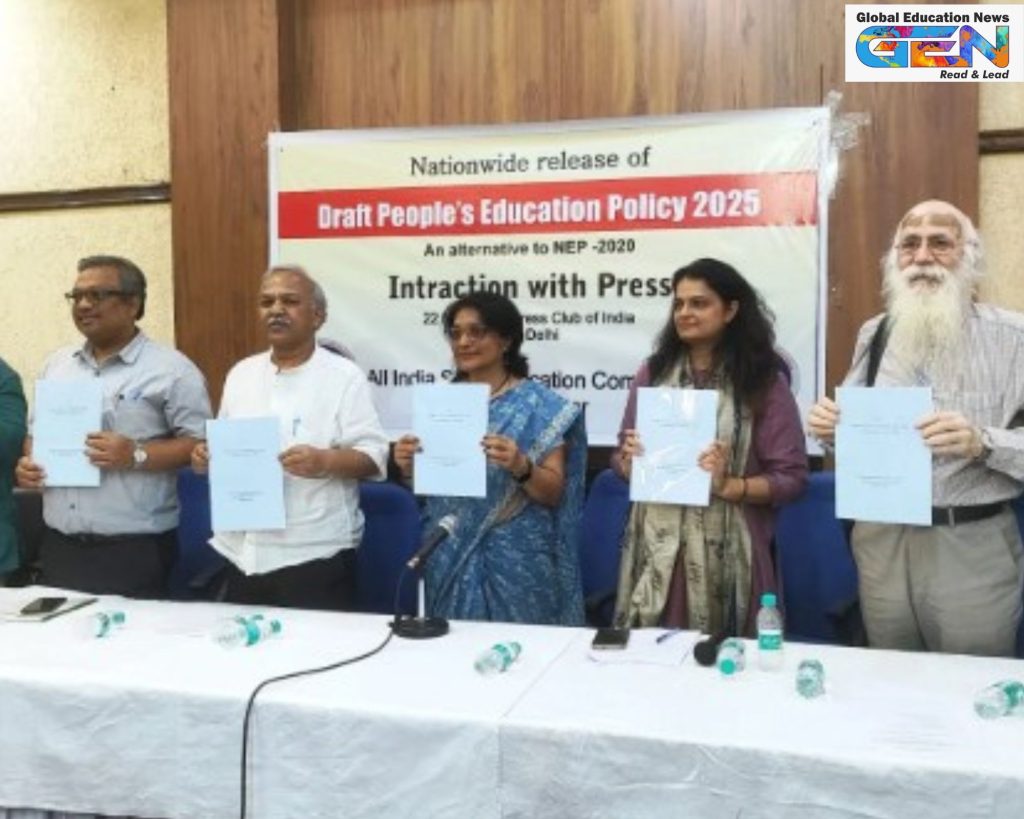
On November 26, 2025, amid escalating concerns over school mergers and budget slashes, the All India Save Education Committee (AISEC) spotlighted its Draft People’s Education Policy 2025 (PEP 2025) as a direct antidote to the National Education Policy (NEP) 2020. Unveiled nationwide in May 2025 after five years of consultations with educators, activists, and students, PEP 2025 addresses the “3Cs” plaguing Indian education—centralization, commercialization, and communalization—exacerbated by NEP’s implementation. With over 89,000 public schools closed since 2014 and education funding stagnant at 2.9% of GDP (far below NEP’s 6% target), the policy emerges from crises like Karnataka’s threat to shutter 6,000+ schools. Analysis shows PEP’s federalist ethos could boost enrollment in underserved areas by 15-20%, per AISHE trends, but its success hinges on state buy-in amid resistance from Tamil Nadu and West Bengal.
The Genesis of PEP 2025: Critiquing NEP’s Flaws in a Time of Crisis
PEP 2025 was born from AISEC’s frustration with NEP 2020’s rushed rollout during the COVID-19 lockdown—sans parliamentary debate or state input—fueling privatization and inequality. Key drivers include drastic budget cuts (e.g., UGC funds slashed 60% since 2014) and policies enabling 42,000+ private schools to proliferate while public ones vanish.
Key Points:
- Budget Betrayals: Central education allocation dipped to 2.49% of the 2024-25 budget, ignoring NEP’s equity pledges and forcing states like Uttar Pradesh to merge 5,000 schools.
- Privatization Surge: NEP’s public-private partnerships (PPPs) and self-financing models have commercialized access, with private fees unregulated and capitation rampant.
- Centralization Concerns: The proposed Higher Education Commission of India (HECI) Bill 2025 grants the Centre “unfettered powers,” overriding state autonomy and enforcing uniform curricula via CUET/NEET.
- Analysis Insight: These flaws have widened gaps—rural secondary GER at 72% vs. urban 86%, SC/ST higher education at 18-23% vs. national 27%—undermining NEP’s 50% GER-by-2035 goal by prioritizing profit over people.
Guiding Principles: Foundations of Secular, Democratic Education
At its core, PEP 2025 anchors in constitutional values—scientific temper, equality, and fraternity—rejecting NEP’s “Indian Knowledge System” for its alleged communal tilt.
Key Points:
- Secularism and Pluralism: Curricula free of religious dogma, promoting tolerance and critical thinking to combat casteism and jingoism.
- Equity and Inclusion: Universal access for marginalized groups (SC/ST, disabled, migrants) via scholarships, hostels, and anti-discrimination committees.
- Federalism: Shift education to the State List; democratic governance through elected bodies of teachers, students, and parents.
- Analysis Insight: Unlike NEP’s top-down approach, PEP’s stakeholder-led model could reduce dropout rates (15% for ages 6-10 in 2023-24) by 10-15% through localized reforms.
Key Proposals: A Blueprint for Reform Across Education Levels
PEP 2025 spans pre-school to adult education, advocating full public funding and rejecting NEP’s structures like 5+3+3+4 or FYUP.
Key Points (PEP vs. NEP Comparison):
| Area | PEP 2025 Proposals | NEP 2020 Critiqued Elements |
|---|---|---|
| Structure | Retain 10+2; voluntary 2-year pre-primary; annual exams from Class 1. | 5+3+3+4; multiple entry/exit; semester overload. |
| Curriculum & Language | Mother tongue medium; two-language formula (mother tongue + English); core subjects with secular values. | Three-language push favoring Hindi/Sanskrit; vocationalization from Class 6. |
| Higher Education | 3-year UG/2-year PG; no centralized admissions; MPhil restoration; 1:15 teacher ratio. | FYUP; CUET/NEET mandates; industry “cafeteria” links. |
| Vocational & Adult Ed | Separate streams post-Class 10; free adult centers for lifelong learning. | Early vocational push; hybrid online modes discriminatory for rural poor. |
| Teacher Training | Mandatory B.Ed./M.Ed.; permanent recruitment; training in empathy and critical pedagogy. | Integrated Teacher Education Programme (ITEP); contractual “facilitators.” |
- Analysis Insight: PEP’s emphasis on physical infrastructure (e.g., ramps, labs) and incentives for remote postings could address 20% urban-rural disparities, contrasting NEP’s digital bias that excludes 35% of peripheral students.
Funding and Equity: Halting the Privatization Tide
PEP demands 10% of central budget (6% GDP) for education, fully state-funded to end commercialization—directly countering NEP’s PPPs and fee hikes.
Key Points:
- Budget Overhaul: Ban self-financing in public institutions; 30% free seats in privates for disadvantaged groups; dissolve National Research Foundation (NRF) for direct university grants.
- Equity Measures: Remedial classes for slow learners; gender-safe campuses with POCSO adherence; scholarships covering full costs for SC/ST/women.
- Data Spotlight: Public spending stagnated at 4.12% GDP (2021-22), with elementary education at 1.75%; PEP targets revival of 25,000+ at-risk schools.
- Analysis Insight: Enforcing PEP’s caps on private fees could save families ₹50,000-1 lakh annually, aligning with Kerala’s model (high GER via public investment) and potentially lifting 4-5 million out-of-school children.
Voices from the Frontlines: Stakeholder Perspectives
AISEC’s consultations amplify marginalized voices, with calls echoing in 2025 protests.
Key Points:
- M. Shajar Khan (AISEC): “Drastic budget reductions… coupled with hiring stoppages, have reached pathetic levels—NEP facilitates privatization, not equity.”
- Prof. Abdul Aziz: “PEP promotes secular, scientific education, opposing NEP’s anti-scientific communalization.”
- Student Activists: Demand rollback of mergers, citing 26,000+ closures in UP/MP alone.
- Analysis Insight: These narratives highlight a 25% rise in teacher vacancies since 2020, fueling PEP’s push for regularization—potentially improving outcomes by 18%, per UGC audits.
The Road Ahead: Mobilizing for Implementation
PEP envisions a National People’s Parliament in January 2026 (Bengaluru) to finalize inputs, urging submission to governments for mandatory adoption.
Key Points:
- Action Steps: Nationwide webinars; feedback via pep2025feedback@gmail.com; coalition-building with PAFRE for advocacy.
- Challenges: Resistance from Centre via HECI; need for constitutional amendments to federalize education.
- Potential Wins: State pilots in TN/Karnataka could scale nationally, boosting literacy (77.7% in 2021) toward 90% by 2030.
- Analysis Insight: If adopted, PEP could reverse privatization trends (private schools up 3.6% yearly), fostering a 20% GER rise in higher ed for underserved castes, but requires ₹75,000 crore reallocation from current budgets.