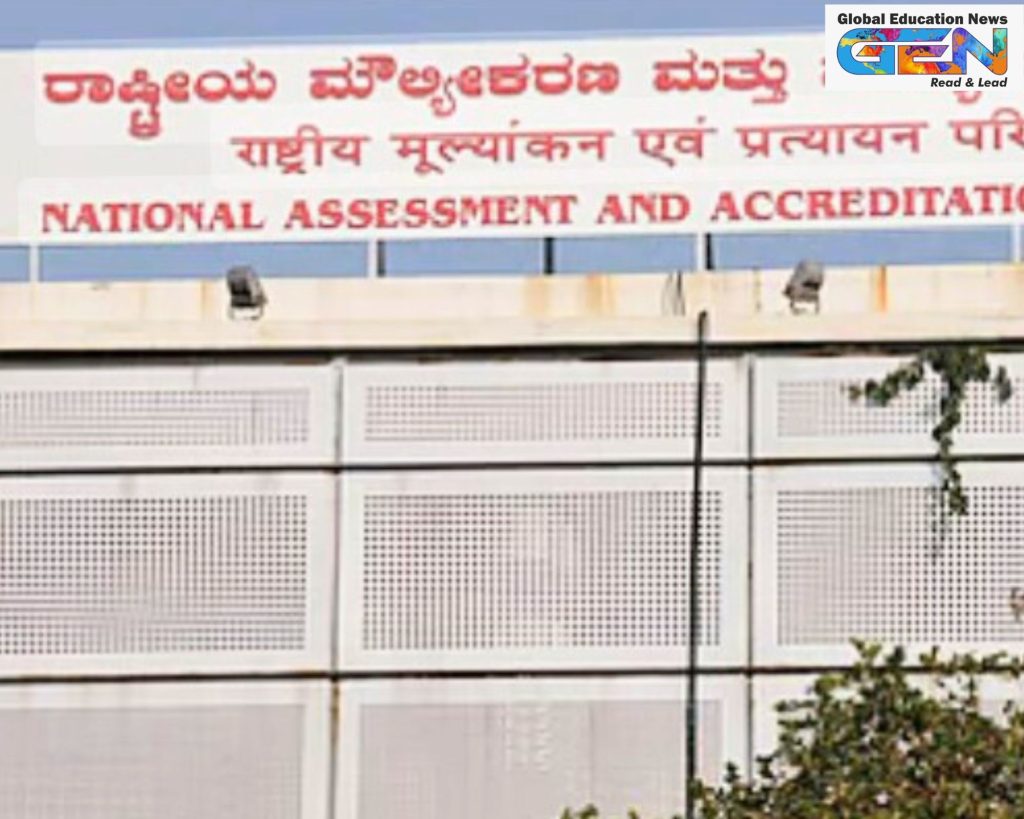
The National Assessment and Accreditation Council (NAAC) is launching a groundbreaking AI-powered accreditation system in August 2025, replacing its 30-year-old model. Announced by NAAC Chairman Prof Anil Sahasrabudhe, this reform shifts from physical inspections to AI-driven assessments and online document verification, aiming to accredit over 90% of India’s higher education institutions (HEIs) within five years. This article explores the new system, its benefits, and its impact on colleges and universities.
Key Points:
- NAAC’s new AI-based accreditation system launches in August 2025.
- Replaces traditional field visits with online, AI-driven evaluations.
- Targets accrediting over 90% of HEIs in five years.
The New Accreditation Framework: Two-Tier System
The revamped system introduces two levels of assessment: a basic accreditation and a maturity-based graded accreditation with five progressive levels (Level 1 to 5). The existing eight-point grading scale (A++, A+, etc.) is replaced with a simpler “Accredited” or “Not Accredited” outcome for basic accreditation.
Key Points:
- Basic accreditation classifies institutions as “Accredited” or “Not Accredited.”
- Maturity-based system offers five levels for advanced evaluation.
- Replaces the previous eight-point grading structure.
AI-Driven Assessment: Enhancing Transparency
To address past concerns about transparency and corruption, the new system eliminates peer review visits for basic accreditation. Instead, it uses AI to analyze institutional data and verify documents online, with stakeholder validation ensuring credibility.
Key Points:
- AI scans data and generates questions for stakeholder verification.
- Randomly selected panel of 100+ stakeholders (faculty, industry experts, NGOs) assesses authenticity.
- Institutions submitting fake documents face a three-year accreditation ban.
Credibility Scoring: Trust with Verification
Each institution starts with a default credibility score of 0.5, which adjusts based on stakeholder feedback. AI also monitors the credibility of assessors to maintain integrity.
Key Points:
- Credibility score ranges from 0 to 1, starting at 0.5.
- Score increases with validated documents, decreases with discrepancies.
- AI tracks assessor credibility to ensure fair evaluations.
Evaluation Parameters: Tailored to Institution Type
The basic accreditation assesses universities on 55 parameters, autonomous colleges on 50, and affiliated colleges on 40. Minimum scores required are 50% for universities, 45% for autonomous colleges, and 40% for affiliated colleges.
Key Points:
- Universities: 55 parameters, 50% minimum score.
- Autonomous colleges: 50 parameters, 45% minimum score.
- Affiliated colleges: 40 parameters, 40% minimum score.
Maturity-Based Graded Accreditation: Aspiring Higher
Institutions achieving basic accreditation can opt for maturity-based graded accreditation (Levels 1–5). Higher levels involve more complex parameters, with hybrid (online and on-site) visits required from Level 3 onward.
Key Points:
- Five levels reflect institutional maturity and aspirations.
- Higher levels require 80–100 parameters for evaluation.
- Hybrid visits introduced at Levels 3, 4, and 5 to minimize manipulation.
Alignment with National Education Policy (NEP) 2020
The new system aligns with NEP 2020, supporting innovation, multilingualism, multiple entry-exit options, sustainability, and internationalization. Foreign universities with Indian campuses are also eligible to apply.
Key Points:
- Integrates NEP 2020 principles like innovation and sustainability.
- Foreign universities in India can seek NAAC accreditation.
- Encourages voluntary participation to raise educational standards.
Why This Matters for Students and Institutions
The AI-driven system simplifies accreditation, encourages more institutions to participate, and ensures transparency. Students benefit from reliable quality indicators, while institutions gain access to funding and global recognition.
Key Points:
- Simplifies accreditation, boosting participation (currently 40% universities, 18% colleges accredited).
- Helps students choose quality institutions with verified credentials.
- Enhances institutional funding and international collaboration opportunities.
Conclusion: A Step Toward Quality Education
NAAC’s AI-driven accreditation system, launching in August 2025, marks a transformative shift in evaluating India’s higher education institutions. By leveraging AI and online verification, it aims to ensure transparency, scalability, and alignment with global standards. Students and institutions alike should stay informed via naac.gov.in to navigate this new era of quality assurance.
Key Points:
- Launches in August 2025, targeting 90% HEI coverage by 2030.
- Enhances transparency and eliminates past integrity concerns.
- Check naac.gov.in for updates and accreditation details.