Date: November 24, 2026
Place: Kolkata, West Bengal
Education News: Mathematics, Science and Research
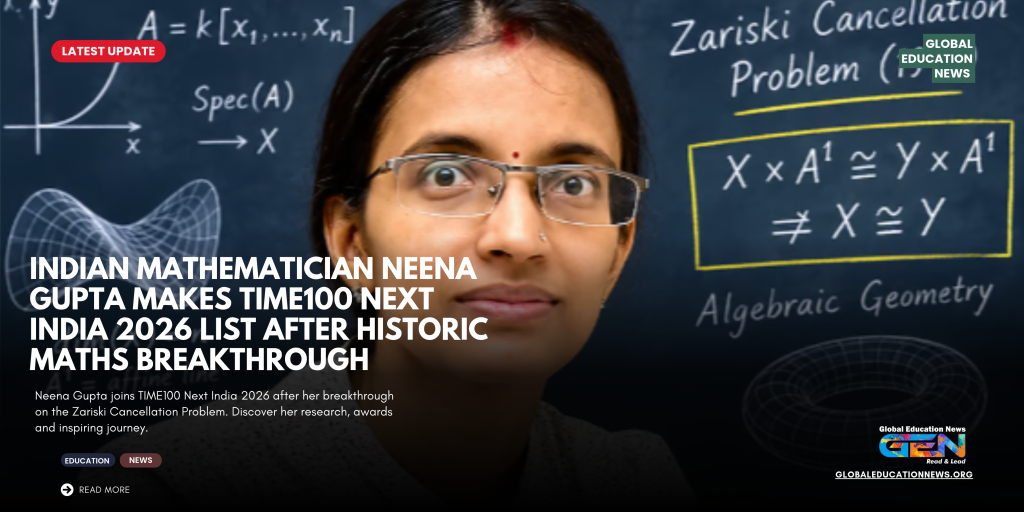
Kolkata, Education News: Indian mathematician and professor Neena Gupta has earned a place on the inaugural TIME100 Next India 2026 list for her contribution to mathematical research. A professor at the Indian Statistical Institute (ISI), Kolkata, Gupta gained international recognition for her breakthrough research on the Zariski Cancellation Problem, a mathematical question first posed in 1949.
Her research, published in 2014, provided a counterexample to the problem in positive characteristic, challenging an assumption that had remained a subject of mathematical investigation for decades.
Gupta’s recognition brings attention to India’s contribution to advanced mathematical research and highlights the importance of curiosity, persistence and fundamental science. Her journey also offers encouragement to students, particularly young women interested in mathematics and research careers.
Who Is Neena Gupta, the Indian Mathematician on TIME100 Next India 2026?
Neena Gupta is a mathematician and professor in the Theoretical Statistics and Mathematics Unit at the Indian Statistical Institute in Kolkata.
Her research focuses on two specialised areas:
- Commutative Algebra: A branch of mathematics that studies algebraic structures, including rings and their properties.
- Affine Algebraic Geometry: A field that explores geometric objects described through polynomial equations and their algebraic structures.
Gupta’s research has contributed to important questions in modern algebraic geometry. Her work on the Zariski Cancellation Problem earned her recognition in the mathematical research community and several major scientific honours.
She was included in the Health and Science Innovators category of TIME100 Next India 2026.
What Is the 70-Year-Old Zariski Cancellation Problem?
The Zariski Cancellation Problem is a longstanding question in algebraic geometry, first posed by mathematician Oscar Zariski in 1949.
In simple terms, it asks whether two mathematical structures that become equivalent after adding an extra dimension must have been equivalent even before that additional dimension was introduced.
Imagine two different geometric structures. If an extra dimension is added to each, their resulting mathematical forms may appear identical. The question is whether this means the original structures must also have been identical.
For decades, mathematicians investigated this question.
In 2014, Neena Gupta demonstrated that the expected cancellation property does not always hold. She used a three-dimensional affine variety constructed by mathematician Takanori Asanuma to provide a counterexample in positive characteristic.
This means her result established a negative answer to the problem in that mathematical setting.
Importantly, the result should not be understood as solving every possible version of the problem under all mathematical conditions. It addressed a significant version of the question and became a landmark contribution to affine algebraic geometry.
How Did Neena Gupta Challenge a Problem That Had Remained Open for Decades?
Gupta’s breakthrough involved studying the mathematical properties of affine varieties and examining whether the cancellation principle always remained valid.
The central idea was to test whether adding an extra variable or dimension preserved enough information to identify the original mathematical structure.
Her research demonstrated that this assumption could fail in positive characteristic.
The result was important because it challenged an established expectation in algebraic geometry and opened further avenues for studying relationships between algebraic structures.
The achievement also showed how fundamental mathematical research can advance knowledge without necessarily producing an immediate commercial product or everyday technology.
Neena Gupta’s Major Awards and Achievements
Gupta’s contribution to mathematics has received recognition through several prestigious awards and academic distinctions.
| Year | Award or achievement |
|---|---|
| 2014 | Recognition for her breakthrough research on the Zariski Cancellation Problem |
| 2019 | Shanti Swarup Bhatnagar Prize in Mathematical Sciences |
| 2021 | DST-ICTP-IMU Ramanujan Prize |
| 2022 | Nari Shakti Puraskar for 2020–21 |
| 2024 | Infosys Prize in Mathematical Sciences |
| 2025 | Selected to deliver the Emmy Noether Lecture |
| 2026 | Named to TIME100 Next India |
The Infosys Prize in Mathematical Sciences recognised her work on the Zariski Cancellation Problem and its impact on algebraic geometry and commutative algebra.
The Ramanujan Prize and Shanti Swarup Bhatnagar Prize further recognised her contributions to mathematical research.
Her selection for the Emmy Noether Lecture in 2025 was another important academic distinction, highlighting the contributions of women mathematicians.
What Is TIME100 Next India 2026?
TIME100 Next India 2026 is the inaugural India edition of the TIME100 Next initiative. It recognises 100 emerging leaders whose work and ideas are helping shape India’s future.
The list covers different fields, including:
- Science and research
- Business and technology
- Entertainment and culture
- Sports
- Advocacy and social change
Gupta’s inclusion in the Health and Science Innovators category recognises the importance of her contribution to mathematics.
The initiative also brings attention to researchers, innovators and professionals whose work may not always receive the same public visibility as developments in entertainment, business or sports.
What Can Students Learn From Neena Gupta’s Research Journey?
Neena Gupta’s achievement offers an important lesson for students: mathematics is not limited to classroom exercises, formulas or examination questions. It is also a subject through which researchers investigate difficult questions and develop new ways of understanding the world.
Students interested in mathematics and scientific research can take several lessons from her journey.
1. Develop curiosity about difficult questions
Students should learn to ask why a mathematical rule works, where it applies and whether there are situations in which it might fail.
2. Build strong mathematical foundations
Algebra, geometry, calculus and logical reasoning provide the foundation for advanced mathematical study.
3. Explore mathematics beyond textbooks
Mathematical puzzles, problem-solving activities, academic lectures and introductory research material can help students discover areas that interest them.
4. Consider research as a career
Students who enjoy exploring unanswered questions can consider higher studies in mathematics, statistics, physics, computer science and related disciplines.
5. Encourage girls to pursue STEM
Gupta’s recognition also highlights the importance of supporting girls who want to pursue mathematics, science, technology and research careers.
What Career Opportunities Are Available in Advanced Mathematics?
Advanced mathematics can lead to several academic and professional pathways. Students interested in the subject can explore different specialisations depending on their interests and qualifications.
| Field | Possible career pathways |
|---|---|
| Pure Mathematics | Mathematician, academic researcher, university professor |
| Applied Mathematics | Research analyst, modelling specialist |
| Statistics | Statistician, data analyst, research professional |
| Mathematical Computing | Scientific computing and computational research |
| Data Science | Data scientist, quantitative analyst |
| Mathematical Education | Mathematics teacher, curriculum developer |
Students interested in fundamental research can pursue undergraduate and postgraduate studies in mathematics before moving towards doctoral research.
Institutions such as the Indian Statistical Institute offer academic and research opportunities in mathematical sciences and related disciplines.
Why Is Neena Gupta’s Recognition Important for Indian Science?
India has a long tradition of contributions to mathematics, but fundamental research often receives less public attention than developments with immediate practical applications.
Gupta’s international recognition brings visibility to the importance of pure mathematics and the researchers who work on complex theoretical questions.
Her achievement also demonstrates that major research contributions can emerge from Indian academic institutions and become recognised internationally.
For students, it is a reminder that scientific progress depends not only on developing new technologies but also on strengthening the fundamental knowledge behind them.
Frequently Asked Questions (FAQs)
1. Who is Neena Gupta?
Neena Gupta is an Indian mathematician and professor at the Indian Statistical Institute in Kolkata. Her research focuses on commutative algebra and affine algebraic geometry.
2. Why has Neena Gupta been included in TIME100 Next India 2026?
She has been recognised for her contribution to mathematical research, particularly her breakthrough work on the Zariski Cancellation Problem.
3. What is the Zariski Cancellation Problem?
It is a question in algebraic geometry that asks whether two mathematical structures that become equivalent after adding an extra dimension must have been equivalent originally.
4. When did Neena Gupta make her breakthrough?
She demonstrated a counterexample to a version of the Zariski Cancellation Problem in 2014.
5. Did Neena Gupta solve the entire Zariski Cancellation Problem?
Her work provided a counterexample in positive characteristic, establishing a negative answer in that setting. It should not be interpreted as resolving every possible version of the problem under all conditions.
6. Which awards has Neena Gupta received?
Her recognitions include the Shanti Swarup Bhatnagar Prize in 2019, the Ramanujan Prize in 2021, the Nari Shakti Puraskar for 2020–21 and the Infosys Prize in 2024.
7. What is Neena Gupta’s research field?
Her research focuses on commutative algebra and affine algebraic geometry.
8. What is TIME100 Next India?
It is an annual list recognising 100 emerging leaders from different fields whose work and ideas are helping shape India’s future. The 2026 edition is its inaugural India edition.
9. What can students learn from her achievement?
Her journey highlights the importance of mathematical curiosity, strong academic foundations, independent thinking and persistence in research.
Conclusion
Neena Gupta’s inclusion in TIME100 Next India 2026 is an important recognition of India’s contribution to fundamental mathematical research. Her breakthrough on the Zariski Cancellation Problem demonstrated how questioning an established mathematical assumption can lead to new discoveries.
For students, her journey sends a valuable message: mathematics is not only about finding the correct answer but also about asking questions that others may not have considered. With strong foundations, curiosity and dedication, students can explore opportunities in research and advanced scientific fields.
Her achievement also highlights the importance of encouraging more young women to pursue mathematics and scientific research.
For more updates on Indian scientists, research breakthroughs, education opportunities and inspiring academic achievements, stay connected with Global Education News.