Date: November 24, 2026
Place: Washington, United States
Education News: International Education and Student Visas
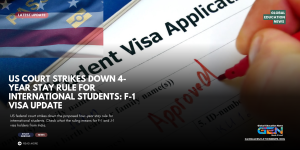
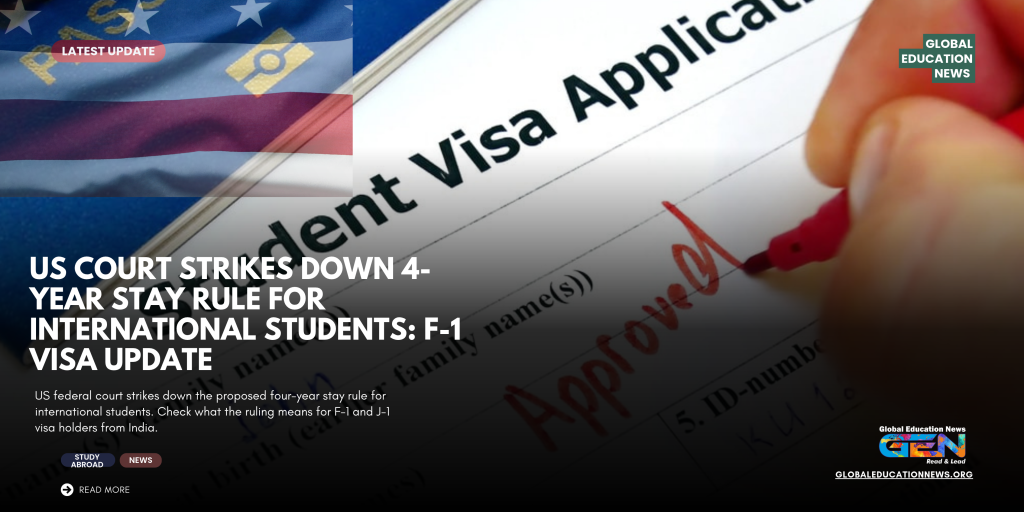
Washington, Education News: International students planning to study in the United States have received an important legal update. A federal court has struck down a Department of Homeland Security (DHS) rule that would have limited the period of stay for many international students and exchange visitors to a maximum of four years.
The judgment, delivered on November 16, 2026, by the US District Court for the District of Massachusetts, vacates the rule that sought to replace the existing Duration of Status (D/S) framework with fixed admission periods and additional extension requirements.
The decision preserves the existing system for eligible F-1 international students and J-1 exchange visitors for now. It is particularly important for students enrolled in longer academic programmes, including doctoral degrees, research programmes and courses that may require additional time to complete.
However, the ruling could still face an appeal. International students must continue following the existing immigration and enrolment requirements.
What Was the US Four-Year Stay Rule for International Students?
The US Department of Homeland Security published a final rule on July 17, 2026, proposing a major change to the way certain international visitors were allowed to remain in the country.
Under the proposed framework, eligible F-1 academic students and J-1 exchange visitors would have received admission for a fixed period linked to their academic or exchange programme, subject to a maximum of four years.
Students who needed additional time beyond the authorised period would have had to apply for an extension of stay under a new procedure.
The rule also proposed restrictions on academic mobility, including changing educational programmes, transferring institutions and pursuing certain additional courses of study.
The government argued that the changes would strengthen immigration oversight, improve monitoring and help address potential visa-related fraud.
However, higher education organisations and other groups challenged the rule, arguing that it could create unnecessary administrative difficulties and disrupt students’ academic progress.
Why Did the US Federal Court Strike Down the Rule?
The case was heard by the US District Court for the District of Massachusetts.
On November 16, 2026, US District Judge F. Dennis Saylor IV ruled in favour of the organisations challenging the regulation. The court found that the DHS rule was arbitrary and capricious and exceeded the department’s legal authority.
One of the important issues was whether the government had adequately considered existing systems for monitoring international students.
The court referred to the Student and Exchange Visitor Information System (SEVIS), which is used to monitor the enrolment and immigration-related records of international students and exchange visitors.
The judgment found that DHS had not sufficiently explained why a new fixed-period system was necessary when existing monitoring mechanisms were already available.
The court also questioned the proposed restrictions on academic mobility, noting that they could interfere with students’ ability to pursue longer or changing academic pathways.
As a result, the court vacated the final rule under the Administrative Procedure Act.
What Is the Duration of Status (D/S) System?
The Duration of Status system is the longstanding framework used for eligible F-1 international students and J-1 exchange visitors.
Under this framework, eligible students are generally permitted to remain in the United States for the duration of their authorised academic programme or exchange activity, provided they maintain their immigration status and comply with applicable requirements.
This is different from a system that automatically limits every student’s admission to a fixed four-year period.
For example, a student enrolled in a programme that takes longer than four years may continue studying under the D/S framework if the student maintains the required status and meets the applicable conditions.
Students who need additional time must follow the relevant programme-extension procedures through their educational institution and designated officials.
The system does not provide unlimited permission to remain in the country. Students must continue meeting the requirements attached to their immigration category.
What Changes for F-1 and J-1 International Students After the Judgment?
The November 16 judgment means the DHS fixed-period rule will not take effect under the vacated regulation unless the legal position changes through further proceedings.
The existing Duration of Status framework therefore remains applicable to eligible F-1 and J-1 students and their dependents.
| Area | Position following the judgment |
|---|---|
| F-1 international students | Existing Duration of Status framework remains in place |
| J-1 exchange visitors | Existing Duration of Status framework remains in place |
| Four-year admission limit | Vacated rule will not take effect |
| New extension-of-stay procedure | Proposed requirements under the vacated rule will not take effect |
| Restrictions on academic mobility | Proposed restrictions under the vacated rule will not take effect |
| Further legal proceedings | An appeal remains possible |
Students should continue following the immigration instructions issued by their educational institutions and relevant authorities.
How Does the Ruling Affect Students Pursuing Long-Term Courses?
The decision is particularly relevant to students enrolled in programmes that may take more than four years to complete.
Some academic pathways involve extended research, practical training, thesis work or changes in specialisation. Under the proposed rule, students could have faced additional extension procedures after reaching the fixed admission limit.
The court’s decision preserves the existing framework instead of introducing those new requirements through the vacated rule.
The development may be especially relevant to:
- PhD students: Doctoral research can require several years, depending on the subject and research progress.
- Research scholars: Extended research projects may require additional academic time.
- International exchange students: J-1 participants remain covered by the existing framework.
- Students changing academic direction: The vacated rule’s proposed restrictions on certain programme changes will not take effect under that regulation.
- Universities: Institutions can continue working under the existing Duration of Status framework while monitoring further legal developments.
This does not remove existing immigration conditions or guarantee approval for every academic change. Students must follow the procedures applicable to their individual circumstances.
Could the US Government Appeal the Decision?
Yes. The November 16 judgment is a final decision by a federal district court, but further legal proceedings remain possible.
The US government may challenge the ruling through an appeal. If that happens, the legal position could be examined by a higher court.
For now, the November 16 judgment has vacated the DHS final rule. Universities and international student offices are continuing to monitor developments and communicate relevant guidance to students.
International students should therefore avoid making major academic or immigration decisions based only on headlines. They should check official university international-student guidance for any subsequent updates.
What Should Indian Students Planning to Study in the US Know?
The decision is relevant to Indian students considering undergraduate, postgraduate, doctoral and exchange programmes in the United States.
Students should understand that the judgment concerns the proposed four-year admission rule. It does not remove the normal requirements for obtaining and maintaining an F-1 or J-1 immigration status.
Before travelling or beginning a programme, students should:
- Check the latest admission and immigration guidance issued by their university.
- Understand the requirements attached to their visa category.
- Maintain valid enrolment and follow the academic conditions applicable to their programme.
- Contact the university’s international student office if a programme extension or academic change is required.
- Follow official updates if the government files an appeal or further legal proceedings change the position.
The decision provides continuity under the existing framework, but students must still comply with all applicable immigration requirements.
Frequently Asked Questions (FAQs)
1. What did the US court decide on November 16, 2026?
A federal district court in Massachusetts vacated a DHS rule that would have introduced fixed admission periods of up to four years for certain international students and exchange visitors.
2. Does the four-year stay limit still apply to F-1 students?
The four-year limit under the vacated DHS rule will not take effect as a result of the November 16 judgment. The existing Duration of Status framework remains in place for eligible students, subject to applicable requirements.
3. What is the Duration of Status system?
Duration of Status is a framework under which eligible F-1 students can generally remain in the United States while pursuing their authorised academic programmes, provided they maintain their immigration status and comply with the applicable rules.
4. Does the ruling apply to J-1 exchange visitors?
Yes. The vacated DHS rule also covered J-1 exchange visitors. The existing Duration of Status framework remains in place for eligible J-1 participants.
5. Can international students now stay in the US indefinitely?
No. Students must maintain their immigration status, comply with programme requirements and follow applicable immigration regulations. The ruling does not provide unlimited permission to remain in the United States.
6. Will students still need extensions if their courses take longer?
Students must follow the applicable procedures for extending their academic programmes and maintaining their immigration status. The new extension-of-stay procedure proposed under the vacated DHS rule will not take effect under that regulation.
7. Can the US government challenge the court’s decision?
Yes. The federal government may appeal the judgment. Students and universities should monitor further legal developments.
8. Does the ruling affect Indian students planning to study in the US?
Yes. It is relevant to eligible Indian students applying for or studying under F-1 and J-1 categories. However, they must continue meeting the normal visa, enrolment and immigration requirements.
Conclusion
The US court’s decision to strike down the proposed four-year stay rule is an important development for international education. By vacating the DHS regulation, the court has preserved the longstanding Duration of Status framework for eligible F-1 students and J-1 exchange visitors.
For international students, including those from India, the decision provides continuity for academic programmes that may require more than four years. However, the possibility of an appeal means the legal situation should continue to be monitored.
Students planning to study in the United States should follow official immigration updates and guidance from their universities before making decisions about admissions, programme changes or extensions.
For more updates on international education, overseas admissions, student visas and global university policies, stay connected with Global Education News.