Date: November 24, 2026
Place: Guntur, Andhra Pradesh
Education News: Higher Education, Artificial Intelligence and Quantum Technology
Guntur, Education News: India has taken a significant step towards advanced technology education with the inauguration of its first dedicated Quantum Computing and Artificial Intelligence (AI) university campus in Andhra Pradesh. The temporary campus of the National Institute of Electronics and Information Technology (NIELIT) has been established at Acharya Nagarjuna University in Guntur, while a permanent campus is planned in Amaravati.
The new institution aims to prepare students and technology professionals for emerging fields such as quantum computing, artificial intelligence, machine learning, semiconductor design and high-performance computing. It is also expected to strengthen Andhra Pradesh’s ambition to develop Amaravati as a major centre for quantum technology research and innovation.
The initiative includes an investment of ₹47 crore in four specialised laboratories at the temporary campus and an approved investment of ₹730.70 crore for the permanent facility.
Where Is India’s First Quantum-AI University Campus Located?
The newly inaugurated campus is operating from the Centre for Distance Education building at Acharya Nagarjuna University in Guntur.
It is being established by NIELIT, a Deemed-to-be University under the Ministry of Electronics and Information Technology (MeitY), with support from the Andhra Pradesh government.
The Guntur facility will function as a temporary campus until the permanent university infrastructure in Amaravati is developed.
The campus inauguration took place on November 21, 2026. A. Pratibha, Financial Adviser to MeitY, inaugurated the facility in the presence of NIELIT Director General Madan Mohan Tripathi.
What Courses Will the Quantum-AI University Offer?
The institution plans to provide education and training in several advanced technology areas. Its proposed academic programmes will cover undergraduate, postgraduate, doctoral and diploma-level studies, alongside shorter skill-development and certificate courses.
Key areas include:
- Quantum Computing and Quantum Communication
- Artificial Intelligence and Machine Learning
- AI applications in science and engineering
- Chip Design and VLSI
- Embedded Systems
- Internet of Things (IoT)
- Semiconductor Technologies
- Data Science and High-Performance Computing
- Information Security and related emerging technologies
The objective is to connect academic learning with practical technology skills. Students will be able to explore fields that are becoming increasingly important in research, computing, electronics and the semiconductor industry.
Four Advanced Laboratories to Receive ₹47 Crore Investment
One of the major features of the Guntur campus is the plan to establish four specialised laboratories with an investment of ₹47 crore.
| Laboratory | Main focus |
|---|---|
| Quantum Computing Lab | Quantum computing concepts and practical research |
| Quantum Communication Lab | Advanced communication technologies |
| Chip Design and VLSI Lab | Semiconductor design and integrated circuits |
| AI and Computing Lab | Artificial intelligence and computing applications |
These laboratories are expected to provide practical exposure to emerging technologies and support specialised training.
The proposed infrastructure is particularly relevant for students interested in electronics, computer science, semiconductor engineering, artificial intelligence and research careers.
₹730.70 Crore Permanent Campus Planned in Amaravati
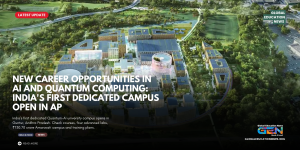
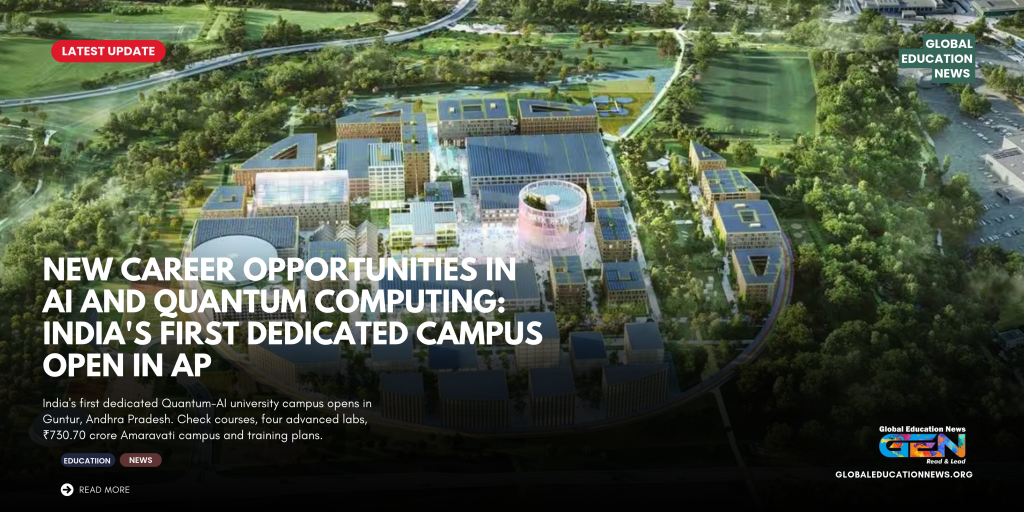
While the temporary campus has opened in Guntur, the permanent Quantum-AI university facility is planned at Nidamarru in Amaravati.
The project has an approved investment of ₹730.70 crore and is expected to be developed on approximately 8.5 acres.
The permanent campus is planned to include advanced laboratories, academic facilities and research infrastructure. It will support education, technology development, innovation and entrepreneurship in quantum computing, AI and semiconductor-related fields.
The Andhra Pradesh government has allocated land for the project, while NIELIT and the Union Ministry will support its development and infrastructure.
A confirmed completion date for the permanent campus has not yet been announced.
How Many Students Will Benefit From the New University?
The project aims to train approximately 8,250 learners over five years through formal academic programmes and skill-development initiatives.
| Training category | Proposed number of learners |
|---|---|
| Degree programmes | 1,650 |
| Skill development and certification | 6,600 |
| Total target | 8,250 |
The target reflects the institution’s wider ambition to develop a skilled workforce for India’s emerging technology sectors.
The university also plans to offer opportunities for students to engage with advanced quantum-computing facilities being developed under the Amaravati Quantum Valley initiative, including access to an IBM quantum computer.
When Will Classes and Training Programmes Begin?
The temporary campus has been inaugurated, and training programmes are expected to begin shortly.
However, published reports have given different timelines. Some reports indicate that programmes are scheduled to start on December 1, 2026, while another report places the launch of advanced certificate courses in January 2027.
Students should therefore check the latest NIELIT announcements for confirmed course dates, application windows, eligibility requirements, fees and admission procedures.
The exact admission schedule for full undergraduate, postgraduate and doctoral programmes has not been clearly established in the information currently available.
Why Is Quantum Computing and AI Education Important for Students?
Artificial intelligence is already influencing industries such as healthcare, education, manufacturing, finance and transportation. Quantum computing, meanwhile, is an emerging field with potential applications in specialised areas of scientific research, materials science, optimisation and advanced computing.
India’s growing focus on these technologies is creating a need for people with strong foundations in mathematics, physics, computer science, electronics and engineering.
The new campus could help students explore these subjects through specialised courses and practical training.
For students planning careers in emerging technologies, the development also highlights several important areas to explore:
- Computer Science: Artificial intelligence, machine learning and advanced computing.
- Physics and Mathematics: Quantum mechanics, algorithms and computational methods.
- Electronics Engineering: Chip design, VLSI and semiconductor technologies.
- Research and Development: Quantum communication, computing systems and advanced scientific applications.
Students should remember that these fields require strong fundamentals. Learning programming, mathematics, physics and problem-solving can provide a useful foundation before moving into specialised courses.
Frequently Asked Questions (FAQs)
1. Where has India’s first dedicated Quantum-AI university campus been inaugurated?
The temporary campus has been inaugurated at Acharya Nagarjuna University in Guntur, Andhra Pradesh. Its permanent campus is planned in Amaravati.
2. Which organisation is establishing the Quantum-AI university?
The campus is being established by the National Institute of Electronics and Information Technology (NIELIT), under the Ministry of Electronics and Information Technology.
3. What subjects will students study?
The proposed areas include quantum computing, quantum communication, artificial intelligence, machine learning, chip design, VLSI, embedded systems, IoT and semiconductor technologies.
4. How much investment is planned for the project?
The permanent Amaravati campus has an approved investment of ₹730.70 crore. Four specialised laboratories at the temporary Guntur campus are planned with an investment of ₹47 crore.
5. How many learners will the university train?
The project aims to train approximately 8,250 learners over five years, including 1,650 through degree programmes and 6,600 through skill-development and certification programmes.
6. When will the courses begin?
Some reports indicate December 1, 2026, while another report mentions January 2027 for advanced certificate courses. Students should wait for the relevant official course notification to confirm the schedule.
7. Will the university offer undergraduate and postgraduate programmes?
Yes. The proposed academic structure includes undergraduate, postgraduate, doctoral and diploma programmes in quantum technology, AI and semiconductors. Specific admission dates and programme details should be confirmed through official announcements.
8. Will students get practical laboratory experience?
The project includes four specialised laboratories covering quantum computing, quantum communication, chip design and VLSI, and AI and computing.
Conclusion
The inauguration of the Quantum-AI university campus in Guntur marks an important development in India’s efforts to expand education in advanced technologies. With specialised laboratories, proposed degree programmes and a ₹730.70 crore permanent campus planned in Amaravati, the initiative aims to strengthen the country’s talent pipeline in quantum computing, artificial intelligence and semiconductors.
For students, the project offers a glimpse into the academic and career opportunities emerging beyond traditional technology courses. The next important developments will be the publication of course details, confirmed admission dates and the rollout of specialised training programmes.
Stay connected with Global Education News for updates on new universities, emerging technology courses, admissions and future-ready career opportunities.