Date: November 25, 2026
Place: New Delhi
Education News: IITs, Medical Education and Healthcare Technology
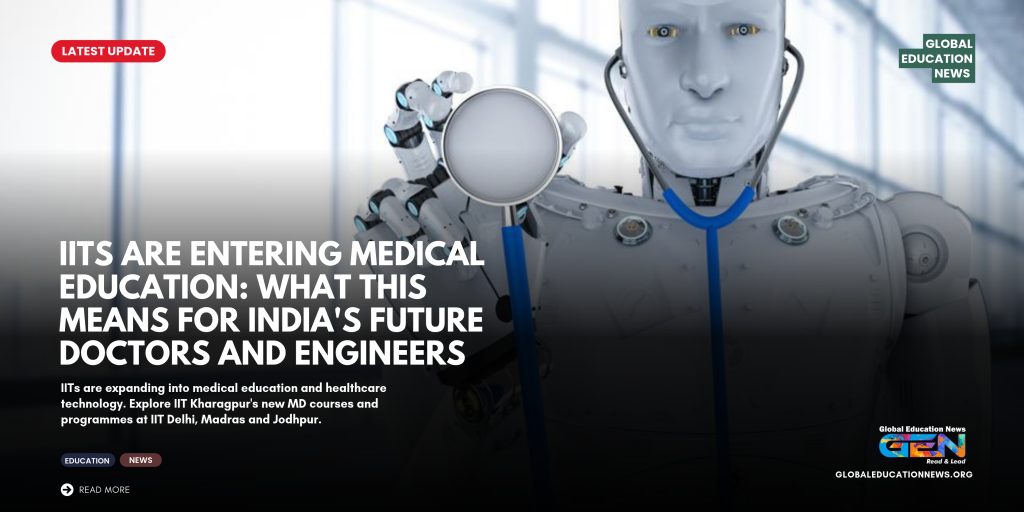
New Delhi, Education News: India’s healthcare sector is entering a period of rapid technological change. Artificial intelligence (AI), robotics, advanced medical imaging, genomics and digital health are transforming how diseases are detected, studied and treated. As these technologies become increasingly important, the boundaries between medicine, engineering and scientific research are becoming less distinct.
Recognising this shift, the Indian Institutes of Technology (IITs) are expanding their engagement with medical sciences and healthcare innovation. Their programmes are bringing doctors, engineers, biomedical scientists and technology researchers into closer academic collaboration.
A significant milestone is IIT Kharagpur’s introduction of National Medical Commission (NMC)-accredited postgraduate medical programmes for the 2026–27 academic session. Other IITs, including IIT Delhi, IIT Madras and IIT Jodhpur, are also developing programmes that connect clinical knowledge with engineering and medical technology.
The development points towards a broader change in Indian higher education: preparing professionals who can understand medical challenges and contribute to technological solutions.
Why Are IITs Expanding into Medical Education and Engineering Integration?
Medicine increasingly depends on technologies that require expertise beyond conventional clinical training.
For example, medical imaging systems rely on engineering and computational methods. AI-based tools can assist in analysing medical information, while biomedical devices combine electronics, materials science and an understanding of the human body.
This creates a need for professionals who can work across disciplines.
Traditional medical education develops clinical knowledge and patient-care skills. Engineering education builds expertise in designing systems, devices and technologies. When these areas work together, researchers can develop solutions that respond more closely to real healthcare needs.
IITs are positioned to contribute because of their existing strengths in engineering, computer science, artificial intelligence, biotechnology, materials science and applied research.
IIT Kharagpur Introduces Six NMC-Accredited MD Programmes
IIT Kharagpur has become the first IIT in India to introduce NMC-accredited postgraduate medical degree programmes.
The programmes will operate through the Dr B. C. Roy Multi-Speciality Medical Research Centre and begin in the 2026–27 academic session.
The institute is offering 12 seats across six MD specialisations, with two seats in each discipline.
| MD specialisation | Number of seats |
|---|---|
| General Medicine | 2 |
| Radiology | 2 |
| Physiology | 2 |
| Pathology | 2 |
| Community Medicine | 2 |
| Biochemistry | 2 |
| Total | 12 |
Admissions are through NEET-PG 2026 online counselling. Candidates must follow the official counselling schedule, eligibility conditions and seat matrix.
What Makes IIT Kharagpur’s Medical Programmes Different?
The initiative aims to connect postgraduate medical training with the institute’s wider research capabilities.
Potential interdisciplinary areas include:
- AI-assisted clinical decision-making
- Advanced medical imaging
- Computational pathology
- Biomedical devices
- Molecular diagnostics
- Precision medicine
- Population health
- Affordable healthcare technologies
The objective is to create opportunities for medical specialists to engage with scientific research and technological innovation alongside their clinical education.
The programmes are particularly significant because they bring clinical postgraduate medical education into an IIT environment, rather than limiting the institute’s role to engineering or healthcare technology research.
How Are Other IITs Connecting Medicine with Engineering?
IIT Kharagpur is not the only institution exploring this direction. Other IITs have established programmes and research initiatives that connect medical sciences with engineering.
Their approaches differ, but they share an interest in using technology and interdisciplinary research to address healthcare challenges.
1. IIT Delhi: Biomedical Engineering and Healthcare Research
IIT Delhi has developed academic and research activities in biomedical engineering and healthcare technology.
Its Centre for Biomedical Engineering works across areas such as medical imaging, biomaterials, bioelectronics and rehabilitation engineering.
The institute also offers research-oriented opportunities for medical professionals to engage with engineering-based healthcare research. Such collaborations can help translate clinical problems into research questions and technological solutions.
2. IIT Madras: Medical Sciences and Technology
IIT Madras established its Department of Medical Sciences and Technology in 2023.
Its interdisciplinary programmes combine medical sciences with engineering, mathematical modelling and emerging technologies. The four-year BS programme in Medical Sciences and Engineering is designed to expose students to both human biology and technological approaches to healthcare.
The department also offers research pathways for medical graduates interested in combining clinical knowledge with scientific investigation.
3. IIT Jodhpur: Medical Technologies
IIT Jodhpur has developed programmes in Medical Technologies, including postgraduate and doctoral opportunities.
The institute’s approach brings medical and engineering graduates together to work on healthcare-related research and innovation.
Its collaboration with AIIMS Jodhpur supports interaction between clinical expertise and technological research, including work related to medical devices and diagnostic solutions.
IIT Medical and Engineering Programmes: A Comparison
| Institute | Major area of focus | Nature of initiative |
|---|---|---|
| IIT Kharagpur | Six MD specialisations | NMC-accredited postgraduate medical degrees |
| IIT Delhi | Biomedical engineering and healthcare technology | Engineering and research programmes, including pathways for doctors |
| IIT Madras | Medical Sciences and Technology | Interdisciplinary education and research |
| IIT Jodhpur | Medical Technologies | Postgraduate and doctoral programmes and research |
Important: These programmes are not interchangeable. IIT Kharagpur’s new MD courses are postgraduate medical degrees, while the other initiatives listed here focus on different combinations of engineering, medical technology, research and interdisciplinary education.
How Can Artificial Intelligence and Engineering Transform Healthcare?
AI and engineering are becoming increasingly important in modern healthcare. Their role extends from medical research to diagnostic support and the development of new devices.
Some important areas include:
AI-Assisted Medical Analysis
AI systems can help researchers and medical professionals analyse complex medical information, including medical images and diagnostic data. These tools can support clinical work, but they do not replace the professional judgement of qualified doctors.
Advanced Medical Imaging
Engineering advances can improve the way medical imaging systems capture and process information. Better imaging technologies can support research and help clinicians examine medical conditions.
Biomedical Devices
Biomedical engineering combines principles from engineering and medicine to develop devices used in monitoring, diagnosis, rehabilitation and treatment.
Precision Medicine
Precision medicine uses information about an individual’s health and biological characteristics to support more tailored healthcare approaches. Data science, genomics and computational research can contribute to this field.
Affordable Healthcare Technology
India needs healthcare technologies that are not only advanced but also accessible and affordable. Collaboration between doctors, engineers and researchers can help develop solutions suited to different healthcare settings.
What Does Medical-Engineering Integration Mean for Students?
The growing connection between medicine and engineering is creating new academic and research pathways.
Students interested in healthcare may increasingly find opportunities in areas that combine biological sciences, technology, data analysis and clinical research.
However, the right programme depends on the student’s educational background and career objective.
| Student background or interest | Possible academic direction |
|---|---|
| Medical graduates interested in research | Medical science and technology research |
| Engineering students interested in healthcare | Biomedical engineering and medical technology |
| Students interested in AI applications | AI, data science and healthcare research |
| Biology and science students | Biomedical sciences and related interdisciplinary programmes |
| Doctors interested in innovation | Clinical research, medical devices and translational research |
Students should carefully check the eligibility criteria of each programme. An engineering degree, a medical degree and an interdisciplinary science programme have different admission requirements and professional outcomes.
Will IITs Change the Future of Medical Education in India?
The growing involvement of IITs could strengthen collaboration between medical colleges, hospitals, engineering departments and research institutions.
It may also encourage more research-driven medical education, particularly in areas where clinical problems require technological solutions.
However, interdisciplinary education must maintain strong foundations in clinical training, patient care, research ethics and professional standards. Technology can support healthcare, but medical education must continue to prioritise patient safety and clinical competence.
The long-term impact will depend on the quality of teaching, research opportunities, hospital collaborations, faculty expertise and the ability to translate research into useful healthcare solutions.
Frequently Asked Questions (FAQs)
1. Why are IITs entering medical education and healthcare research?
IITs are expanding into healthcare because modern medicine increasingly uses AI, biomedical engineering, medical imaging, robotics and other technologies. Collaboration between doctors and engineers can help develop better diagnostic tools, medical devices and research solutions.
2. Which IIT has introduced postgraduate MD programmes?
IIT Kharagpur has become the first IIT in India to introduce NMC-accredited postgraduate MD programmes for the 2026–27 academic session.
3. How many MD seats are available at IIT Kharagpur?
IIT Kharagpur is offering 12 seats across six specialisations, with two seats each in General Medicine, Radiology, Physiology, Pathology, Community Medicine and Biochemistry.
4. How can students get admission to IIT Kharagpur’s MD programmes?
Admissions are being conducted through NEET-PG 2026 online counselling. Candidates should check the Medical Counselling Committee’s official portal for the current seat matrix, eligibility requirements and counselling schedule.
5. Does IIT Madras offer programmes connecting medicine and engineering?
Yes. IIT Madras has a Department of Medical Sciences and Technology, with interdisciplinary academic and research programmes that combine medical sciences with engineering and technology.
6. What does biomedical engineering mean?
Biomedical engineering applies engineering principles to healthcare. It includes areas such as medical devices, imaging systems, biomaterials, rehabilitation technology and diagnostic equipment.
7. Can engineering graduates become doctors through biomedical engineering programmes?
No. Biomedical engineering is not a substitute for an MBBS degree or the required medical qualifications. Students who want to practise as doctors must complete the prescribed medical education and licensing requirements.
8. What career opportunities are connected with medical-engineering integration?
Depending on their qualifications, students and graduates may explore biomedical engineering, medical technology research, healthcare AI, medical-device development, computational biology, clinical research and related interdisciplinary fields.
Conclusion: A New Direction for India’s Medical and Engineering Education
The growing connection between IITs and medical education reflects an important shift in India’s higher-education landscape. Healthcare challenges are becoming more complex, and addressing them increasingly requires collaboration between doctors, engineers, scientists and technology researchers.
IIT Kharagpur’s new MD programmes mark a significant development in postgraduate medical education, while initiatives at IIT Delhi, IIT Madras and IIT Jodhpur demonstrate the wider expansion of medical-engineering collaboration.
The next challenge will be to turn these academic initiatives into meaningful research, innovation and improvements in healthcare delivery.
As medicine and technology continue to evolve together, interdisciplinary education could play an important role in preparing India’s next generation of healthcare researchers, medical specialists and technology innovators.
Global Education News will continue to track developments in IIT programmes, medical education, emerging technologies and the future of higher education in India.