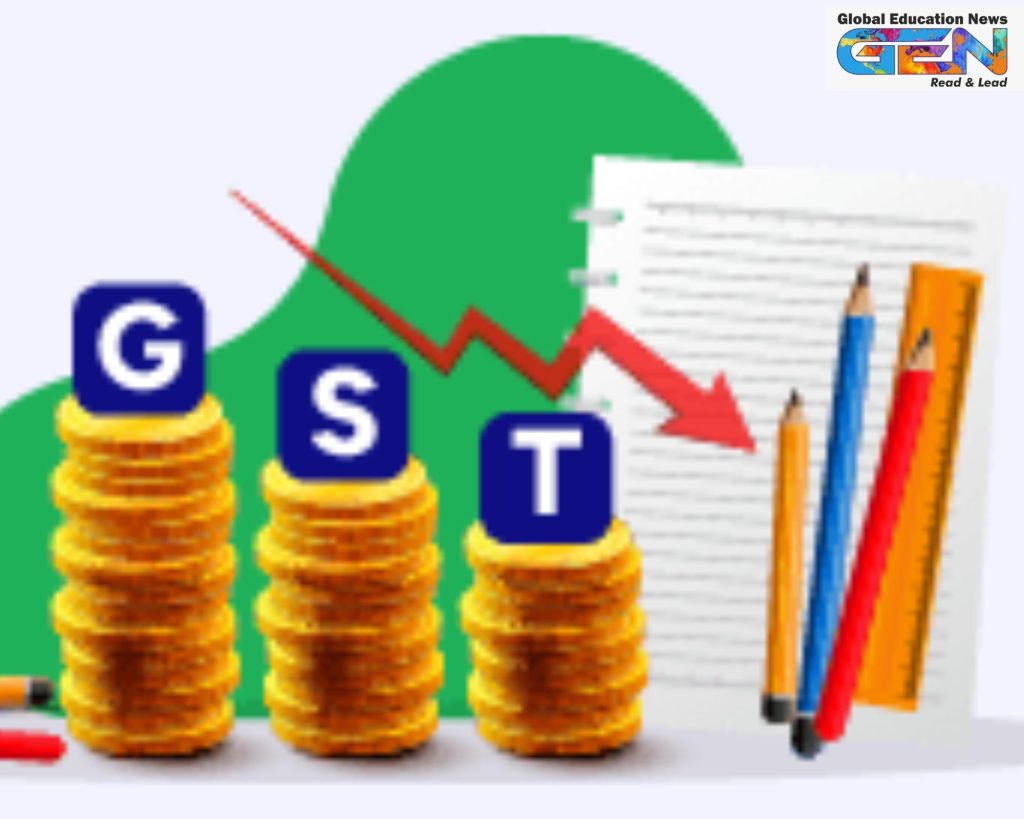
The Goods and Services Tax (GST) Council, in its 56th meeting on September 3, 2025, unveiled GST 2.0, a transformative tax reform effective from September 22, 2025. Announced by Union Finance Minister Nirmala Sitharaman, the new two-slab structure (5% and 18%, with a 40% demerit rate for luxury goods) significantly reduces costs for school stationery and educational materials, offering relief to parents and students preparing for CBSE board exams 2026 and other academic pursuits. However, school fees remain unaffected, leaving a mixed impact on education costs.
Key Points:
- Zero GST on notebooks, exercise books, graph books, lab notebooks, pencils, sharpeners, erasers, crayons, charcoal sticks, and chalk.
- 5% GST on geometry boxes, mathematical boxes, color boxes, and stationery pouches, down from 12%.
- Paper Tax Reduced: Uncoated paper/paperboard for notebooks and books now taxed at 12% (from 18%), lowering printing costs.
- No GST changes for school fees, but higher education and coaching remain at 18%.
This reform, hailed by PM Narendra Modi as “historic,” aims to ease financial burdens for families while supporting Atmanirbhar Bharat goals.
Stationery Gets Cheaper: A Boon for Students
The GST 2.0 reforms make school essentials more affordable, directly benefiting students preparing for Class 10 and 12 board exams, UPSC, NEET, and JEE. By slashing taxes on stationery items, the government is reducing the cost of education for millions of families.
Key Points:
- Zero GST Items: Notebooks, exercise books, graph books, lab notebooks, pencils, sharpeners, erasers, crayons, charcoal sticks, and chalk are now tax-free (previously 12%).
- 5% GST Items: Geometry boxes, mathematical boxes, color boxes, and stationery pouches/wallets reduced from 12% to 5%.
- Paper Cost Savings: Uncoated paper and paperboard, used in notebooks and textbooks, now taxed at 12% (down from 18%), potentially lowering book prices.
- Impact: Parents of young students, especially in primary and secondary schools, will save significantly on stationery costs.
These changes make essential learning tools more accessible, supporting students across CBSE, state boards, and competitive exam preparation.
School Fees Unchanged: What It Means for Parents
Despite the sweeping GST cuts, primary and secondary school fees remain exempt from GST, as they were before. However, higher education, professional coaching (e.g., for UPSC, NEET, JEE), and online courses continue to attract an 18% GST, offering no relief for students in these sectors.
Key Points:
- Primary Education: School fees for CBSE and state board schools remain GST-free, maintaining status quo.
- Higher Education and Coaching: Professional courses, coaching institutes, and online learning platforms are still taxed at 18%, impacting aspirants’ budgets.
- Indirect Benefits: Lower printing costs (due to reduced paper tax) may gradually reduce textbook prices, indirectly easing school expenses.
- No Fee Relief: Parents hoping for direct fee reductions will be disappointed, as the GST Council made no changes in this area.
This distinction highlights the need for students and parents to budget carefully for coaching and higher education costs.
Broader Economic Impact on Education
The GST 2.0 reforms, with an estimated fiscal impact of ₹48,000 crore, are expected to boost consumption by ₹5.31 lakh crore (~1.6% of GDP), potentially increasing funding for education and scholarships. The Confederation of Indian Industry (CII) praised the reforms for simplifying compliance and stimulating demand, which could indirectly benefit the education sector.
Key Points:
- Increased Affordability: Zero or 5% GST on stationery reduces back-to-school expenses, especially for low-income families.
- Economic Boost: Higher consumption may lead to more government investment in education infrastructure and student welfare programs.
- Coaching Industry: The 5% GST on gyms, yoga centers, and salons (down from 18%) could support student well-being, complementing efforts like Rajasthan’s coaching regulation bill.
- Long-Term Savings: Lower printing costs may reduce textbook prices over time, benefiting schools and students.
These reforms align with inclusive education goals, making learning materials more affordable while supporting economic growth.