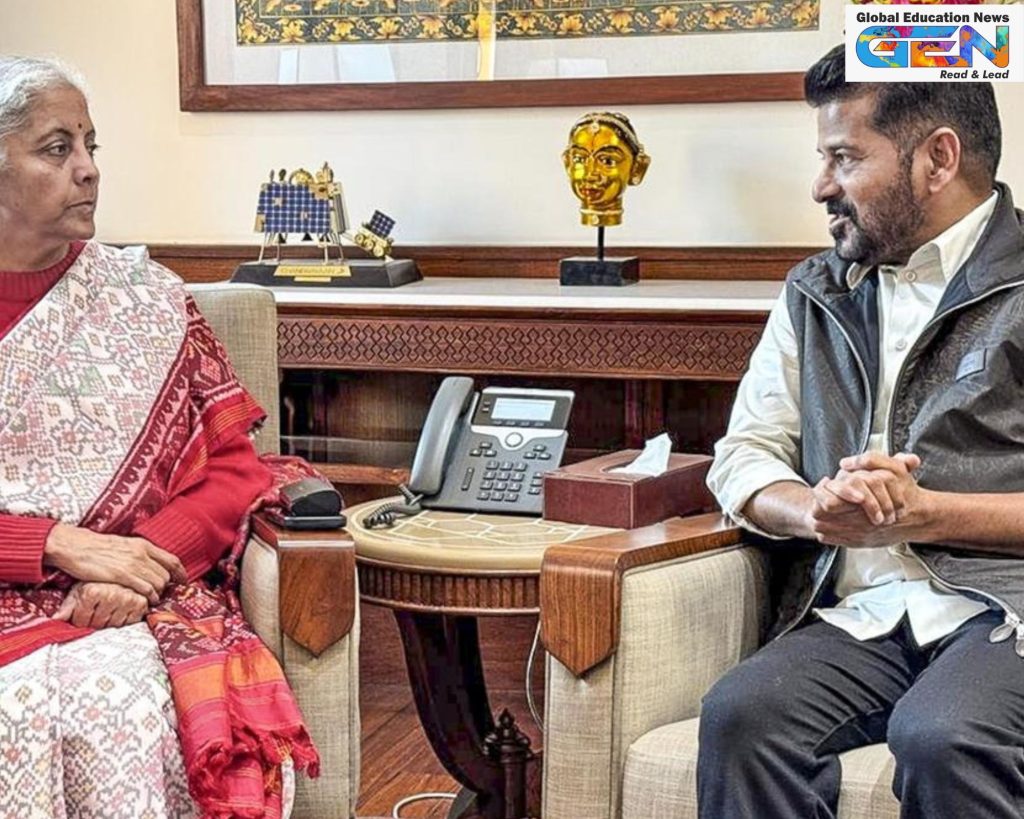
Telangana Chief Minister A Revanth Reddy has intensified the state’s advocacy for transformative education reforms by requesting ₹30,000 crore in funding from the Union government, exempt from fiscal borrowing ceilings. Raised during high-level meetings in New Delhi on December 16, 2025, with Union Finance Minister Nirmala Sitharaman and Education Minister Dharmendra Pradhan, these demands underscore education as a cornerstone of social equity and economic growth. Targeting Backward Classes, Scheduled Castes, Scheduled Tribes, and minorities—who constitute the state’s demographic majority—the proposals aim to establish premier institutions and upgrade infrastructure, positioning Hyderabad as a global education hub in tech, life sciences, and beyond.
Key Points:
- Strategic Timing: Discussions followed Reddy’s attendance at the AICC rally in Delhi since December 14, 2025, blending political outreach with policy advocacy.
- Core Philosophy: Reddy emphasized treating education investments as “long-term social and economic development” rather than mere expenditure, aligning with national goals like Viksit Bharat.
- Analytical Insight: This push reflects Telangana’s post-bifurcation challenges, where education spending (already 15-20% of state budget) seeks central leverage to scale impact amid fiscal constraints.
Key Demands: Funding and Institutional Expansions
Reddy’s agenda centers on a ₹30,000 crore infusion, split between residential schooling and higher education upgrades, alongside approvals for central institutions. The state proposes a special purpose vehicle for borrowings to sidestep Fiscal Responsibility and Budget Management (FRBM) limits, ensuring fiscal space for these initiatives.
Funding Breakdown
| Component | Allocation (₹ Crore) | Details and Beneficiaries |
|---|---|---|
| Young India Integrated Residential Schools | 21,000 | 105 schools (Classes V-XII) across constituencies; 2,560 students/school; direct admissions for ~270,000; resource hubs for lakhs more in nearby govt schools. |
| Higher Education Upgrades | 9,000 | Labs, infra in junior/degree colleges, technical institutes; enhances access to quality higher ed. |
| Total | 30,000 | Exempt from FRBM via special corporation. |
Institutional Proposals
- IIM in Telangana: 200 acres identified at University of Hyderabad; transit campus ready for immediate classes. Reddy quoted: “The Union govt has established 21 IIMs in 19 states and a Union Territory. There is a need to establish an IIM in Telangana also.” State to provide full support, leveraging Hyderabad’s connectivity and talent ecosystem.
- Kendriya Vidyalayas (KVs): 9 new ones in districts like Asifabad, Bhupalpally, Kamareddy, Gadwal, Narayanpet, Nagarkurnool, Suryapet, Vikarabad, and Nirmal.
- Jawahar Navodaya Vidyalayas (JNVs): 16 in areas including Hanumakonda, Malkajgiri, and Bhuvanagiri; state offers land and facilities.
Key Points:
- Equity Focus: Schools prioritize marginalized groups, with modern amenities like labs and sports to foster holistic development.
- Scale Potential: 105 campuses could serve 2.7 lakh directly, amplifying reach via resource-sharing.
- Analytical Insight: IIM demand taps Hyderabad’s “Silicon Valley of India” status, potentially adding 500-1,000 management seats annually, but requires central nod for branding and funding.
Union Response: Positive Signals, Pending Details
Sitharaman commended Telangana’s residential school model as innovative and sought specifics on the proposed special purpose corporation, signaling openness to dialogue. Pradhan received renewed pitches for KVs and JNVs, though no firm commitments emerged. This cautious positivity mirrors central-state dynamics, where education (Concurrent List) demands collaborative funding.
Key Points:
- Sitharaman’s Nod: Appreciation for “emphasis on education” hints at possible FRBM carve-outs, akin to past exemptions for infra projects.
- Pradhan’s Engagement: Discussions renewed long-pending proposals, with state readiness (land, permissions) easing approvals.
- Analytical Insight: Union’s response avoids outright promises amid fiscal prudence (post-COVID deficits), but aligns with NEP 2020’s equity push—expect phased sanctions by Budget 2026.
Background and Context: Telangana’s Education Reform Drive
Post-2014 bifurcation, Telangana has ramped up education outlays, establishing model schools and skill hubs amid urban-rural divides. The Young India initiative builds on this, envisioning integrated campuses as “academic resource centers” to bridge gaps. Hyderabad’s prowess in tech and aerospace underscores the IIM rationale, yet central institutions remain unevenly distributed (e.g., no IIM in Telangana despite 21 nationwide).
Key Points:
- Demographic Imperative: Marginalized communities form “majority” of population, driving inclusive reforms.
- Existing Momentum: State already invests heavily; central tie-ups could multiply impact without straining budgets.
- Analytical Insight: Proposals echo national schemes like Samagra Shiksha, but Telangana’s scale (105 schools) rivals entire states, highlighting southern pushback against perceived northern bias in allocations.
Challenges and Critical Insights: Navigating Fiscal and Equity Hurdles
While visionary, the demands face FRBM rigidity (3% deficit cap) and inter-state competition for central largesse. Infrastructure execution risks delays, as seen in past JNV rollouts (20% lag). Equity gains hinge on sustained monitoring to prevent elite capture.
Key Points:
- Fiscal Barriers: ₹30,000 crore exemption unprecedented; partial approvals (e.g., ₹10,000 crore tranche) more likely.
- Implementation Risks: Land acquisition smooth, but faculty shortages (national 25% vacancy) could hamper quality.
- Analytical Insight: Success could model for other states, boosting GDP via skilled workforce (projected 5-7% uplift), but failure risks widening urban-rural chasms—benchmark against Kerala’s 90%+ enrollment.