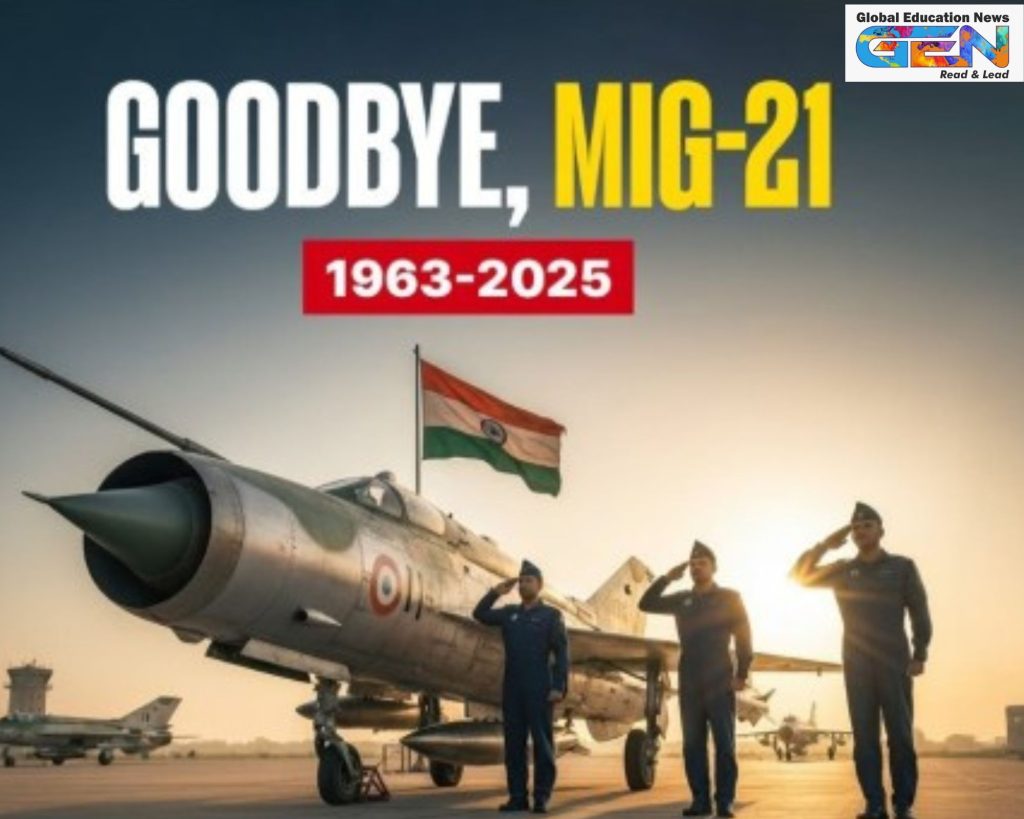
On September 26, 2025, the Indian Air Force (IAF) hosted a poignant farewell ceremony at Chandigarh Air Force Station for its last two MiG-21 squadrons—No. 23 “Panthers” and No. 3 “Cobras”—comprising 36 jets. Water cannon salutes and a majestic flypast marked the end of a 62-year saga for the Soviet-era icon, inducted in 1963 as India’s first supersonic fighter. Defense Minister Rajnath Singh called the MiG-21 “family members” of the IAF, honoring the “courage, sacrifice, and excellence” of its pilots. This retirement, delayed multiple times due to induction lags, leaves a void but paves the way for indigenous replacements like the Tejas.
Key Points:
- Ceremony featured solo sorties by Air Chief Marshal Amar Preet Singh, echoing his August flights from Nal Air Base.
- Over 700 MiG-21 variants procured, many built by Hindustan Aeronautics Limited (HAL); the Bison upgrade added modern avionics but couldn’t fix engine woes.
- Nicknamed “flying coffin” for over 480 crashes and 170+ pilot deaths, yet pilots like Air Marshal (Retd) Krishan Kumar “Timmy” Nohwar defend its reliability given intense usage.
- Last operational flights at Nal in August; Chandigarh event symbolized closure since the jet’s 1963 induction there.
A Storied Legacy: MiG-21’s Battlefield Heroics
The MiG-21 wasn’t just an aircraft—it was a symbol of India’s aerial grit. As the IAF’s premier interceptor, it spearheaded operations in the 1965 and 1971 Indo-Pak wars, the 1999 Kargil conflict, 2019 Balakot strikes, and 2025’s Operation Sindoor. Wing Commander Abhinandan Varthaman’s 2019 dogfight, downing a Pakistani F-16, immortalized it. Upgrades like the Bison variant integrated advanced weapons, making it a “bird of all seasons” per Air Vice Marshal (Retd) Arjun Subramaniam. Despite repurposing as trainers in the 1970s amid shortages, it trained generations of pilots.
Key Points:
- Key roles: 1965 war intercepts, 1971 strikes on Pakistani airfields, Kargil high-altitude ops, and recent precision missions.
- Design life: 20-25 years, extended to 62 due to delays; peaked at 60% of IAF fleet.
- Indo-Russian ties: Embodied enduring partnership, with local production boosting self-reliance.
- Pilot tributes: Squadron Leader Priya Sharma, India’s seventh woman fighter pilot, flew a formation sortie, calling it a “deserved farewell.”
Squadron Crunch: IAF’s 29 vs. Rivals’ Might
Post-retirement, IAF’s fighter squadrons stand at 29—down from a 1996 peak of 41 and below the sanctioned 42—equating to 464-522 jets. This near-parity with Pakistan’s 20-25 squadrons is alarming amid China’s 60+ (1,200+ aircraft). Older fleets like MiG-29, Jaguar, and Mirage 2000 face phase-out by 2035, potentially dropping IAF to 25 squadrons without swift inductions. The MiG-21’s exit exacerbates a decade-long depletion from crashes, obsolescence, and procurement hurdles.
Key Points:
- Sanctioned: 42 squadrons (756-840 jets); current: 29 (below 1965 war levels).
- Regional gap: Pakistan at 450 jets; China dominates with 2,000+ fighters.
- Future risk: Without action, strength could hit 25 by 2035, per ORF analysis.
- IAF goal: Expand beyond 42 to 60 by 2047 for two-front readiness.
Bridging the Gap: Air Defence Boosters on Horizon
To counter squadron shortfalls, IAF leans on missile shields like the Russian S-400 (inducted despite U.S. CAATSA threats) and indigenous Akashteer, tested in ops for automated air defense. These provide interim layered protection, buying time for fighter rebuilds amid global volatility.
Key Points:
- S-400: Long-range SAM system operational since 2021, enabling 300km+ engagements.
- Akashteer: Homegrown command-control network, integrating radars and missiles for real-time threats.
- Strategic shift: Emphasizes integrated air defense over sheer numbers.
- Global context: Enhances deterrence against China’s PLAAF and Pakistan’s modernizing PAF.
Indigenous Surge: Tejas Takes Center Stage
IAF’s homegrown hero, LCA Tejas Mk1, already fields two squadrons. A landmark $7 billion deal signed September 25, 2025, adds 97 Mk1A jets (68 single-seaters, 29 twin-seaters upgraded to Mk1A specs)—totaling 180 with the 2021 order of 83. Featuring AESA radar, EW suite, and Astra missiles, deliveries start mid-2025 despite GE engine delays. HAL targets 16 annually, aiming for full rollout by mid-2030s.
Key Points:
- Mk1A upgrades: EL/M-2052 AESA (or Uttam), DFCC Mk1A, indigenous weapons integration.
- Timeline: First deliveries 2025; trainers with Mk1A avionics for advanced training.
- Production: HAL-GE co-production of F414 engines to hit 98kN thrust.
- Impact: Directly replaces MiG-21s, boosting self-reliance to 75-85%.
Global Hunt: MRFA’s 114-Jet Quest
The Multi-Role Fighter Aircraft (MRFA) program eyes 114 jets via government-to-government deals, with Dassault Rafale as frontrunner. Bids reopen in 2025, potentially skipping tenders for urgency—initial flyaways from France, rest co-produced in India. Contenders include F-35 (U.S.), Eurofighter, Gripen, and Su-57; F-15EX eyes entry. Acceptance of Necessity by October 2025 aims for 4-5 year inductions.
Key Points:
- Deal value: $20-25 billion; 50-60% local manufacturing with tech transfer.
- Rafale edge: Proven in Balakot/Sindoor; G2G route fast-tracks amid squadron crisis.
- Alternatives: U.S. F-35 pitched by Trump; Russia eyes Su-57 co-production during Putin’s September visit.
- Timeline: Bids 2025; deliveries by 2030 to stem depletion.
Stealth Horizon: AMCA’s Ambitious Roadmap
India’s fifth-gen dream, Advanced Medium Combat Aircraft (AMCA), enters prototype phase with a 10-year plan: rollout late 2026/early 2027, first flight 2028, certification 2032, induction 2034. Five prototypes target stealth, AI avionics, and internal bays; 75% indigenous content rising to 85%. France-India engine JV (₹61,000 crore) powers Mk2 variant.
Key Points:
- Specs: 25-tonne stealth jet with GE F414 (later co-developed 110kN engine).
- Development: Full-scale model at Aero India 2025; open bidding for HAL/private firms.
- IAF plan: 125 jets (7 squadrons); naval variant explored.
- Challenges: Engine tech transfer; aligns with 2042 full indigenization goal.
Super-30 and Beyond: Upgrading the Backbone
To extend lifespans, 84 Su-30MKI jets get Super-30 upgrades (avionics, radar) over 15 years, starting early 2025. This, plus Tejas and MRFA, aims for 35-36 squadrons by mid-2030s—still short of 42 without AMCA.
Key Points:
- Super-30: 5-7 year upgrade post-testing; enhances AESA, EW for two-front ops.
- Broader push: Private sector role in production; ₹66,000 crore Tejas infusion.
- Delays’ toll: MMRCA scrap (2015) and engine bottlenecks from GE.
- Vision: 60 squadrons by 2047 via indigenous focus.