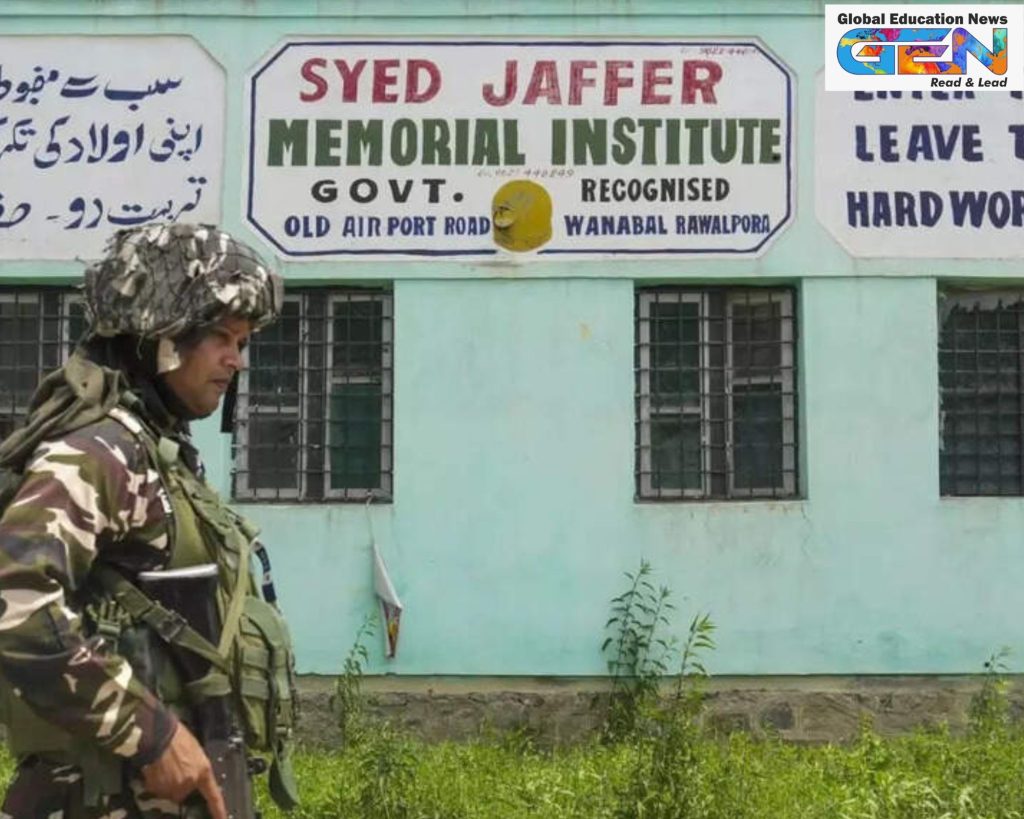
On August 23, 2025, the Jammu and Kashmir (J&K) government initiated a controversial takeover of 215 schools affiliated with the banned Jamaat-e-Islami (JeI) and its educational wing, Falah-e-Aam Trust (FAT), across 10 districts of the Kashmir Valley. Aimed at safeguarding the academic future of over 51,000 students, the move has sparked sharp criticism from opposition parties, who label it as “undemocratic” and an “assault on J&K’s identity.” Education Minister Sakina Itoo clarified that the takeover is temporary, pending the formation of new management committees, but the decision has fueled political tensions and raised questions about its execution and intent. Here’s a comprehensive look at the takeover, its rationale, and its broader implications.
The Takeover: A Swift and Coordinated Operation
The J&K School Education Department issued an order on August 22, 2025, directing the temporary takeover of 215 schools linked to JeI and FAT, citing their affiliations with a banned organization and expired or adversely reported management committees. The process began the next day, with teams of district officials, police, and principals from nearby government schools assuming control.
Key Points:
- Date and Scope: The takeover started on August 23, 2025, covering 215 schools across 10 Kashmir districts, impacting over 51,000 students and hundreds of teachers.
- Process: Administrative teams, accompanied by police, checked documents, infrastructure, and interacted with staff, ensuring a “peaceful and smooth” transition without disrupting classes.
- Objective: To align schools with National Education Policy (NEP) 2020 norms and prevent deregistration due to management issues, safeguarding students’ academic futures.
- Management Shift: District Magistrates/Deputy Commissioners were initially tasked to oversee the schools, but Minister Itoo clarified that principals of nearby government schools would manage them temporarily.
Rationale: Security Concerns and Student Welfare
The government justified the takeover based on intelligence reports linking the schools to JeI, banned under the Unlawful Activities (Prevention) Act (UAPA) in 2019 and 2024 for alleged secessionist activities. The schools’ managing committees, established by FAT since 1972, faced “negative” Criminal Investigation Department (CID) verifications over the past six to eight years, leaving them without valid oversight.
Key Points:
- Security Concerns: Intelligence agencies flagged the schools for direct or indirect ties to JeI, raising fears of radical influence. The BJP’s J&K spokesman, Altaf Thakur, praised the move as a step to shield students from “separatist narratives.”
- Student Challenges: Students faced issues with board exam registrations due to the schools’ lack of valid management, prompting government intervention.
- Temporary Measure: Minister Itoo emphasized that the takeover is interim, with new committees to be formed within three months after CID verification.
- Support from Staff: Teachers like Mohammad Ishaq from Hanfia Islamia Institute in Anantnag welcomed the move, citing streamlined operations and past precedents in the 1980s.
Political Backlash: A Storm of Criticism
The takeover triggered widespread condemnation from opposition parties, including the Peoples Democratic Party (PDP), Peoples Conference, Apni Party, and Justice and Development Front (JDF), who accused the Omar Abdullah-led National Conference (NC) government of overreach and aligning with the BJP’s agenda.
Key Points:
- PDP’s Stance: PDP president Mehbooba Mufti called the move an “assault on J&K’s identity,” praising FAT schools for providing affordable, quality education to the poor. She criticized the NC for acting against public interests.
- Peoples Conference: Leader Sajad Lone labeled the takeover an act of “unimaginable servility,” accusing the NC of enabling anti-Kashmiri policies.
- Apni Party: Chief Altaf Bukhari argued that the government could have regulated the schools instead of seizing control, calling the move “unjustified.”
- JDF’s Response: The JeI-backed JDF denounced the takeover as a “painful reminder of NC’s history of betrayal,” urging its immediate reversal to ensure uninterrupted education.
Controversy Over the Order: Itoo’s Clarification
Education Minister Sakina Itoo distanced herself from the official order issued by Ram Niwas Sharma, the School Education Department Secretary, claiming it was “distorted.” She asserted that her approved draft intended for principals, not District Magistrates, to oversee the schools temporarily, hinting at possible bureaucratic interference.
Key Points:
- Order Discrepancy: Itoo claimed the order misaligned with her approval, which focused on cluster principals managing the schools, not Deputy Commissioners.
- Temporary Arrangement: She emphasized that the government would return management to new committees post-CID verification within three months.
- Political Friction: Itoo’s remarks suggest tension with the Lieutenant Governor’s administration, as Sharma reports to the LG. She avoided directly accusing him but noted, “You should ask him.”
- Public Sentiment: X posts reflect polarized views, with some like @dr_firdousbaba praising the move for transparency and NEP compliance, while others like @Kashmir_Clarity highlight concerns about past radicalization in these schools.
Impact on Students and Teachers
The takeover affects over 51,000 students and hundreds of teachers, raising concerns about operational continuity and future management. While the government assures no disruption to education, parents and staff remain uncertain about fee structures and new committee formations.
Key Points:
- Student Continuity: The government pledges to maintain academic schedules, with principals ensuring NEP-compliant education.
- Teacher Perspectives: Some teachers, like Mohammad Ishaq, see streamlined operations, while others, like a Budgam teacher, expressed concerns about unclear fee collection and management nomination processes.
- Parent Concerns: Parents worry about the lack of clarity on fees and long-term management, fearing disruptions for their children.
- Positive Feedback: Student Aliya Irshad from Anantnag believes the move will improve school operations and staff welfare.
Historical Context: JeI and FAT’s Role
The Falah-e-Aam Trust, established in 1972 by JeI, has been a cornerstone of affordable education in J&K, serving the poorest communities with a blend of modern, moral, and Islamic education. Despite its contributions, JeI’s ban in 2019 and 2024 under UAPA, following the Pulwama attack, led to scrutiny of its 300+ schools, with 215 flagged for adverse reports.
Key Points:
- FAT’s Legacy: Produced notable professionals like doctors and engineers, with a reputation for quality education at minimal cost.
- Ban and Crackdown: JeI’s 2019 ban led to arrests of its leaders and closure attempts in 2022, with 50 schools cleared and 215 now targeted.
- Political Sensitivities: The takeover reignites debates over J&K’s cultural and educational autonomy, with opposition parties accusing the NC of aligning with central policies.
Broader Implications: Education and Politics in J&K
The takeover aligns with NEP 2020 goals but raises questions about balancing security, education, and regional identity. While the government aims to protect students, critics argue it risks alienating communities and disrupting a well-established educational network.
Key Points:
- NEP Alignment: The takeover ensures compliance with national education standards, potentially improving board exam access.
- Political Fallout: Opposition parties warn of eroded public trust in the NC, with Mufti and Lone framing it as a betrayal of Kashmiri interests.
- Security vs. Education: The move reflects tensions between curbing radicalization and preserving educational access, with 51,000 students caught in the crossfire.
- Future Steps: The government must form verified management committees within three months to restore normalcy, or risk further backlash.