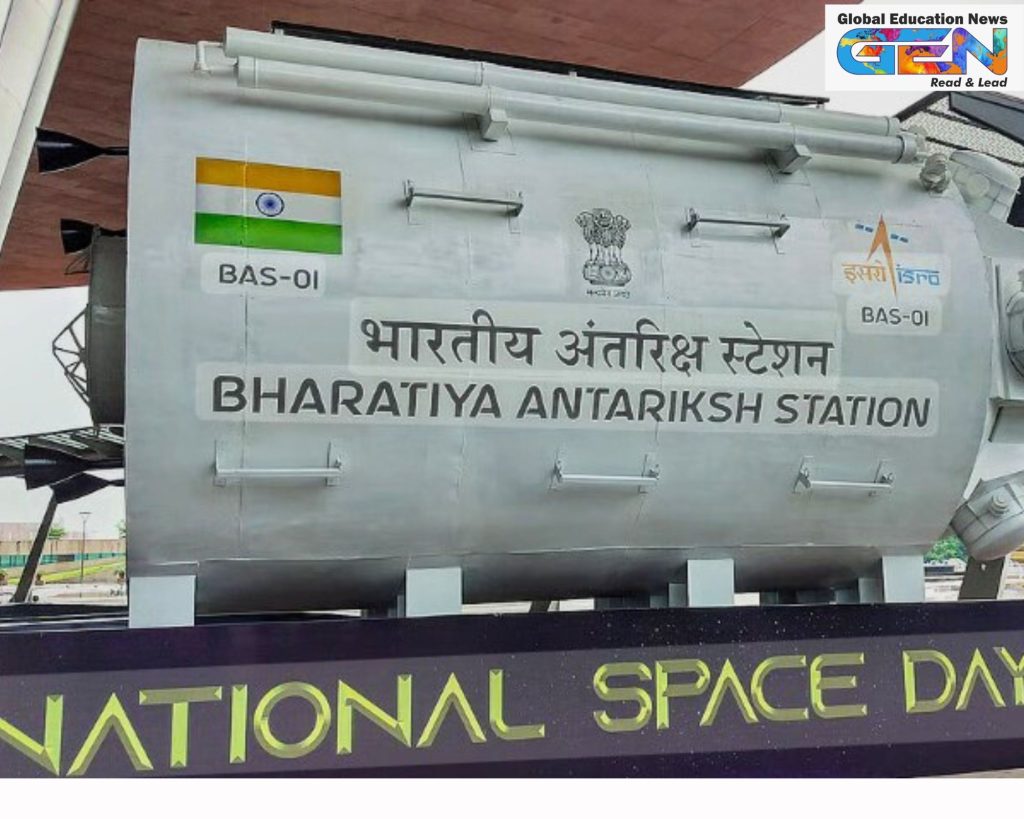
On August 22, 2025, the Indian Space Research Organisation (ISRO) unveiled a 1:1 scale model of the Bharatiya Antariksh Station (BAS-01) module at Bharat Mandapam, New Delhi, during the National Space Day celebrations. This event, marking the second anniversary of the Chandrayaan-3 lunar landing on August 23, 2023, showcased India’s ambitious plan to launch its first home-built space station module by 2028 and complete a five-module orbital laboratory by 2035. The BAS positions India among an elite group of nations, joining the International Space Station (ISS) and China’s Tiangong as operators of orbital labs.
Key Points:
- BAS-01 model unveiled on August 22, 2025, at Bharat Mandapam.
- First module launch planned for 2028, full station operational by 2035.
- India joins the US-led ISS and China’s Tiangong as a space station operator.
BAS-01: A Technological Marvel
The BAS-01 module, weighing 10 tonnes and designed to orbit at 450 km in Low Earth Orbit (LEO), is a testament to India’s indigenous technological prowess. Measuring 3.8 meters in diameter and 8 meters in length, it incorporates advanced features to support human presence and scientific research:
- Indigenous Systems: Includes the Environmental Control and Life Support System (ECLSS), Bharat Docking System, Bharat Berthing Mechanism, and automated hatch systems.
- Research Platform: Designed for microgravity research, technology demonstrations, and scientific imaging via crew viewports.
- Crew Support: Features space suits, airlocks for extravehicular activities, and plug-and-play avionics.
- Safety and Sustainability: Equipped with propulsion and ECLSS fluid refilling, radiation protection, thermal shielding, and Micro Meteoroid Orbital Debris (MMOD) protection.
These features enable BAS to support long-term human missions, making it a versatile platform for space science and commercial ventures.
Key Points:
- BAS-01: 10-tonne module, 3.8m x 8m, orbiting at 450 km.
- Features indigenous ECLSS, docking systems, and airlocks.
- Supports microgravity research and crew safety with advanced protections.
National Space Day: Celebrating India’s Space Legacy
National Space Day, celebrated annually on August 23, commemorates the Chandrayaan-3 mission, which made India the first nation to land near the Moon’s south pole in 2023. The 2025 celebrations, themed around the Bharatiya Antariksh Station, highlighted India’s transition from lunar triumphs to orbital ambitions. ISRO Chairman V. Narayanan announced plans for the Chandrayaan-4 mission, a Venus Orbiter Mission, and a Moon landing by 2040, reinforcing India’s global leadership. Prime Minister Narendra Modi, addressing the event virtually, praised India’s scientists and highlighted Group Captain Shubhanshu Shukla’s Axiom-4 mission, where he hoisted the tricolor at the ISS.
Key Points:
- Celebrates Chandrayaan-3’s 2023 lunar landing on August 23.
- 2025 theme focuses on BAS and India’s orbital aspirations.
- PM Modi lauds Shubhanshu Shukla’s ISS mission and India’s space vision.
BAS: A Hub for Research and Space Tourism
The Bharatiya Antariksh Station will serve as a multifaceted platform for:
- Scientific Research: Studying space sciences, life sciences, medicine, and interplanetary exploration, with a focus on microgravity’s effects on human health.
- Technology Testing: Validating systems for long-duration space missions, critical for future lunar and Martian explorations.
- Space Tourism: Enabling India’s entry into the commercial space sector by leveraging BAS resources for tourism and private ventures.
- International Collaboration: Fostering partnerships with global space agencies, building on India’s role in missions like Axiom-4.
The station is expected to inspire young Indians to pursue careers in space science and technology, strengthening India’s talent pipeline.
Key Points:
- BAS to support microgravity research, space tourism, and global collaboration.
- Studies human health and tests technologies for deep-space missions.
- Aims to inspire youth to join India’s space sector.
India’s Space Ambitions: A Global Power by 2035
By launching BAS-01 in 2028 and completing the five-module station by 2035, India aims to become the third nation with an independent space station, following the US-led ISS and China’s Tiangong. The project aligns with ISRO’s broader goals, including the Gaganyaan mission (first uncrewed launch in December 2025) and a lunar landing by 2040. The Next Generation Launcher (NGL), approved by PM Modi, will support these missions. The BAS-01 model, a 3.8m x 8m centerpiece at Bharat Mandapam, captivated attendees, symbolizing India’s growing stature in the global space economy.
Key Points:
- India to be the third nation with an independent space station by 2035.
- Supports Gaganyaan, Chandrayaan-4, and Venus Orbiter Mission.
- NGL approval enhances India’s launch capabilities.
Challenges and Future Steps
Building the BAS faces challenges like technological complexity, funding, and international coordination. Developing indigenous systems like the ECLSS and ensuring crew safety in LEO require significant investment and expertise. ISRO is addressing these through partnerships with organizations like Hindustan Aeronautics Limited (HAL) and DRDO, alongside global collaborations. The success of Gaganyaan’s uncrewed mission in December 2025 will pave the way for BAS-01’s launch, with ISRO planning rigorous testing to meet the 2028 deadline.
Key Points:
- Challenges: Technological complexity, funding, and global coordination.
- Partnerships with HAL, DRDO, and international agencies.
- Gaganyaan’s success critical for BAS-01’s 2028 launch.