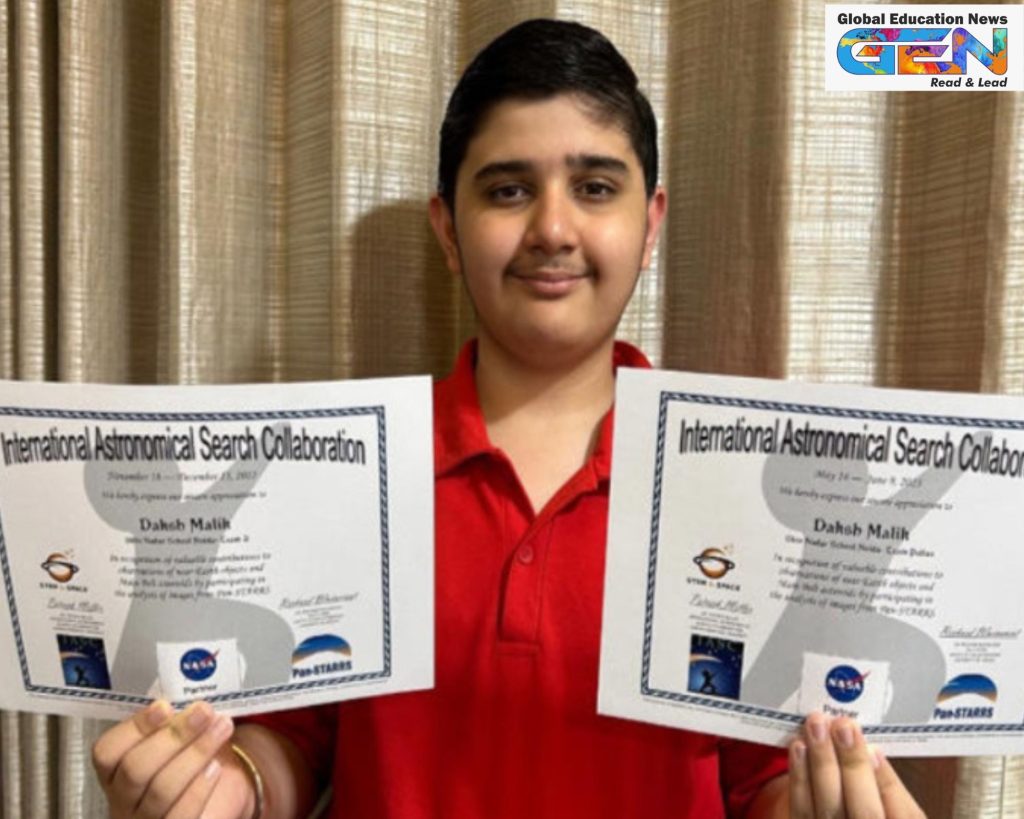
In a remarkable achievement, Daksh Malik, a 14-year-old Class 9 student from Shiv Nadar School, Noida, has earned global recognition for discovering an asteroid through NASA’s International Asteroid Discovery Project (IADP). The asteroid, temporarily named 2023 OG40, lies in the main asteroid belt between Mars and Jupiter. Confirmed as a “Provisional Discovery of a Main Belt Asteroid” by NASA, Daksh now awaits the chance to name this celestial body, a process that could take 4–5 years. His journey, fueled by childhood curiosity and rigorous analysis, highlights the power of citizen science and inspires students worldwide to explore the cosmos.
Key Highlights:
- Discovery: Asteroid 2023 OG40, identified in 2023 via IADP.
- Recognition: Daksh is the sixth Indian student to achieve this feat, joining an elite group of young astronomers.
- Naming Rights: Pending NASA’s verification, Daksh will propose a name, considering options like “Countdown” or “Destroyer of the World.”
Daksh’s Journey: From Stargazing to Stardom
Daksh’s fascination with space began early, sparked by National Geographic documentaries and hours of stargazing. His passion found a platform in 2022 when Shiv Nadar School’s astronomy club shared an opportunity to join the IADP, a NASA-affiliated citizen science initiative under the International Astronomical Search Collaboration (IASC). Alongside two classmates, Daksh spent 18 months analyzing datasets, submitting six preliminary detections before NASA confirmed 2023 OG40.
Key Milestones:
- Early Interest: Inspired by documentaries on planets and the solar system, Daksh joined his school’s astronomy club to deepen his knowledge.
- IADP Participation: In 2022, he began analyzing Pan-STARRS telescope data from Hawaii using Astrometrica software, hunting for moving objects with asteroid-like light emissions.
- Breakthrough: After persistent efforts, one of his detections was confirmed as a main belt asteroid, earning NASA’s provisional recognition.
Quote: “I’ve been fascinated with space since I was little. This is like a dream come true,” Daksh told The Print.
The International Asteroid Discovery Project: A Gateway for Students
The IADP, run by STEM and Space in collaboration with the IASC, engages over 6,500 participants from 80+ countries annually, offering students and amateurs access to real astronomical data. Using images from telescopes like Pan-STARRS and Catalina Sky Survey, participants analyze datasets to identify potential asteroids. Daksh’s success underscores the program’s role in democratizing space exploration.
How It Works:
- Data Access: Participants receive high-quality telescope images to analyze for moving objects.
- Software Tools: Tools like Astrometrica help detect asteroid-like motion and brightness, requiring meticulous calibration.
- Verification Process: Preliminary detections are submitted to NASA, which conducts further observations. The Minor Planet Centre (MPC) grants provisional status, with final naming approved by the International Astronomical Union (IAU) after 4–5 years.
Impact: Only a few participants, including Daksh and five other Indian students, have discovered named asteroids, making this a rare honor.
How to Join the IADP: A Guide for Aspiring Astronomers
Inspired by Daksh’s achievement? The IADP is free and open to students and enthusiasts worldwide. Here’s how you can participate:
Steps to Join:
- Form a Team: Gather friends or classmates to collaborate (solo participation is also possible).
- Register: Sign up via the IASC website by emailing a registration form to Coordinator Cassidy Davis at iascsearch@cisco.edu.
- Train on Astrometrica: Learn to use Astrometrica software for analyzing telescope data (training provided by IASC).
- Join a Campaign: Enroll in an International Asteroid Search Campaign (held regularly) to access datasets.
- Analyze Data: Use software to identify moving objects with asteroid-like characteristics and submit detections to NASA.
- Await Verification: If confirmed, your discovery earns provisional status, with naming rights after full verification (4–5 years).
Requirements:
- A Windows computer with internet access.
- Basic knowledge of astronomy (training provided).
- Patience and persistence, as only a few detections lead to confirmed discoveries.
Why Asteroids Matter: Unlocking Cosmic Secrets
Asteroids, rocky remnants from the solar system’s formation 4.6 billion years ago, offer clues to planetary origins. Most reside in the asteroid belt between Mars and Jupiter, with Vesta (530 km wide) being the largest. Some, like Near-Earth Objects (NEOs), stray closer, posing potential risks but also opportunities for study and resource mining. Daksh’s discovery, 2023 OG40, contributes to mapping these ancient bodies.
Significance:
- Scientific Value: Asteroids reveal the solar system’s early conditions, aiding research on planetary formation.
- Planetary Defense: Tracking NEOs helps predict and mitigate collision risks (e.g., NASA’s DART mission).
- Economic Potential: Asteroids hold metals and minerals, with future mining projected to be a $1 trillion industry by 2040.
Daksh’s Naming Dilemma and Future Aspirations
Daksh is brainstorming names for 2023 OG40, considering playful options like “Countdown” or “Destroyer of the World”, though he may opt for a name inspired by Greek mythology to align with IAU guidelines. The naming process awaits NASA’s rigorous verification, involving multiple observations to confirm the asteroid’s orbit and characteristics.
Daksh’s Ambitions:
- Dual Passions: While astronomy excites him, Daksh’s primary interest lies in law and judiciary, aiming to blend his love for process-driven challenges with cosmic curiosity.
- Inspiration: His mother, Sappna Kapur, notes his focus on the journey over results, a mindset that drove his persistence.