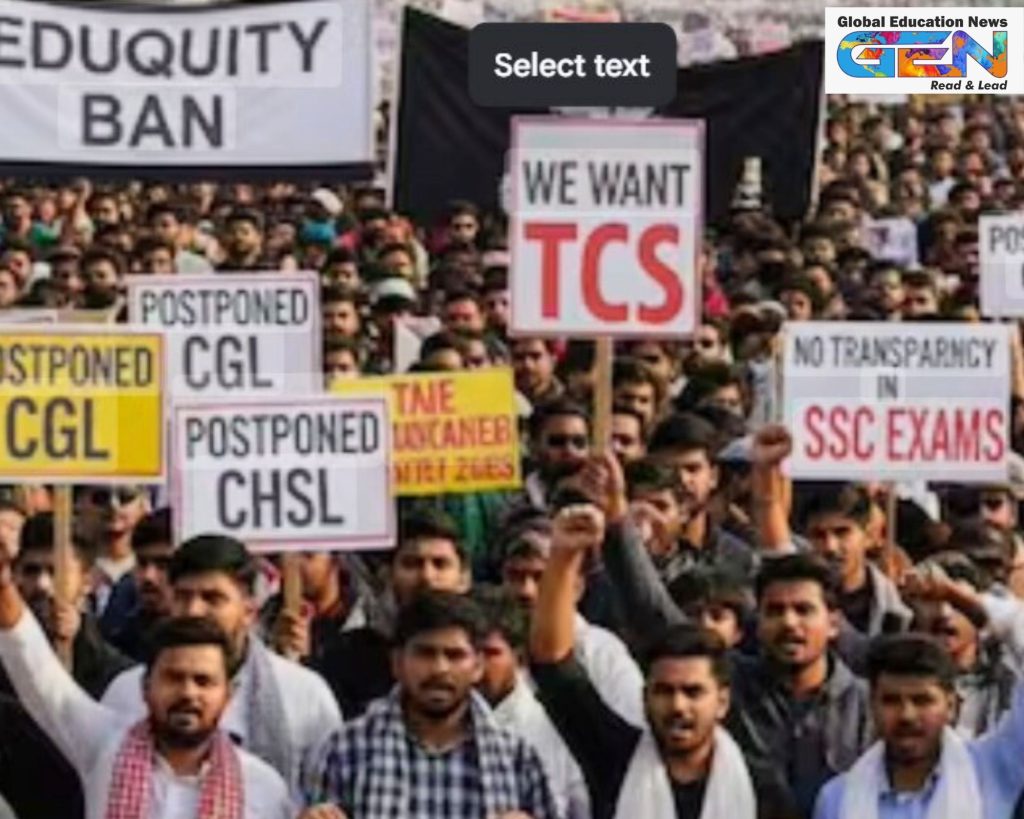
The Staff Selection Commission (SSC) Selection Post Phase 13 exam, conducted from July 24 to August 1, 2025, has sparked widespread protests across India due to alleged mismanagement, technical glitches, exam cancellations, and suspected paper leaks. Thousands of students and educators have taken to the streets, from Patna to Delhi, with protests peaking at Jantar Mantar under the “Delhi Chalo” banner. Social media platforms, particularly X, have amplified the unrest with hashtags like #SSCMisManagement and #SSCVendorFailure trending nationally. Students are demanding transparency, accountability, and systemic reforms to ensure fair recruitment processes.
- Key Points:
- Protests erupted over cancellations, technical failures, and alleged paper leaks in SSC Phase 13 exams.
- Over 55,000 grievances filed, highlighting systemic issues in exam management.
- Students fear for the upcoming SSC CGL 2025 exam with 30 lakh candidates.
What is the SSC Phase 13 Exam?
The SSC Selection Post Phase 13 is a direct recruitment exam for Group C and D posts in various Indian government ministries and organizations. It targets candidates with qualifications ranging from 10th to graduate level for roles like Data Entry Operator, Clerk, Lab Assistant, Technical Operator, Store Keeper, Junior Engineer, Research Assistant, and Junior Stenographer.
- Exam Structure:
- Computer-Based Test (CBT) with 100 MCQs covering Quantitative Aptitude, Reasoning, English Language, and General Knowledge.
- Duration: 60 minutes.
- Significance:
- Offers Grade B and C posts, some with salaries of ₹70,000–₹90,000, making it a critical opportunity for aspirants.
Issues Fueling the Protests
The SSC Phase 13 exam faced widespread disruptions, leading to accusations of systemic failure by the SSC and its new vendor, Eduquity Career Technologies. Key issues include:
- Technical Glitches:
- Server crashes, unresponsive systems, and malfunctioning equipment (e.g., computer mice, keyboards) disrupted exams.
- Example: At Educasa International, Hubballi, the first shift on July 24 was canceled due to technical issues.
- Exam Cancellations:
- Abrupt cancellations at centers like Pawan Ganga Educational Centre 2 (July 24–26) and others in Ghaziabad, Lucknow, and Bhopal left students stranded after traveling 500–1,000 km.
- Cancellations often announced without prior notice, wasting time and money.
- Improper Center Allocation:
- Candidates were assigned centers in remote or unsafe locations, such as a Jaipur student allotted a center in the Andaman and Nicobar Islands.
- Many centers were hundreds of kilometers from candidates’ hometowns, adding financial and logistical burdens.
- Alleged Paper Leaks and Malpractices:
- Students reported invigilators using mobile phones during exams, violating rules, and raising suspicions of paper leaks.
- Social media posts allege a blacklisted vendor (Eduquity) with a history of mismanagement was chosen, fueling distrust.
- Poor Infrastructure and Mistreatment:
- Exam centers lacked basic amenities like fans, functional seating, and safe conditions, with some reporting livestock near venues.
- Allegations of bouncers and security personnel manhandling candidates who raised concerns.
- A viral video showed differently-abled candidates and teachers facing police lathi-charge at Jantar Mantar.
- Key Points:
- Over 55,000 complaints highlight the scale of disruptions.
- New vendor Eduquity criticized for poor track record, replacing TCS.
- Students report mental distress and financial losses due to mismanagement.
Student and Educator Voices
Candidates and educators have voiced frustration over the SSC’s handling of the exam:
- Candidate Raman (to Lallantop): “Invigilators were using mobile phones during exams, receiving calls, and saying, ‘I’m in the exam, I’ll talk later.’ This is the state of exams for Grade B posts.”
- Candidate Shekhar: “My mouse stopped working 10 minutes into the exam. I had prepared well, but this could ruin my chance. How can SSC manage such critical exams like this?”
- Neetu Singh (Educator): “We wanted a meeting with DoPT officials, not a protest. Students have faced these issues for years, and exams are not conducted fairly.”
- Social Media Outrage:
- “Dear SSC, our dreams are not a joke! Technical failures, paper leaks, and mismanagement are destroying years of hard work.” – Rahul Kushwaha (@rk91440336)
- “Students are suffering due to repeated cancellations & poor infrastructure. We demand immediate action & accountability.” – Neetu Singh (@NeetuSingh202)
Protests and Demands
The “Delhi Chalo” protest on July 31, 2025, at Jantar Mantar and the CGO Complex saw thousands of aspirants and educators, including NSUI president Varun Choudhary, demanding:
- Independent Investigation: A CBI probe into alleged paper leaks and vendor selection.
- Vendor Accountability: Review or cancellation of Eduquity’s contract due to its alleged history of failures.
- Systemic Reforms:
- Transparent grievance redressal mechanism.
- Proximity-based center allocation to reduce travel burdens.
- Compensation for financial losses due to cancellations.
- Enhanced Infrastructure: Backup systems, functional equipment, and safe exam conditions.
- Fair Recruitment Process: Timely communication, standardized procedures, and anti-leak measures.
- Key Points:
- Protests spread to cities like Patna, Bhopal, and Lucknow, with 55,000+ grievances filed.
- Police action, including detentions and lathi-charge, intensified outrage.
- Political leaders like Rahul Gandhi and Chandrashekhar Azad support the movement, criticizing government negligence.
SSC’s Response
SSC Chairman S Gopalakrishnan addressed the concerns on August 3, 2025, stating:
- The shift to Eduquity was due to a Supreme Court mandate preventing reliance on a single agency like TCS.
- Technical issues were acknowledged, with assurances to minimize disruptions in future exams.
- Center allocation issues were attributed to students selecting distant centers or limited availability, though this claim was disputed.
- C-DAC is now monitoring exams to ensure transparency.
- No formal statement has addressed paper leak allegations or vendor blacklisting claims.
- Key Points:
- SSC denies hiring a blacklisted vendor, claiming a transparent selection process.
- Rescheduling of canceled exams began on July 28, but communication remains inadequate.
- Concerns persist for the SSC CGL 2025 exam starting August 13.
Broader Implications
The SSC Phase 13 protests highlight a crisis of trust in India’s recruitment system, with implications for the SSC CGL 2025 exam, expected to involve 30 lakh candidates. Critics, including Rahul Gandhi, argue that over 85 lakh students have been affected by exam irregularities in 2025, including NEET and UGC-NET. The controversy raises questions about the privatization of exam services and the government’s ability to conduct fair, glitch-free exams.
- Key Points:
- Protests underscore systemic issues in exam management, impacting youth employment.
- Education experts call for a centralized exam calendar and anti-leak laws.
- Ongoing unrest could affect SSC’s credibility if reforms are not implemented.
Conclusion: A Call for Urgent Reform
The SSC Phase 13 exam protests reflect the frustration of lakhs of aspirants whose dreams of government jobs are jeopardized by mismanagement, technical failures, and alleged malpractices. With over 55,000 complaints and a nationwide movement, the SSC faces pressure to deliver transparent, fair, and efficient exams. As the SSC CGL 2025 looms, immediate reforms, including vendor accountability, better infrastructure, and clear communication, are critical to restoring trust and ensuring justice for India’s youth.