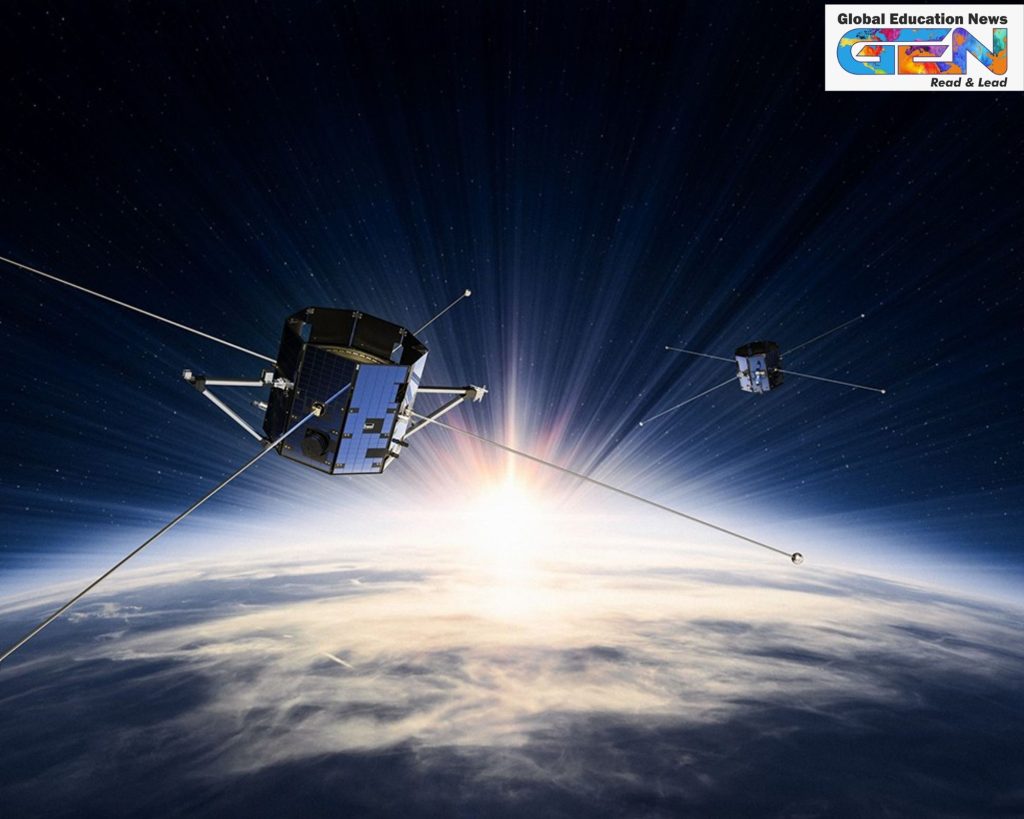
NASA’s TRACERS (Tandem Reconnection and Cusp Electrodynamics Reconnaissance Satellites) mission blasted off on July 23, 2025, from Vandenberg Space Force Base, California, aboard a SpaceX Falcon 9 rocket. This $170 million mission is set to decode the explosive process of magnetic reconnection, where the Sun’s magnetic field collides with Earth’s, unleashing energy bursts that spark auroras and threaten technology. By studying these interactions, TRACERS aims to shield our planet’s critical systems from the chaos of space weather.
- Launched July 23, 2025, on a SpaceX Falcon 9 from Vandenberg Space Force Base, California.
- Twin satellites study magnetic reconnection in Earth’s polar cusps.
- Aims to protect satellites, GPS, and power grids from solar storms.
Zooming In on Magnetic Reconnection
Key Points:
- Focuses on polar cusps, funnel-shaped gaps in Earth’s magnetic field near the North Pole.
- Satellites fly 10 seconds apart to capture rapid changes in reconnection events.
- Will collect 3,000 measurements over one year for unprecedented insights.
Picture two satellites, each the size of a washing machine, racing through Earth’s magnetic gateways at 16,000 mph! TRACERS’ twin spacecraft, orbiting at 367 miles (590 km) above Earth, zoom through the polar cusps—regions where the Sun’s solar wind sneaks past Earth’s magnetic shield. By flying just 10 seconds apart, they capture real-time data on how magnetic field lines snap and reconnect, flinging particles at near-light speeds. With 3,000 measurements planned in a year, TRACERS will map how these events evolve, offering clues to predict disruptive space storms.
Why Space Weather Matters
Key Points:
- Solar storms can disrupt satellites, GPS navigation, and power grids.
- May 2024’s geomagnetic storm caused flight rerouting and GPS failures.
- TRACERS data will improve space weather forecasting for global safety.
Space isn’t just a silent vacuum—it’s a battleground of charged particles! Magnetic reconnection fuels stunning auroras but also powers geomagnetic storms that can wreak havoc. In May 2024, the strongest storm in 20 years disrupted high-voltage power lines, trans-Atlantic flights, and GPS-guided tractors. TRACERS’ mission is to understand these events, helping countries like India, reliant on ISRO satellites for navigation and weather forecasting, protect vital infrastructure and prepare for future space exploration.
Cutting-Edge Tech in Action
Key Points:
- Each satellite carries instruments to measure electric/magnetic fields, ions, and electrons.
- Built by Millennium Space Systems with contributions from University of Iowa, UCLA, and UC Berkeley.
- Four-week commissioning phase began post-launch on July 23, 2025.
TRACERS isn’t just a pair of satellites—it’s a flying laboratory! Each spacecraft, weighing under 440 pounds, is packed with ultra-sensitive instruments from top institutions like the University of Iowa and UCLA. These tools measure electric and magnetic fields, track charged particles, and analyze plasma behavior in the harsh environment of low-Earth orbit. After a successful launch, the satellites entered a four-week commissioning phase to test systems before their year-long mission to unravel space weather mysteries.
Rideshare Payloads: A Bonus Boost
Key Points:
- Includes Athena EPIC for cost-effective satellite tech and radiation studies.
- PExT tests roaming signal systems for better satellite connectivity.
- REAL CubeSat examines electron escape from Van Allen radiation belts.
TRACERS didn’t fly alone! The Falcon 9 carried three NASA-funded payloads: Athena EPIC, developing cheaper satellite tech; PExT, testing seamless satellite communication networks; and REAL, studying harmful electrons in the Van Allen belts. Two private satellites, LIDE and Skykraft 4, also hitched a ride, showcasing the mission’s efficient rideshare model. These payloads enhance TRACERS’ impact, advancing technology and science for Earth and beyond.
India’s Stake in Space Weather
Key Points:
- Protects ISRO missions like Chandrayaan and Gaganyaan from solar disruptions.
- Safeguards India’s communication, navigation, and weather forecasting systems.
- Supports India’s space exploration goals with better storm predictions.
For India, TRACERS is a game-changer. With ISRO’s Chandrayaan-4 and Gaganyaan missions on the horizon, understanding space weather is critical to ensure astronaut safety and mission success. Solar storms can disrupt satellite-based navigation and weather forecasting, vital for India’s agriculture and disaster management. TRACERS’ data will help India bolster its infrastructure against geomagnetic disruptions, aligning with its vision to become a global space leader.
Global Collaboration for Cosmic Insights
Key Points:
- Led by David Miles at the University of Iowa, managed by Southwest Research Institute.
- Partners include NASA Goddard, UCLA, UC Berkeley, and U.S. Space Force.
- Complements missions like Parker Solar Probe, EZIE, and PUNCH for a holistic view.
TRACERS is a team effort! Led by David Miles at the University of Iowa and managed by the Southwest Research Institute, the mission unites top minds from NASA Goddard, UCLA, UC Berkeley, and others. It works alongside NASA’s Parker Solar Probe (studying the Sun), EZIE (exploring auroral currents), and PUNCH (analyzing solar wind), creating a global network to decode space weather. This collaboration promises breakthroughs for Earth and future Moon and Mars missions.
Challenges and Public Buzz
Key Points:
- Launch delayed 24 hours due to FAA airspace issues from a power outage.
- Sonic booms from Falcon 9’s booster landing rattled Central Coast residents.
- X posts show excitement for aurora insights but call for broader public outreach.
The road to launch wasn’t smooth. A regional power outage delayed TRACERS by 24 hours, with the FAA citing airspace safety concerns. The Falcon 9’s 16th flight of booster B1081 ended with a successful landing at Landing Zone 4, but sonic booms startled residents across Santa Barbara and Ventura counties. X posts buzzed with excitement for TRACERS’ aurora research, though some urged NASA to simplify its science for public understanding.
A Shield for Earth’s Future
Key Points:
- Enhances space weather forecasting to protect global infrastructure.
- Supports astronaut safety for future lunar and Martian missions.
- Sets stage for a tech-resilient world amid growing solar activity.
TRACERS is more than a mission—it’s a shield for our tech-driven world! By mapping magnetic reconnection, it will improve predictions of geomagnetic storms, protecting satellites, power grids, and GPS systems. For India and beyond, TRACERS ensures safer space exploration and resilient infrastructure. As we eye the Moon and Mars, this mission, launched on July 23, 2025, is a bold step toward a future where humanity thrives amid cosmic storms.