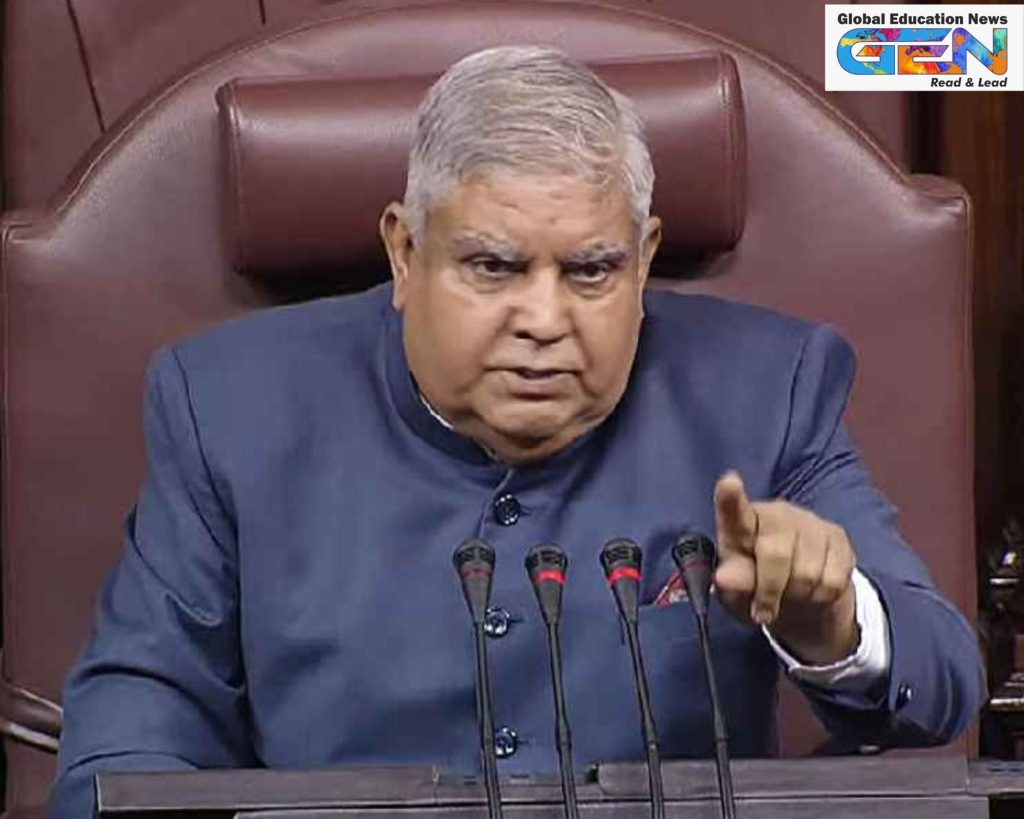
The Vice President of India, the second-highest constitutional office, serves as the ex-officio Chairman of the Rajya Sabha and acts as President when the latter is unable to discharge their duties. As of July 23, 2025, the most significant recent controversy surrounding this office involves the resignation of Jagdeep Dhankhar, who stepped down on July 21, 2025, citing health reasons, though speculation suggests deeper political motives. Below is a detailed overview of the role and the controversy, based on available information.
Role of the Vice President of India
- Constitutional Position: The Vice President is elected under Article 66 of the Indian Constitution by an electoral college of members from both Houses of Parliament (Lok Sabha and Rajya Sabha), using a proportional representation system with a single transferable vote. Eligibility requires Indian citizenship, being at least 35 years old, and qualification for Rajya Sabha membership without holding any office of profit.
- Key Duties:
- Chairs Rajya Sabha proceedings, ensuring parliamentary order.
- Acts as President in case of vacancy or absence (Article 65).
- Serves as Chancellor of institutions like Panjab University and Delhi University.
- Term: Five years, with the possibility to continue until a successor assumes office (Article 67).
- Removal: Can be removed by a resolution passed by a majority in the Rajya Sabha and agreed to by the Lok Sabha, with 14 days’ notice (Article 67(b)).
Jagdeep Dhankhar’s Resignation and Controversy
Jagdeep Dhankhar, the 14th Vice President of India, assumed office on August 11, 2022, and resigned on July 21, 2025, citing health concerns in his letter to President Droupadi Murmu, effective immediately under Article 67(a). His resignation, accepted on July 22, 2025, sparked significant controversy due to its timing, political context, and widespread speculation about underlying reasons.
Key Details of the Resignation
- Stated Reason: Dhankhar, aged 74, cited the need to “prioritize health care and abide by medical advice” after undergoing angioplasty at AIIMS Delhi in March 2025. He appeared frail at some events but remained active in Parliament.
- Timing: The resignation coincided with the first day of the Monsoon Session of Parliament (July 21, 2025), catching the ruling BJP-led National Democratic Alliance (NDA) and opposition off guard.
- Historical Context: Dhankhar is the third Vice President to resign mid-term, following V.V. Giri and R. Venkataraman, both of whom stepped down to contest presidential elections.
Controversial Aspects
- Speculation Beyond Health:
- Opposition Claims: The Congress party, led by figures like Jairam Ramesh and Gaurav Gogoi, argued there were “far deeper reasons” for the resignation, calling it “shocking” and “inexplicable.” Ramesh noted Dhankhar chaired a Business Advisory Committee (BAC) meeting at 12:30 p.m. on July 21, attended by key figures like JP Nadda and Kiren Rijiju, but their absence from a later BAC meeting raised suspicions.
- Shiv Sena (UBT): MP Sanjay Raut dismissed health as the sole reason, stating, “Big politics is going on behind the scenes,” and suggested Dhankhar appeared healthy the previous day.
- Congress MP Manish Tewari: Called the resignation’s swift acceptance by the Union Home Ministry “surprising” and unprecedented, urging Dhankhar to reveal the true circumstances to India’s 146 crore citizens.
- Justice Varma Impeachment Notice:
- On July 21, 2025, Dhankhar announced he had received a notice from 68 opposition MPs seeking the impeachment of Justice Yashwant Varma, linked to a cash stash recovery at his residence. His decision to admit the notice reportedly clashed with the government’s simultaneous anti-corruption motion in the Lok Sabha, potentially causing friction with the NDA. The absence of Nadda and Rijiju from a subsequent BAC meeting fueled speculation that Dhankhar’s move displeased the government.
- Political Angle: Some reports suggest the BJP viewed Dhankhar’s action as undermining their narrative, prompting his exit to stabilize the Modi government.
- Prior Tensions:
- Dhankhar’s tenure was marked by frequent clashes with the opposition, culminating in a historic no-confidence motion in December 2024, signed by over 50 MPs, accusing him of “explicitly partisan” conduct in Rajya Sabha proceedings. The motion, the first against a sitting Vice President, was rejected by Deputy Chairman Harivansh Narayan Singh.
- Opposition leaders like Priyanka Chaturvedi (Shiv Sena-UBT) criticized Dhankhar’s “partisan manner,” while X posts, such as by @whoskj2, claimed his biases damaged the office’s legitimacy.
- Earlier in 2024, X posts by @rishibagree and @FrontalForce highlighted opposition MPs abusing Dhankhar with derogatory terms like “boka choda” and “Baijir Chele,” reflecting the heated political atmosphere.
- Bihar Political Theory:
- A speculative theory suggests Dhankhar’s resignation was strategic to pave the way for Nitish Kumar, Bihar Chief Minister and Janata Dal (United) leader, to become Vice President ahead of Bihar’s 2025 elections. BJP MLA Haribhushan Thakur supported this, stating it would benefit Bihar. This move could help the BJP secure a larger share of seats in the state, where it has never held power alone.
Immediate Aftermath
- Rajya Sabha Operations: Deputy Chairman Harivansh Narayan Singh assumed chairmanship duties on July 22, 2025, as per Article 91 of the Constitution, ensuring continuity in Rajya Sabha proceedings.
- Election Timeline: The Election Commission of India (ECI) must hold elections within 60 days, by September 19, 2025, to fill the vacancy. The new Vice President will serve a full five-year term.
- Potential Successors: Harivansh Narayan Singh, a Janata Dal (United) MP and Rajya Sabha Deputy Chairman since 2020, is a leading contender due to his government ties. The NDA, with a majority in the electoral college, will likely select a “non-controversial” veteran, per BJP sources.
Dhankhar’s Legacy
- Dhankhar, a former West Bengal Governor, described his tenure as a “privilege” during India’s “remarkable economic progress.” He thanked President Murmu for her “unwavering support” and PM Narendra Modi for “invaluable cooperation.”
- Post-resignation, he is entitled to a pension of ₹125,000 per month and Z+ security.
- His tenure saw vocal commentary on farmers’ welfare, judicial accountability, and opposition to “ahankar” (arrogance) in public life, though his outspokenness occasionally strained relations with both the opposition and the NDA.
Broader Context and Sentiment
- Political Reactions:
- Congress: Urged PM Modi to convince Dhankhar to reconsider, while questioning the government’s prior knowledge and transition plans.
- National Conference: Omar Abdullah hoped Dhankhar’s successor would “do justice” to the Vice President’s chair.
- BJP: MP Tejasvi Surya wished Dhankhar good health, while a BJP leader emphasized selecting a “non-controversial” successor.
Critical Analysis
While Dhankhar’s health concerns, including his angioplasty, provide a plausible reason for resignation, the timing—on the Monsoon Session’s first day—and his controversial decision to admit the Justice Varma impeachment notice suggest political pressures. The opposition’s no-confidence motion in 2024 and their allegations of partisanship indicate a fraught tenure, possibly exacerbated by Dhankhar’s outspoken style. The Bihar election theory, though speculative, aligns with NDA’s strategic needs, but no official confirmation exists. The lack of BJP ministers’ congratulatory messages, as noted by India Today, further hints at internal NDA friction.
What’s Next?
- The ECI will announce elections soon, with nominations requiring at least 20 MPs as proposers and 20 as seconders, and a ₹15,000 security deposit.
- Harivansh Narayan Singh is a frontrunner, but the NDA’s final choice remains unclear.
- The controversy underscores the delicate balance of the Vice President’s role as a neutral Rajya Sabha chair amid polarized politics.