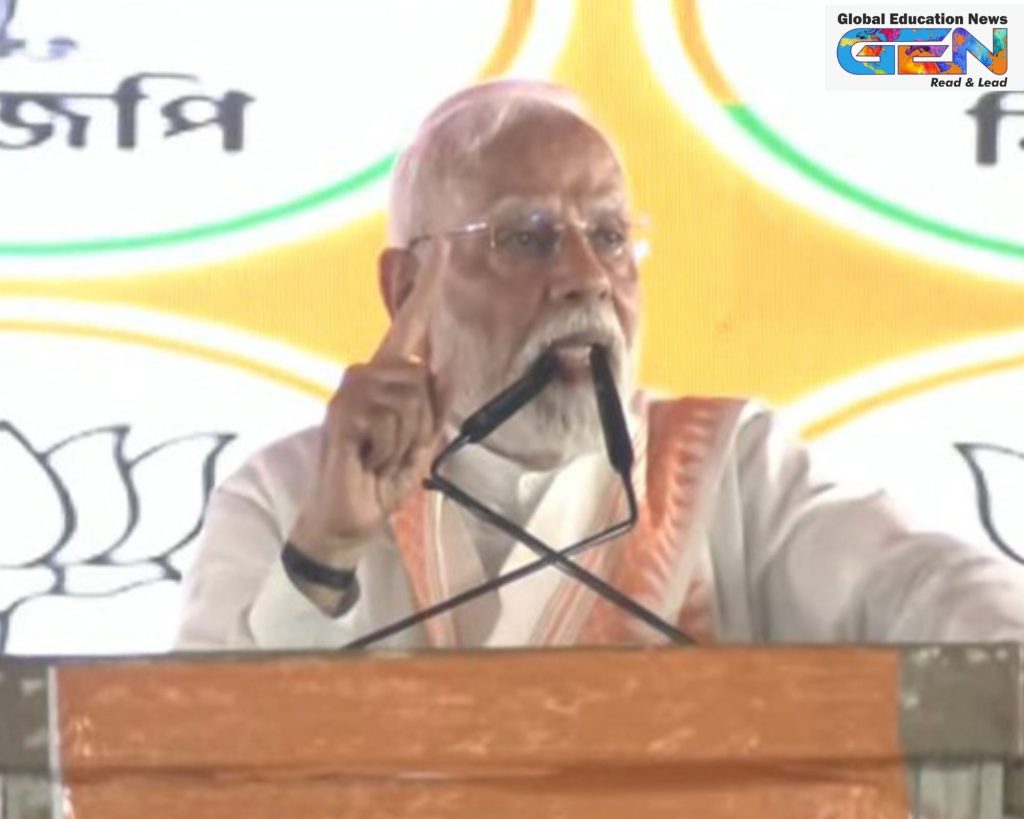
In a charged rally in Durgapur, West Bengal, on July 18, 2025, Prime Minister Narendra Modi unleashed a scathing critique of the Trinamool Congress (TMC) government, accusing it of plunging the state’s education system into chaos. From primary schools to colleges, Modi claimed that TMC’s “double attack of crime and corruption” has left Bengal’s youth struggling and its education sector in tatters. But what’s behind these bold claims, and what does this mean for the future of education in West Bengal?
- Key Points:
- Modi accuses TMC of ruining education at all levels through corruption.
- Highlights 2024 Calcutta High Court ruling on teacher recruitment scam.
- Calls for BJP to lead an “honest, hardworking” government in 2026.
The Teacher Recruitment Scam: A Blow to Bengal’s Educators
At the heart of Modi’s critique is the 2024 Calcutta High Court ruling that canceled nearly 26,000 teacher and non-teaching staff appointments due to a massive recruitment scam. This scandal, Modi argued, has left thousands of qualified teachers jobless, robbing students of quality education. “The TMC government has handed Bengal’s education to crime and corruption,” he declared, pointing to protests by SSC-qualified teachers demanding justice at the state secretariat.
- Key Points:
- Calcutta High Court canceled 26,000 teacher appointments in 2024.
- Protests by teachers under Jogya Shikshak Shikshika Adhikar Mancha continue.
- Scam undermines trust in Bengal’s education system, Modi claims.
Campus Safety Under Fire
Modi didn’t stop at recruitment issues. He raised alarms over campus safety, citing the RG Kar Medical College case, where a doctor faced alleged sexual harassment, sparking widespread protests. “Even hospitals in West Bengal are no longer safe,” Modi said, accusing the TMC of shielding the accused rather than protecting victims. This, he argued, reflects a broader failure to ensure safe learning environments for students, especially women.
- Key Points:
- RG Kar Medical College case fueled protests over campus safety.
- Modi accuses TMC of protecting perpetrators, not victims.
- Safety concerns threaten Bengal’s reputation as an education hub.
Neglecting Bengali Pride and Language
Modi also took aim at TMC’s cultural record, claiming it has ignored the Bengali language alongside allies like the Left and Congress. He contrasted this with the BJP’s efforts, noting that his government granted classical language status to Bangla—a move he says TMC and its allies never prioritized. “The BJP respects Bengali ‘asmita’ (pride),” Modi asserted, positioning his party as a defender of Bengal’s cultural heritage.
- Key Points:
- BJP granted classical language status to Bangla, unlike TMC.
- Modi accuses TMC, Left, and Congress of neglecting Bengali pride.
- Cultural neglect adds to TMC’s education failures, per Modi.
Youth Migration and Industrial Decline
Beyond education, Modi linked TMC’s governance to broader issues like youth migration and industrial stagnation. He claimed that TMC’s “Gunda Tax” (extortion) and biased policing deter investment, forcing young Bengalis to seek jobs elsewhere. “West Bengal was once a hub of development,” Modi said, lamenting the lack of opportunities driving youth away from the state.
- Key Points:
- TMC’s policies blamed for industrial decline and job scarcity.
- Youth migration rises due to lack of local opportunities.
- Modi calls for a business-friendly Bengal under BJP leadership.
TMC’s Response and Political Context
The TMC has not directly addressed Modi’s education-specific allegations in recent reports, but the party has emphasized Chief Minister Mamata Banerjee’s efforts to ensure peaceful elections and governance. Posts on X echo Modi’s criticisms, with users like @narendramodi and @ians_india amplifying the narrative of TMC’s failure in education. However, these claims lack independent verification in the provided sources, and TMC’s defenders may argue that the state faces systemic challenges beyond one party’s control.
- Key Points:
- TMC highlights efforts for peaceful elections under Mamata Banerjee.
- X posts amplify Modi’s claims but lack independent evidence.
- Debate over education crisis reflects broader political battle for 2026.
A Broader Vision for Education
Modi’s remarks come against the backdrop of his government’s push for the National Education Policy (NEP) 2020, which he has called a “futuristic” reform to transform India’s education system. Speaking at events like the 2022 Swaminarayan Gurukul address, Modi emphasized increasing premier institutions like IITs and AIIMS since 2014, contrasting this with TMC’s alleged failures. He also advocated for education rooted in Indian values, citing Arya Samaj schools as a model.
- Key Points:
- NEP 2020 aims to modernize education, per Modi’s vision.
- BJP expanded IITs, IIMs, and AIIMS since 2014.
- Modi promotes Arya Samaj schools for value-based education.
Challenges Ahead for Bengal’s Education
The issues Modi highlighted—corruption, safety, and joblessness—point to real challenges. The teacher recruitment scam has disrupted schools, and campus safety concerns, like the RG Kar case, demand urgent action. However, critics argue that Modi’s narrative overlooks systemic issues, like teacher shortages (6 lakh vacant posts under SSA) and funding cuts (e.g., 22% reduction for Sarva Shiksha Abhiyan in 2015). Solving these requires cooperation between state and central governments, not just political blame.
- Key Points:
- Teacher shortages and funding cuts exacerbate Bengal’s crisis.
- RG Kar case highlights need for stronger campus safety measures.
- Central-state collaboration needed to address systemic issues.
What’s Next for West Bengal?
With the 2026 West Bengal assembly polls looming, Modi’s rally signals a heated campaign. He urged voters to choose a “strong, honest” BJP government to restore Bengal’s education and economy. For students and parents, the focus is on immediate fixes: transparent hiring, safer campuses, and better opportunities. As one X post put it, “Everyone is saying ‘TMC hatao, Bengal bachao’”—but can the BJP deliver if given the chance?
- Key Points:
- Modi pushes for BJP victory in 2026 to fix education.
- Students need transparent hiring and safer campuses now.
- Political rhetoric must translate into actionable reforms.
A Call to Action for Bengal’s Future
PM Modi’s fiery critique paints a grim picture of West Bengal’s education system under TMC rule, from recruitment scams to unsafe campuses. While his accusations resonate with many, as seen in X posts, the path forward requires more than rhetoric. Students, educators, and parents deserve a system free from corruption, rich in opportunity, and safe for all. As Bengal gears up for 2026, the question remains: Can its leaders—state or central—turn the tide for education?