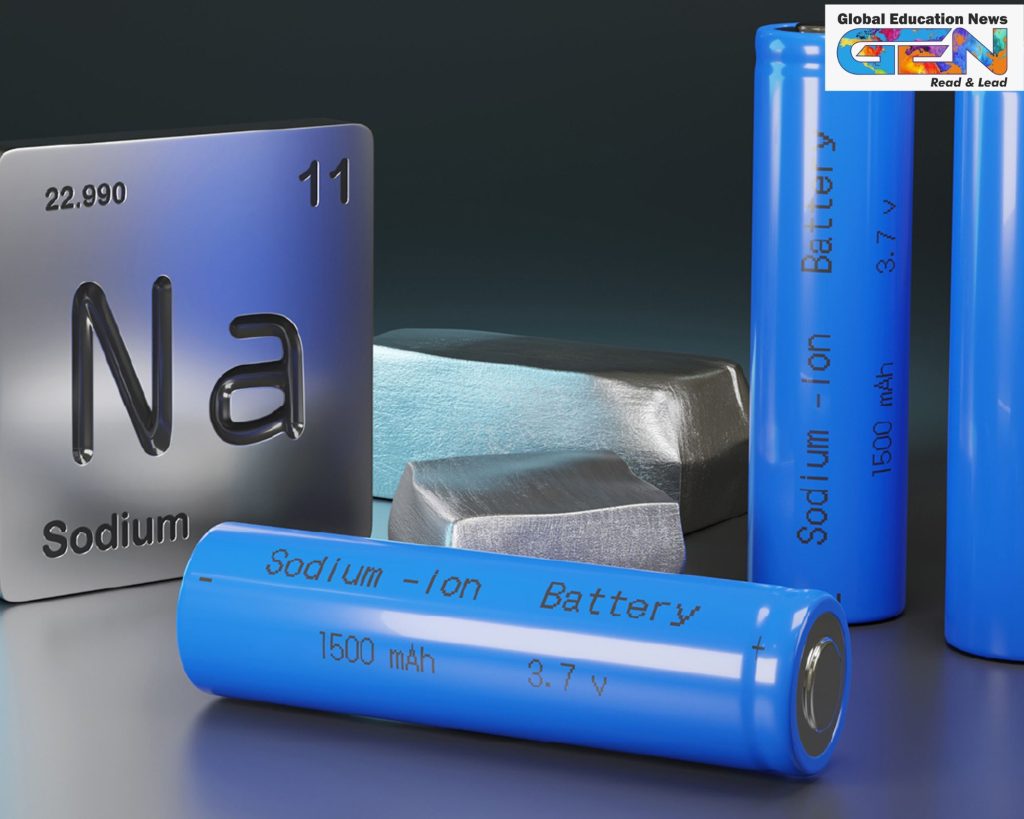
The race for cleaner, cheaper energy storage just got a jolt from India! Researchers at Jawaharlal Nehru Centre for Advanced Scientific Research (JNCASR) in Bengaluru have unveiled a game-changing sodium-ion battery that charges to 80% in just 6 minutes and lasts over 3,000 cycles. Powered by a novel anode material, Na₁.₀V₀.₂₅Al₀.₂₅Nb₁.₅(PO₄)₃, this innovation promises to outshine traditional lithium-ion batteries with faster charging, enhanced safety, and a lower price tag. As India pushes for self-reliance under Atmanirbhar Bharat, this breakthrough could electrify everything from electric vehicles to rural grids. Here’s why this sodium-ion marvel is sparking global excitement!
A Chemistry Breakthrough: What Makes This Battery Special?
Key Points:
- Novel anode material: Na₁.₀V₀.₂₅Al₀.₂₅Nb₁.₅(PO₄)₃, a NASICON-type compound, boosts ion conductivity.
- Nanoscaling: Shrinking particles to nanoscale increases surface area for faster sodium-ion movement.
- Carbon coating: A thin layer enhances conductivity and protects against degradation.
- Aluminium doping: Small aluminum additions improve structural stability and performance.
Led by Prof. Premkumar Senguttuvan and Ph.D. scholar Biplab Patra, the Bengaluru team engineered a NASICON (Sodium Super Ionic Conductor) anode that redefines battery performance. By reducing particle size to the nanoscale, they’ve supercharged ion mobility, making charging lightning-fast. A carbon coating ensures better electrical flow and durability, while aluminium doping strengthens the material, allowing the battery to withstand thousands of cycles. These tweaks, validated through electrochemical cycling and quantum simulations, make this battery a standout in energy storage innovation.
Lightning-Fast Charging and Unmatched Longevity
Key Points:
- Charges to 80% in 6 minutes, ideal for electric vehicles and high-demand applications.
- Lasts over 3,000 charge-discharge cycles, far outpacing traditional sodium-ion batteries.
- Outperforms lithium-ion batteries in durability and charging speed.
Forget long charging waits! This sodium-ion battery hits 80% capacity in just 6 minutes, a feat that could revolutionize EV charging and grid storage. Tested for over 3,000 cycles, it maintains performance where conventional sodium-ion batteries falter, offering a lifespan that reduces replacement costs. Compared to lithium-ion batteries, which often degrade faster, this innovation delivers a one-two punch of speed and staying power, making it a game-changer for sustainable energy.
Economic Edge: Why Sodium Trumps Lithium
Key Points:
- Sodium abundance: Plentiful in India, unlike scarce, costly lithium.
- Cost-effective: Reduces reliance on expensive imports, aligning with Atmanirbhar Bharat.
- Supports rural electrification and affordable EVs for broader access.
India’s lithium imports are a pricey bottleneck, but sodium is a homegrown hero. Found abundantly in saltwater and local resources, sodium slashes battery costs, making this technology a perfect fit for India’s self-reliance mission. Cheaper batteries mean more accessible electric vehicles, solar storage, and rural power grids, bridging the energy gap for millions. Posts on X celebrate this as a “big leap for India’s energy independence,” with users like @_PriyankaSingh7 hailing its affordability.
Safety First: A Fire-Proof Alternative
Key Points:
- Eliminates thermal runaway risks common in lithium-ion batteries.
- Non-flammable design enhances safety for EVs and home storage.
- Validated through advanced testing, ensuring reliability.
Lithium-ion batteries can overheat and catch fire, but Bengaluru’s sodium-ion battery sidesteps these dangers. Its NASICON structure and carbon coating minimize thermal runaway, making it safer for electric vehicles, home energy systems, and large-scale grids. Rigorous electrochemical tests and quantum simulations confirm its reliability, earning praise on X for being “safer than lithium” (@DealBeeOfficial). This could set a new standard for battery safety worldwide.
Environmental Impact: Greening India’s Energy Future
Key Points:
- Eco-friendly: No cobalt, copper, or nickel, reducing mining impacts.
- Supports India’s carbon-neutral goal by 2050.
- Enables clean energy access in rural and urban areas.
Unlike lithium-ion batteries, which rely on environmentally damaging cobalt and nickel mining, sodium-ion batteries use abundant, sustainable materials. This aligns with India’s net-zero emissions target, cutting the carbon footprint of battery production. By powering solar grids and EVs, these batteries could electrify remote villages and urban centers alike, advancing clean energy equity. X users like @anooshkabathwal call it a “game-changer for India’s green future.”
Challenges and the Road to Commercialization
Key Points:
- Requires scaling up production and real-world testing.
- Needs investment and policy support for mass adoption.
- Faces competition from established lithium-ion and emerging battery tech.
While the tech is promising, it’s not ready for store shelves yet. Scaling Na₁.₀V₀.₂₅Al₀.₂₅Nb₁.₅(PO₄)₃ production demands significant investment and infrastructure. Policy incentives, like those under Atmanirbhar Bharat, could accelerate commercialization, but competition from lithium-ion and other alternatives (e.g., potassium-ion batteries) looms. Experts on X urge “continued R&D” to refine energy density and compete globally (@dheerendra075).
India’s Global Play: Leading the Battery Revolution
Key Points:
- Positions India as a green tech leader, per JNCASR researchers.
- Potential for exporting sodium-ion tech to global markets.
- Aligns with 2030 cost-competitiveness goals against lithium-ion.
This breakthrough could put India on the map as a battery technology powerhouse. With sodium-ion batteries projected to rival lithium-ion costs by the 2030s, India’s affordable, sustainable solution could capture global markets. The Department of Science & Technology highlights its potential to drive electrification from “cars to villages,” while X posts like @beatsinbrief celebrate India’s “safer, cheaper alternative.” Continued funding and partnerships could see India exporting not just batteries, but energy self-reliance.