The controversy involving NALSAR University of Law and the Bar Council of India (BCI) in August 2026 may have begun with a disagreement over a convocation invitation, but it quickly developed into a much larger debate about student dissent, university autonomy, regulatory authority and the limits of the BCI’s powers.
The immediate dispute centred on a section of NALSAR students objecting to the proposed participation of Chief Justice of India Surya Kant as chief guest at the university’s convocation. Around 450 students from the approximately 1,400-strong student body reportedly signed a representation opposing the invitation. The protest followed concerns among students about remarks made by the CJI during proceedings concerning alleged police excesses against protesters.
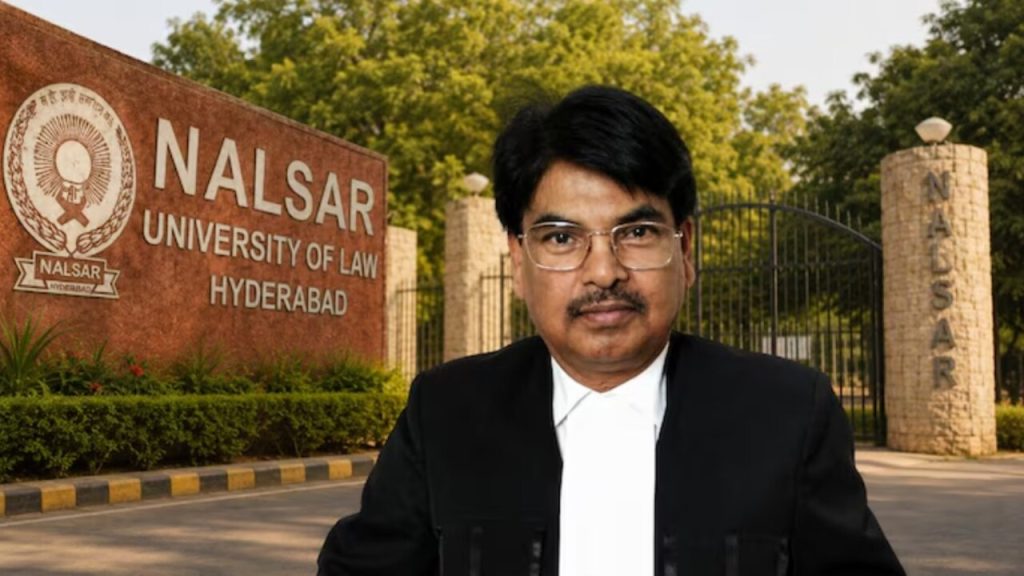
What transformed the episode from a campus controversy into a national legal debate was the response of the BCI. On August 13, 2026, the regulator directed State Bar Councils not to enrol the entire NALSAR 2026 graduating batch as advocates pending an inquiry into the student campaign. The order was withdrawn within hours. The BCI subsequently closed proceedings against the batch, and its chairman, Manan Kumar Mishra, apologised to students.
The Supreme Court also took a strong view of the intervention, with CJI Surya Kant observing that students have a right to protest and questioning what role the BCI had in the dispute.
Yet the NALSAR episode is not an isolated disagreement. For decades, students and law institutions have encountered the BCI over issues ranging from attendance requirements and examinations to dress codes, professional training, enrolment and the regulation of legal education.
The deeper question, therefore, is not simply who was right in the NALSAR controversy. It is this:
How far should a professional regulator be able to reach into the academic and civic life of law students?
NALSAR Controversy: What Happened and Why It Escalated
The immediate dispute arose over NALSAR’s proposed convocation and the invitation extended to CJI Surya Kant.
A group of students opposed the invitation, arguing that their concerns about the judiciary and recent judicial proceedings justified questioning the decision. The representation was not merely a private disagreement; it became a collective expression of student opinion.
The BCI’s response dramatically changed the character of the controversy.
The sequence of events
| Development | What happened |
|---|---|
| Student representation | Around 450 NALSAR students opposed the proposed CJI participation at the convocation |
| BCI intervention | The BCI sought information about those allegedly involved in organising the campaign |
| Enrolment directive | State Bar Councils were initially told not to enrol NALSAR’s 2026 graduating batch |
| First reversal | The BCI modified the order within hours, allowing the majority of students to proceed |
| Supreme Court intervention | The Court questioned the BCI’s role and protected students and faculty from punitive action |
| Proceedings closed | The BCI subsequently announced that proceedings against the 2026 batch were being closed |
| Apology | BCI chairman Manan Kumar Mishra later apologised to students |
The consequences of the original directive were potentially serious. Enrolment with a State Bar Council is an important step for a law graduate seeking to enter legal practice. A blanket restriction could therefore have affected graduates who had already secured employment, clerkships or professional opportunities.
The controversy also raised a fundamental legal question: Can the BCI collectively restrict graduates from enrolment because some students participated in a campus protest?
The concern was particularly significant because the Advocates Act provides the statutory framework governing advocates and gives the BCI important responsibilities concerning professional standards and legal education. Critics questioned whether those powers could be stretched into collective action against an entire graduating class over a university-related protest.
Why the NALSAR Episode Is Part of a Much Longer Conflict
The relationship between the BCI and law students has rarely been straightforward.
The BCI has a legitimate and important role: legal education is professional education, and the quality of law graduates ultimately affects the administration of justice. The regulator therefore prescribes standards concerning curriculum, attendance, clinical training and institutional recognition.
The problem emerges when professional regulation intersects with student autonomy.
1. Attendance rules have repeatedly triggered student disputes
One of the most persistent flashpoints has been attendance.
BCI rules have traditionally required law students to meet minimum attendance requirements before appearing for examinations. The rationale is straightforward: lawyers cannot be adequately trained through textbooks and examinations alone. They need classroom participation, clinical education, moot courts, internships and practical exposure.
But the implementation of attendance rules has repeatedly produced conflict.
At Delhi University’s Faculty of Law, hundreds of students were detained from examinations over attendance shortages. The dispute eventually reached the Delhi High Court in 2018.
The court found serious problems with the way attendance had been administered. It noted that the law faculty itself had failed to conduct the minimum classes required under the BCI framework and found discrepancies in attendance records. The detention orders were subsequently quashed in the cases before the court.
The significance of that episode extends beyond attendance.
It demonstrated that a regulation can be legitimate in principle but unfair in implementation.
The same issue resurfaced years later. In 2025, the Delhi High Court asked the BCI to reconsider mandatory attendance requirements for law students, observing that legal education involves much more than conventional classroom learning. The issue also led to discussion about whether students should be prevented from taking examinations solely because of attendance shortages.
The BCI subsequently defended its attendance framework and argued that its requirements were intended to maintain professional standards. It also moved towards biometric attendance mechanisms at recognised centres of legal education.
This illustrates the recurring tension:
BCI’s position: professional education requires discipline and minimum standards.
Students’ position: regulations should not become inflexible barriers when institutional failures contribute to the problem.
2. Dress Codes Became an Unexpected Battleground
The BCI’s engagement with student life has also extended to matters that appear less directly connected with legal competence.
In 2016, a dispute at the National Law School of India University in Bengaluru involving a student’s clothing became the backdrop to a BCI recommendation concerning dress codes at law institutions.
The BCI advised law colleges to formulate dress codes “befitting the profession”, with white shirts and white, black or grey trousers suggested as a preferred standard. The recommendation triggered criticism from students who saw it as unnecessary regimentation. Academics and students debated whether professional discipline should extend into regulating ordinary campus clothing.
Similar rules were subsequently adopted by some law institutions.
The disagreement was not really about shirts and trousers.
It was about where professional regulation ends and student autonomy begins.
For a professional regulator, appearance can be linked to courtroom decorum and the public image of lawyers. For students, however, a dress requirement imposed by an external regulator can appear to blur the distinction between professional conduct inside a courtroom and personal expression on a university campus.
That same philosophical question is visible in the NALSAR dispute.
3. Examinations, AIBE and the Transition From Student to Advocate
Another recurring area of friction concerns the transition between legal education and professional practice.
The All-India Bar Examination (AIBE), enrolment requirements and eligibility conditions have periodically become sources of anxiety for graduating law students.
The reason is structural: a law degree does not by itself eliminate every regulatory step between graduation and legal practice.
The BCI regulates professional entry, while State Bar Councils handle enrolment. This creates a powerful regulatory architecture around the final stage of a law student’s education.
That power becomes particularly consequential when regulatory decisions affect an entire graduating cohort.
The NALSAR episode exposed this vulnerability dramatically. Students who had completed their degrees and were preparing to enter professional life suddenly found themselves potentially affected by an order concerning conduct on campus.
The issue was therefore not merely whether students could protest.
It was whether access to a profession could become contingent upon conformity with the expectations of a regulatory authority outside the university’s ordinary academic structure.
That is why the controversy attracted support from alumni, lawyers and students at other national law universities. Hundreds of NALSAR alumni mobilised against what they regarded as disproportionate regulatory intervention. Students and alumni at NLSIU Bengaluru also expressed solidarity with the NALSAR students.
What the NALSAR Row Says About the BCI’s Legal Powers
The most important dimension of the controversy is ultimately institutional.
The BCI has extensive responsibilities under the Advocates Act, 1961. It plays a central role in:
- regulating professional standards;
- recognising law degrees for professional purposes;
- prescribing standards of legal education;
- supervising State Bar Councils;
- regulating professional conduct and discipline;
- overseeing aspects of entry into the legal profession.
But regulatory authority is not necessarily unlimited.
The NALSAR dispute prompted questions about whether powers designed to regulate advocates and legal education could be used to collectively penalise students for a campus protest.
The Indian Express’ legal analysis noted that the BCI’s statutory authority and its supervisory relationship with State Bar Councils were central to the dispute. Critics argued that an individualised statutory process cannot simply be converted into a blanket suspension of enrolment for an entire graduating class.
This distinction is crucial.
Regulation versus punishment
A regulator may legitimately ask:
Has a student satisfied the statutory conditions for professional enrolment?
A much more contentious question is:
Should a graduate’s professional future be affected because they participated in a lawful expression of political or institutional opinion?
The second question directly engages constitutional values, particularly freedom of speech, peaceful expression and institutional autonomy.
The Constitutional Dimension: Can Law Students Question Authority?
The NALSAR controversy is especially significant because law schools are not ordinary professional training centres.
They are institutions where students study the Constitution, judicial review, fundamental rights, administrative power and limits on state authority.
A law student who learns that government institutions must remain accountable cannot reasonably be expected to treat every powerful institution as beyond criticism.
That does not mean students have unlimited freedom.
Peaceful protest does not authorise violence, intimidation, destruction of property or unlawful disruption. Universities also have legitimate responsibilities to maintain academic functioning and institutional order.
But disagreement with an institution is not automatically misconduct.
The Supreme Court’s intervention in the NALSAR matter reinforced this principle. CJI Surya Kant said that students have a right to protest and described the BCI’s intervention as unnecessary. The Court also restrained punitive action against students and faculty in connection with the controversy.
There is an additional irony.
The students’ protest concerned the Chief Justice himself, yet the Chief Justice’s response to the dispute emphasised their right to express disagreement.
That distinction matters for constitutional democracy: the strength of an institution is not demonstrated by eliminating criticism but by being able to withstand it.
Broader Perspectives: Why the BCI’s Position Cannot Simply Be Dismissed
A balanced assessment must also recognise why regulators intervene in legal education.
Law is different from many academic disciplines because its graduates may soon represent clients, appear before courts and influence people’s legal rights.
The BCI therefore has legitimate reasons to insist upon:
- adequate classroom participation;
- practical legal training;
- ethical standards;
- professional discipline;
- minimum academic requirements;
- recognised qualifications;
- competence before entry into practice.
Weak regulation could damage not only students but also litigants and the justice system.
There is also a genuine institutional challenge. India’s legal education system is highly uneven. Elite National Law Universities operate alongside thousands of law colleges with very different levels of infrastructure, faculty strength and clinical opportunities.
Research on Indian legal education has repeatedly pointed to the gap between regulatory requirements and actual educational conditions. The challenge is therefore not whether the BCI should regulate, but how it should regulate without treating all institutions and all students as though they operate under identical conditions.
The NALSAR episode also highlights another lesson: procedural legitimacy matters.
Reports indicated that the initial BCI directive generated internal disagreement over the manner in which it had been issued, with BCI office-bearers questioning whether the chairman had acted without adequate consultation. The order was then modified and eventually withdrawn.
For a statutory regulator, that sequence raises an important governance principle:
Even when an authority believes intervention is justified, the process used to exercise that authority must itself be transparent, reasoned and legally defensible.
A New Question for Law Schools: How Much Autonomy Should They Have?
The NALSAR dispute has also revived discussion about university autonomy.
National Law Universities were created partly to modernise Indian legal education. They were intended to encourage interdisciplinary scholarship, research, clinical training and a more intellectually independent approach to legal education.
Their students are not merely being trained to memorise statutes.
They are being prepared to become:
- advocates;
- judges;
- academics;
- civil servants;
- policy professionals;
- corporate lawyers;
- public-interest practitioners.
That requires the ability to question assumptions.
A university where students are afraid to challenge institutional authority may produce technically trained graduates, but it risks weakening one of the most important qualities of a lawyer: independent judgment.
At the same time, autonomy cannot mean immunity from legitimate regulation. Professional standards remain necessary, particularly when graduates seek entry into the legal profession.
The challenge is therefore to create a clear boundary:
Universities should govern academic and campus life, while the BCI should exercise its statutory regulatory responsibilities without unnecessarily intruding into lawful student expression.
The NALSAR Effect: Why the Controversy Has Spread Beyond Hyderabad
The most striking feature of the episode has been its ripple effect.
The controversy prompted support from NALSAR alumni, lawyers and students at other National Law Universities. NLSIU students and alumni subsequently raised similar concerns, and the institution’s own 2026 convocation became the subject of a separate controversy involving invitations to CJI Surya Kant and BCI chairman Manan Kumar Mishra. More than 700 students, alumni and graduating students were reported to have signed an open letter connected to the dispute.
The development shows that the issue has moved beyond one university.
It now concerns a broader question:
What kind of professional culture should India’s law schools cultivate?
One model emphasises hierarchy, discipline and professional decorum.
Another places greater weight on debate, dissent and institutional accountability.
The future of legal education will probably require both.
A lawyer needs discipline, but also independence.
A lawyer must understand professional ethics, but also constitutional rights.
A lawyer must respect courts, but must also understand that judicial institutions can be scrutinised.
A lawyer must follow legitimate professional rules, but must also know how to identify when power exceeds legal authority.
That balance cannot be taught only through textbooks.
It has to be experienced.
Conclusion: The Real Lesson From the NALSAR–BCI Conflict
The NALSAR controversy is unlikely to be remembered merely as a disagreement over a convocation guest.
Its larger significance lies in the questions it exposed about the boundaries of regulatory power, student rights and the autonomy of legal education.
The history of BCI–student tensions shows a recurring pattern. Attendance requirements, examination eligibility, professional training, dress codes and enrolment rules have all placed students and the regulator on opposite sides at different points.
Yet the underlying dispute is remarkably consistent.
How should professional standards be enforced without turning regulation into excessive control?
The BCI has an indispensable role in maintaining standards in India’s legal profession. But regulatory legitimacy depends not only on the objective being pursued; it also depends on statutory authority, due process, proportionality and respect for constitutional freedoms.
For law students, the lesson is equally important. The right to dissent carries responsibilities: protest must remain peaceful, reasoned and lawful. But learning to question authority is not a departure from legal education. It is one of its purposes.
The NALSAR episode therefore offers a larger lesson for India’s legal education system:
A law school should not merely teach students what the law says. It should teach them how to question the exercise of power within the law.
If India’s future lawyers are expected to defend constitutional freedoms for others, the educational institutions preparing them must also leave sufficient space for them to exercise those freedoms themselves.
Key Takeaways
- The NALSAR controversy began with student opposition to the proposed participation of CJI Surya Kant at the university’s 2026 convocation.
- The BCI initially directed State Bar Councils not to enrol the entire graduating batch, before reversing the decision.
- The Supreme Court questioned the BCI’s intervention and affirmed students’ right to protest.
- The dispute reflects older tensions involving BCI rules on attendance, dress codes, examinations and professional entry.
- The central issue is the balance between professional regulation and university autonomy.
- Legal education requires discipline, but it also requires independent thought, constitutional awareness and the ability to scrutinise authority.
- The episode has implications for how India regulates not just law graduates, but the culture in which future lawyers are educated.