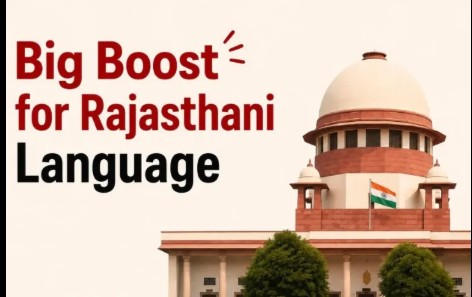
In a major development for regional language education in India, the Supreme Court has directed the Rajasthan government to formulate a comprehensive policy for introducing and promoting the Rajasthani language in schools and colleges across the state. The ruling is being viewed as a landmark moment for mother-tongue education and cultural preservation in Rajasthan.
A bench comprising Justices Vikram Nath and Sandeep Mehta observed that the constitutional promise of mother-tongue education cannot remain merely symbolic and must be implemented through effective state policies. The court stressed that children have the right to learn in a language they understand best during foundational years of education.
The judgment comes amid growing national discussions around regional languages, multilingual education, and the implementation of the National Education Policy (NEP) 2020.
What the Supreme Court Said
The apex court instructed the Rajasthan government to take “necessary measures” to recognize and accord proper status to Rajasthani as a local and regional language for educational purposes.
The bench stated that Rajasthani should gradually be introduced as:
- A subject in schools
- A medium of instruction at foundational stages
- A language integrated into higher levels of education over time
The court emphasized that education in one’s mother tongue strengthens conceptual understanding, learning outcomes, and cognitive development among children.
The judges also remarked that “executive inaction or indifference” cannot delay constitutional rights related to language and education.
Why the Case Reached the Supreme Court
The matter originated from a petition challenging the exclusion of Rajasthani from:
- School-level educational frameworks
- The Rajasthan Eligibility Examination for Teachers (REET) syllabus
Petitioners argued that despite being spoken by more than 4.6 crore people, Rajasthani was not receiving adequate recognition in Rajasthan’s school education system.
The plea highlighted that several other regional languages such as Gujarati, Punjabi, Sindhi, and Urdu were already included in educational structures and teacher eligibility examinations, while Rajasthani continued to remain excluded.
The petition also relied on:
- Article 350A of the Constitution
- Right to Education principles
- National Education Policy (NEP) 2020
all of which encourage education in the mother tongue, especially during early schooling years.
Court Rejects Rajasthan Government’s Stand
During the hearing, the Rajasthan government reportedly argued that only languages listed in the Eighth Schedule of the Constitution could be formally incorporated into school curricula.
However, the Supreme Court rejected this argument and described the approach as “pedantic.”
The bench pointed out that Rajasthani is already being taught in several universities across the state, including:
- University of Rajasthan
- Jai Narain Vyas University
- Maharaja Ganga Singh University
This, the court observed, clearly demonstrates the language’s academic recognition and pedagogical viability.
NEP 2020 and Mother-Tongue Education
The judgment strongly aligns with the vision of the National Education Policy 2020, which advocates teaching children in their home language or mother tongue during foundational years wherever possible.
NEP 2020 emphasizes that early education in local languages improves:
- Conceptual clarity
- Learning efficiency
- Emotional connection with education
- Cultural identity and inclusivity
Experts say the Supreme Court’s ruling could encourage other states to strengthen regional language education policies in line with NEP goals.
Why the Decision Matters for Rajasthan
Rajasthani is not a single dialect but a broad linguistic family including:
- Marwari
- Mewari
- Shekhawati
- Harauti
- Dhundhari
- Bagri
Despite being widely spoken across Rajasthan, the language has long struggled for official constitutional recognition.
The Rajasthan Legislative Assembly had passed a resolution over two decades ago recommending inclusion of Rajasthani in the Eighth Schedule of the Constitution, but the proposal is still pending with the Centre.
Language activists believe the Supreme Court order could revive efforts to secure official recognition and institutional support for Rajasthani.
Introduction Likely in Phases
The court has asked Rajasthan to introduce Rajasthani in a phased manner across both government and private schools.
According to legal reports, implementation may begin with:
- Foundational and preparatory stages
- Lower primary classes
- Optional language modules
- Teacher training and curriculum preparation
before gradually expanding to higher classes and broader academic integration.
Experts Welcome the Judgment
Education experts and linguists have welcomed the ruling, calling it an important step toward preserving India’s linguistic diversity.
Supporters argue that regional language education can:
- Improve classroom participation
- Reduce learning gaps
- Increase student confidence
- Strengthen cultural identity
- Make education more inclusive
Several researchers have also linked mother-tongue learning with improved literacy and better long-term academic performance.
Challenges Ahead for Rajasthan Government
While the judgment has been widely welcomed, implementing it could pose significant challenges for the Rajasthan government.
Key hurdles may include:
- Designing standardized Rajasthani curriculum
- Training teachers
- Preparing textbooks and learning materials
- Addressing dialect diversity within Rajasthani
- Balancing multilingual education frameworks
Experts say policy execution will determine whether the judgment leads to meaningful educational reform or remains symbolic.
A Significant Moment for Regional Language Education
The Supreme Court’s intervention signals a growing institutional push toward multilingual and culturally rooted education in India.
As debates continue around language identity, education reform, and NEP implementation, the Rajasthan case could become a major precedent for promoting regional languages in school education nationwide.
For millions of students in Rajasthan, the ruling may soon make classrooms more connected to the language spoken at home — bringing education closer to their cultural and linguistic roots.