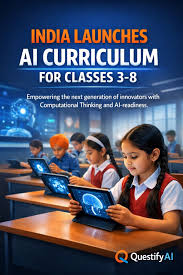
In a major transformation of school education, the Central Board of Secondary Education (CBSE) and the National Council of Educational Research and Training (NCERT) have rolled out a new Artificial Intelligence (AI) and Computational Thinking curriculum for students from Classes 3 to 8. The initiative marks one of India’s most ambitious attempts to integrate future technologies into mainstream school education at an early stage.
The curriculum will officially be implemented from the 2026-27 academic session and is aligned with the vision of the National Education Policy (NEP) 2020, which emphasises skill-based, experiential, and technology-driven learning.
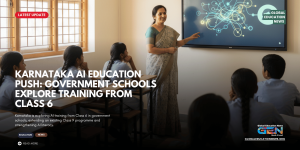
School Education and Literacy Secretary Sanjay Kumar confirmed that teacher training programmes will begin during the summer vacation so that schools are ready to start AI instruction once classes reopen.
What the New AI Curriculum Includes
The newly launched framework focuses on developing foundational digital and analytical skills among school students. Rather than teaching advanced programming immediately, the curriculum is designed to gradually introduce children to logical thinking, pattern recognition, problem-solving, and ethical use of technology.
Key Focus Areas of the Curriculum
- Computational Thinking (CT)
- Artificial Intelligence basics
- Logical and analytical reasoning
- Problem-solving techniques
- Pattern recognition
- Data organisation and interpretation
- Digital literacy and AI ethics
- Real-world technology applications
According to the curriculum framework, students in Classes 3 to 5 will learn through puzzles, games, visual reasoning, and hands-on activities integrated with subjects like Mathematics and “The World Around Us” (TWAU).
For Classes 6 to 8, students will move toward introductory AI concepts, data analysis, interdisciplinary projects, and exposure to AI tools through experiential learning models.
AI Education Will Not Be Limited to Coding
Officials clarified that the initiative is not merely about coding lessons. Instead, the broader aim is to help children develop “computational thinking” — a structured way of understanding and solving problems.
The curriculum places strong emphasis on:
- Breaking complex problems into smaller parts
- Identifying patterns
- Building logical sequences
- Understanding algorithms
- Ethical and responsible AI usage
Experts believe these skills are increasingly essential in the modern workforce and digital economy.
Teacher Training to Begin During Summer Vacation
One of the biggest components of the rollout is large-scale teacher training.
CBSE has officially declared “Computational Thinking and Understanding Artificial Intelligence” as the training theme for the 2026-27 academic year. Schools affiliated with CBSE will conduct workshops, district-level training programmes, and interdisciplinary teaching sessions.
The teacher training modules will focus on:
- Foundations of AI and computational thinking
- Interdisciplinary teaching methods
- Classroom pedagogy for AI learning
- Assessment techniques
- Ethical AI practices
- Real-world AI applications
Officials said teachers will be trained to integrate AI concepts into multiple subjects instead of treating it as an isolated discipline.
NCERT Preparing AI Textbooks for Senior Classes
The government has also confirmed that dedicated AI textbooks are being developed for higher classes.
NCERT is currently preparing AI-related learning materials for Classes 9, 10, 11, and 12 to expand technology-based education beyond middle school.
Education experts see this as part of a larger national push toward AI literacy and digital preparedness.
Atal Tinkering Labs Expansion Planned
Alongside curriculum reforms, the government is also planning a major expansion of innovation infrastructure in schools.
Officials announced that nearly 50,000 additional Atal Tinkering Labs (ATLs) are being planned under the Atal Innovation Mission initiative.
These labs are designed to provide students with practical exposure to:
- Robotics
- Electronics
- Coding
- Sensors and IoT
- 3D design and printing
- Innovation-based projects
Experts believe these labs could play a key role in translating AI concepts into hands-on learning experiences.
Why Computational Thinking Matters in Modern Education
Educational researchers increasingly view computational thinking as a core 21st-century skill.
Studies suggest that early exposure to AI and computational reasoning can improve:
- Critical thinking abilities
- Creativity and innovation
- Analytical reasoning
- Decision-making skills
- Ethical technology awareness
A recent academic study on AI-based computational learning also found that introducing AI concepts in early computer science education improved student engagement, self-confidence, and ethical understanding of technology.
NEP 2020 and the Shift Toward Skill-Based Learning
The AI curriculum rollout reflects the broader shift envisioned under the National Education Policy 2020, which encourages schools to move away from rote memorisation and toward competency-based learning.
The updated approach prioritises:
- Experiential learning
- Real-life problem solving
- Interdisciplinary education
- Digital literacy
- Future-ready skill development
Education experts believe India is now positioning itself among a small group of countries attempting AI education at such a large school-level scale.
Challenges Ahead for Schools and Teachers
Despite the ambitious rollout, experts caution that implementation could become the biggest challenge.
Several concerns remain, including:
- Availability of trained teachers
- Infrastructure gaps in rural schools
- Digital divide issues
- Access to AI tools and devices
- Need for continuous teacher upskilling
Experts say the success of the initiative will largely depend on how effectively teachers are able to bring AI concepts into everyday classroom learning.
A Major Shift in India’s Education System
The introduction of AI and computational thinking from Class 3 signals a significant shift in how Indian schools are preparing students for the future.
With AI rapidly transforming industries, workplaces, and everyday life, policymakers believe early exposure to technology and logical reasoning could help students become more adaptable, innovative, and digitally aware citizens.
For millions of students entering classrooms in 2026-27, Artificial Intelligence may soon become as fundamental as Mathematics and Science.