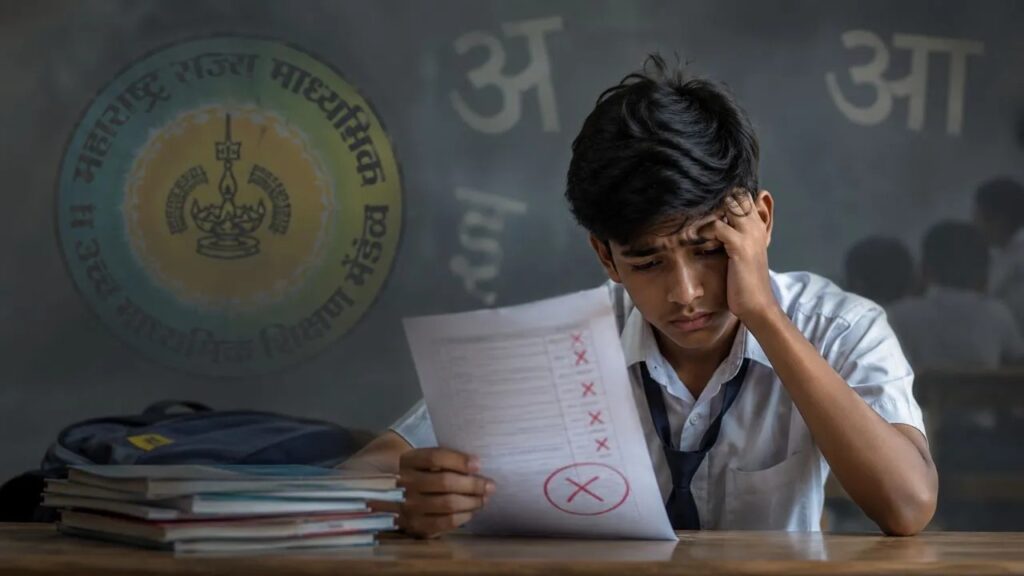
The Maharashtra State Board of Secondary and Higher Secondary Education (MSBSHSE) has come under focus after more than 80,000 students failed the Marathi first language paper in the SSC (Class 10) Examination 2026.
The development has triggered widespread concern among educators, parents, and language experts, especially because Marathi is the official language of Maharashtra and a core subject for lakhs of students across the state.
Over 10 Lakh Students Appeared for Marathi Paper
According to official examination data:
- More than 10.8 lakh students opted for Marathi as their first language subject
- Around 80,803 students failed the paper this year
Despite the high failure count, the overall pass percentage in the Marathi first language paper remained above 92%. However, the large number of failures has raised questions about language proficiency and teaching quality in schools.
Why the Results Have Sparked Concern
Education experts believe the issue goes beyond examination difficulty and reflects deeper challenges in language education.
Key Concerns Raised
- Declining interest in regional languages
- Weak reading and writing skills among students
- Overdependence on rote learning
- Reduced focus on grammar and comprehension
- Growing dominance of English-medium education
Many educators argue that students are increasingly becoming disconnected from their mother tongue despite studying it for several years.
Debate Over Marathi Language Learning
The results have intensified discussions about the quality of Marathi language teaching in schools across Maharashtra.
Experts suggest that:
- Students may struggle with formal Marathi writing
- Classroom teaching methods need modernization
- Language learning should become more interactive and practical
Some teachers also pointed out that students often focus more heavily on science and mathematics subjects, treating language papers as secondary priorities.
Regional Language Education Under Spotlight
The issue comes at a time when language and identity debates are gaining attention in Maharashtra.
Recently, discussions around:
- Promotion of Marathi language
- Use of Marathi in administration
- Regional language preservation
- Language-based education policies
have remained prominent across the state.
Education experts believe stronger language skills are important not only for academics but also for preserving cultural identity and communication abilities.
Overall Maharashtra SSC Performance Remains Strong
Despite concerns regarding Marathi results, Maharashtra SSC 2026 recorded a strong overall performance.
SSC 2026 Highlights
- Overall pass percentage remained above 92%
- Girls outperformed boys once again
- Konkan division emerged among the top-performing regions
However, the Marathi language results have become one of the biggest talking points following the declaration of board results.
Experts Call for Reforms in Language Teaching
Education analysts say the situation highlights the urgent need for reforms in language education.
Suggestions Being Discussed
- Activity-based language learning
- Improved reading culture among students
- Digital Marathi learning tools
- Better teacher training programs
- Stronger focus on comprehension instead of memorization
Some experts also believe schools should encourage students to read Marathi literature, newspapers, and creative content regularly to strengthen language skills.
Importance of Marathi in Maharashtra
Marathi remains one of India’s major regional languages and the official language of Maharashtra.
The language holds deep cultural and historical significance and is widely used in:
- Administration
- Literature
- Media
- Education
- Performing arts
The poor performance in Marathi language examinations has therefore become a matter of wider educational and cultural concern.
Parents and Teachers Seek Balanced Learning
Parents and teachers are now urging schools to maintain a balanced approach between:
- Competitive exam preparation
- STEM education
- Language and communication skills
Many believe that strong command over one’s mother tongue also improves overall cognitive and communication abilities.