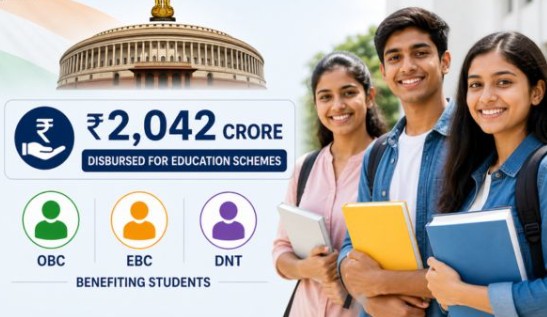
In a significant move aimed at strengthening inclusive education in India, the Ministry of Social Justice and Empowerment has disbursed over ₹2,042 crore on educational schemes during the financial year 2025–26. The investment targets students from Other Backward Classes (OBCs), Economically Backward Classes (EBCs), and De-notified, Nomadic and Semi-Nomadic Tribes (DNTs), reinforcing the government’s focus on bridging educational gaps.
A Major Boost to Educational Inclusion
The ₹2,042 crore allocation marks a substantial commitment toward expanding access to quality education for historically underrepresented communities. Officials noted that the funding is aimed at:
- Improving academic progression among disadvantaged students
- Expanding access to schools, colleges, and higher education institutions
- Strengthening targeted welfare delivery systems
The move reflects a broader national push to align education policy with equity, accessibility, and social justice goals.
Sharp Rise in Scholarship Spending
A closer look at the data reveals significant growth across key scholarship schemes, indicating a targeted expansion of support:
- Pre-Matric Scholarships: ↑ 59.13%
- Post-Matric Scholarships: ↑ 27.18%
- Top Class Education (Schools): ↑ 154%
- Top Class Education (Colleges): ↑ 105.8%
This sharp increase highlights a multi-level intervention strategy, supporting students from school education through to higher studies.
Focus on OBC Welfare Sees Strong Growth
Spending under OBC-focused welfare schemes alone rose by nearly 37% compared to the previous financial year.
This surge signals a more targeted and data-driven approach to educational funding, ensuring that benefits reach those who need them most.
Beyond Funding: Building Academic Pathways
The government’s approach goes beyond financial aid. The schemes are designed to:
- Enable continuity in education from school to university
- Reduce dropout rates among disadvantaged groups
- Promote merit-based advancement through scholarships
Education experts believe such interventions are critical to creating a more equitable academic ecosystem, especially in a country with vast socio-economic diversity.
Part of a Larger Welfare Expansion
The ₹2,042 crore education spending is part of a broader record-breaking expenditure by the ministry, which crossed ₹11,800 crore in FY26 across welfare programmes—a notable increase from the previous year.
This wider allocation covers multiple areas, including:
- Welfare of Scheduled Castes and backward communities
- Skill development and employment initiatives
- Support for vulnerable populations such as senior citizens and transgender persons
Why This Matters Now
The increased investment comes at a time when India is focusing heavily on education as a driver of economic growth and social mobility. With rising competition and evolving job markets, access to quality education is more critical than ever.
Key implications include:
- Greater representation of marginalized groups in higher education
- Improved long-term employment opportunities
- Strengthened human capital development