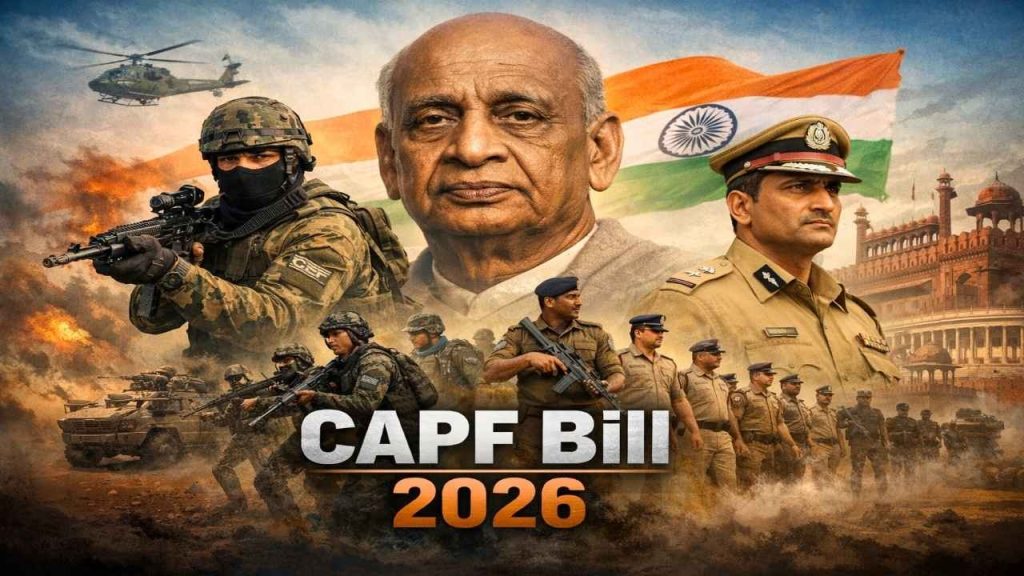
The CAPF Umbrella Bill 2026—officially known as the Central Armed Police Forces (General Administration) Bill—marks a significant shift in how India manages its internal security forces. Designed as a comprehensive administrative reform, the bill seeks to unify service rules, streamline governance, and redefine leadership structures across the Central Armed Police Forces (CAPFs).
This article presents a structured, analytical overview of the bill, its objectives, provisions, and implications.
1. What is the CAPF Umbrella Bill 2026?
The bill is proposed as a single, overarching legal framework to regulate multiple CAPFs, replacing fragmented rules that currently govern different forces.
Forces covered:
- CRPF (Central Reserve Police Force)
- BSF (Border Security Force)
- CISF (Central Industrial Security Force)
- ITBP (Indo-Tibetan Border Police)
- SSB (Sashastra Seema Bal)
Key Insight: The bill aims to bring uniformity in recruitment, promotions, and service conditions across all CAPFs.
2. Core Objective: Administrative Unification
Why an “umbrella” law?
Currently, each CAPF operates under separate acts and service rules, leading to:
- Administrative inconsistencies
- Variations in promotion policies
- Lack of uniform career progression
The bill aims to:
- Standardize service conditions
- Simplify administrative processes
- Improve coordination across forces
Analysis: A unified structure can enhance efficiency, transparency, and operational cohesion.
3. IPS Deputation: The Most Debated Provision
One of the most significant—and controversial—features is the formalisation of IPS deputation in senior roles.
Proposed provisions:
- Reservation of key senior posts (IG, ADG, DG levels) for Indian Police Service (IPS) officers
- Continuation of deputation system in top leadership roles
Key data:
- Around 50% IG-level posts and 67% ADG-level posts may be reserved for IPS officers
Insight: The bill converts an existing practice into a statutory mandate, giving it legal backing.
4. Conflict with Supreme Court Ruling
The bill comes in the backdrop of a 2025 Supreme Court judgment that:
- Granted Organised Group A Services (OGAS) status to CAPF officers
- Directed the government to reduce IPS deputation over time
Issue:
- The bill appears to retain or even strengthen IPS presence instead of reducing it
Analysis: This creates a policy-judicial tension, raising concerns about compliance with judicial directives.
5. Impact on CAPF Cadre Officers
Potential concerns:
- Limited promotion opportunities for CAPF cadre officers
- Perception of inequality in leadership roles
- Career stagnation at senior levels
Possible benefits:
- Structured promotion pathways
- Clear service rules and administrative clarity
Key Point: The bill attempts to balance institutional efficiency with cadre aspirations, but tensions remain.
6. Strategic Rationale Behind the Bill
The government justifies the bill on grounds of:
Operational efficiency:
- Better coordination between Centre and states
- Leveraging IPS experience in policing and administration
National security:
- Stronger leadership structure in critical forces
- Unified command and policy implementation
Insight: The bill reflects a centralised approach to internal security management.
7. Broader Administrative Reforms
Beyond deputation, the bill also aims to:
- Introduce clear service and recruitment rules
- Enable cadre restructuring and promotions
- Standardize administrative procedures
Analysis: This could modernize CAPFs into a more professional and structured security apparatus.
8. Key Challenges and Criticism
Major concerns:
- Undermining autonomy of CAPF cadre officers
- Legal challenges due to conflict with Supreme Court rulings
- Morale issues within forces
- Centralisation vs decentralisation debate
Insight: The bill’s success depends on balancing efficiency with fairness.