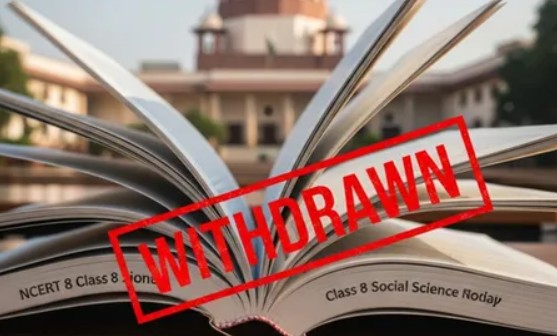
The National Council of Educational Research and Training has been directed to revise the Class 8 Social Science textbook chapter on the judiciary following a controversy that reached the Supreme Court of India. The government has now set up an expert panel to rewrite the chapter after criticism over portions dealing with perceived negative portrayals of the judicial system.
Why Revision Was Ordered: The Controversy Explained
The dispute began after NCERT included a section in the Class 8 textbook that discussed structural challenges faced by the Indian judiciary — including issues like judicial corruption, case backlog, and systemic limitations. Critics argued that the content could undermine trust in the judiciary without adequate context.
The matter escalated when the Supreme Court took suo motu cognisance of the chapter, describing it as poorly calibrated for young learners and potentially damaging to the image of one of India’s key democratic institutions. The Court criticised the authors and even ruled that they should not be involved in writing future textbooks.
Government Response and Legal Outcome
In response to the Supreme Court’s concerns, the Central government informed the court that it has constituted a three-member expert committee to review and rewrite the judiciary chapter. The Court has closed the proceedings following this assurance.
Members of the Expert Committee
- Senior Advocate and former Attorney General KK Venugopal
- Former Supreme Court Judge Justice Indu Malhotra
- Former Supreme Court Judge and National Judicial Academy Director Justice Aniruddha Bose
This committee will ensure that the revised content is balanced, educationally appropriate, and reflects a measured portrayal of judicial functions.
What Happened to the Original Book
Before the panel was formed:
- NCERT withdrew the textbook containing the controversial chapter and halted further distribution.
- The Supreme Court ordered a blanket ban on circulation and production of the book.
- The government issued an unqualified apology for the contentious content.
This sequence marked a rare instance where a textbook was halted after judicial scrutiny — underscoring the sensitivity of educational content around state institutions.
Key Issues Raised by the Court
The Supreme Court’s objections were not limited to the presence of criticism in the chapter but focused on:
- Pedagogical suitability for young students
- Potential to erode public trust in the judiciary
- Perception that the chapter lacked adequate contextual balance on how courts work and contribute to democracy → the Constitution’s scheme places emphasis on the role of judiciary as a guardian of rights and democratic norms.
The Court stressed that discussions regarding judicial functioning and challenges have a place in education, but must be presented thoughtfully and responsibly.
Broader Implications for Textbook Review and Curriculum Oversight
This controversy highlights deeper questions about the NCERT content oversight mechanism, especially around chapters dealing with:
- Constitutional institutions
- Democratic values
- Sensitive societal issues
Legal experts and educators now point toward the need for clearer review processes for curriculum content — balancing academic inquiry with institutional respect.
Public & Academic Reactions
The issue has sparked a wider debate:
- Some argue that students should learn about real-world challenges, including issues like judicial transparency and case backlogs.
- Others emphasise that young learners require well-contextualised material that avoids generalisations and maintains respect for democratic institutions.
This has drawn commentary from civil society, educators, and even student communities about academic freedom versus institutional dignity.