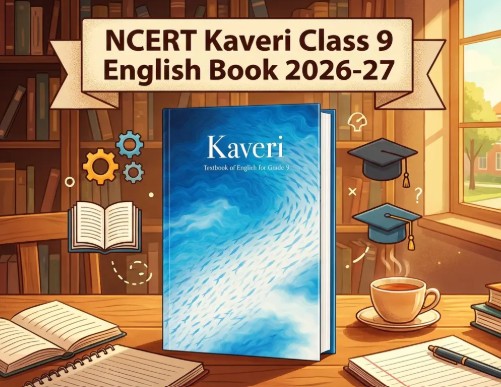
India’s school education system is witnessing another major curriculum change as the National Council of Educational Research and Training (NCERT) introduces a new Class 9 English textbook titled “Kaveri.” The book will be implemented from the 2026-27 academic session and will replace the existing textbooks “Beehive” and “Moments.”
The introduction of Kaveri is part of a broader effort to redesign school textbooks in line with the National Education Policy (NEP) 2020 and the National Curriculum Framework (NCF) 2023. The new textbook aims to shift classroom learning from rote memorisation toward competency-based education, creative thinking, and language skills development.
Why NCERT Introduced the ‘Kaveri’ Textbook
The new textbook reflects a larger reform in India’s education policy that emphasises conceptual learning and real-world application of knowledge.
Key Reasons Behind the Change
- Implementation of NEP 2020 reforms in school curriculum
- Shift from content-heavy textbooks to skill-based learning
- Greater focus on communication and critical thinking
- Integration of Indian culture and literature
- Simplification of the English syllabus for better comprehension
Education experts note that the revised curriculum focuses on building reading, writing, and analytical skills rather than memorising literary content.
Major Changes in the New Class 9 English Textbook
The introduction of Kaveri brings several structural and pedagogical changes to the English curriculum.
1. Replacement of Multiple Books with a Single Textbook
Previously, Class 9 English included three books:
- Beehive (main reader)
- Moments (supplementary reader)
- Words and Expressions (workbook)
The new Kaveri textbook integrates learning elements into a more unified structure, simplifying the curriculum for students.
2. Increased Representation of Indian Authors
One of the key highlights of the textbook is the inclusion of more Indian writers and culturally rooted stories.
For example, the book begins with a story adapted from Sudha Murty’s work “How I Taught My Grandmother to Read.”
The focus on Indian authors aims to help students connect better with literature while learning language skills through familiar cultural contexts.
3. Emphasis on Competency-Based Learning
The new textbook places strong emphasis on developing competencies rather than memorising texts.
Students will engage with activities designed to build:
- Analytical thinking
- Reading comprehension
- Creative writing
- Communication skills
- Interpretation of texts
The curriculum also encourages students to apply language skills in real-life situations.
4. Revised Writing and Language Activities
Kaveri introduces modern writing formats and exercises such as:
- Persuasive essays
- Research-based writing
- Analytical responses
- Project-based language activities
These exercises aim to strengthen students’ practical communication abilities and prepare them for higher academic levels.
Alignment with NEP 2020 and NCF 2023
The launch of Kaveri reflects the broader transformation of school education in India under the National Education Policy 2020.
The revised English curriculum focuses on:
- Holistic development of language skills
- Interdisciplinary learning
- Encouraging curiosity and exploration
- Connecting classroom education with real-life contexts
The textbook also integrates themes related to Indian knowledge systems, social awareness, and cultural diversity.