For students who do not clear Class 10 or Class 12, the word “Fail” printed prominently on a marksheet can carry social pressure and affect how they view their own academic prospects.
The Bihar government now wants to change that language.
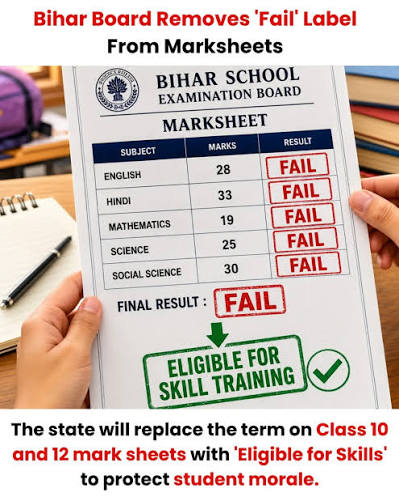
The state has decided to remove the word “Fail” from the marksheets of students appearing for examinations conducted by the Bihar School Examination Board (BSEB). Instead, students who do not meet the required criteria would see the phrase “Eligible for Skill Training”, or “Kaushal ke liye patra”, on their marksheets.
The proposal was announced by Bihar Education Minister Mithilesh Tiwari and is intended to reduce the stigma associated with examination failure while encouraging students to consider skill development and vocational education as alternative pathways.
The change will require amendments to the existing rules before the new terminology can formally be implemented by the Bihar Board.
What Will Change on Bihar Board Marksheets?
Under the proposed system, students who do not pass their BSEB Class 10 or Class 12 board examinations would no longer have the conventional “Fail” label printed on their marksheets.
Instead, the marksheet would indicate that the student is eligible for skill training.
The idea is not to alter a student’s examination performance or passing criteria. Rather, it changes the way the result is represented and, more importantly, signals that not clearing a board examination does not have to be the end of a student’s educational journey.
The proposed terminology shifts the emphasis from a negative academic label to the availability of another pathway.
In simple terms:
Earlier: Student does not meet the passing criteria → “Fail”
Proposed: Student does not meet the passing criteria → “Eligible for Skill Training”
This distinction is central to understanding the reform.
The Bihar government is not announcing automatic promotion or declaring unsuccessful students as having passed. It is proposing a different way of recording the outcome while connecting students with further learning and skill-development opportunities.
Why Bihar Wants to Remove the Word ‘Fail’
The reform is rooted partly in the concern that academic failure can carry a strong social stigma.
Students who do not pass a board examination may face pressure from families, peers and society. A formal document carrying the word “Fail” can reinforce the perception that a student has reached a dead end.
The Bihar government’s approach attempts to change that narrative.
Instead of defining a student solely by an unsuccessful examination result, the new wording points towards what the student can do next.
That is an important shift in the language of education policy:
From “You did not pass” to “Here is another pathway.”
The government has linked the initiative to skill and vocational training opportunities, including routes through the Bihar Board of Open Schooling and Examination (BBOSE).
Skill Training Becomes the Alternative Pathway
The proposed marksheet wording is closely connected to Bihar’s broader effort to expand skill-based education.
Students who do not clear their board examination would be encouraged to explore vocational and skill-development options rather than viewing the examination result as the end of their education.
This can be particularly relevant for students who may have strengths that are not fully reflected in conventional academic examinations.
Skill-based education can provide opportunities to develop practical competencies that are useful for further education, training and employment.
The broader message is that academic performance and future potential are not necessarily the same thing.
Students Will Also Get Another Academic Opportunity
The Bihar government’s approach does not ask students to choose between academic education and skill development.
For students appearing for the Matric supplementary examination, the Education Department has decided to organise special classes for one month to provide additional preparation and academic support.
This creates two possible routes for students who do not achieve the required result:
Route 1: Improve the Academic Result
Students can receive additional preparation and appear for the supplementary examination.
Route 2: Explore Skill Development
Students can consider skill-based or vocational training through available education and training pathways.
The approach recognises that students may need different forms of support after an unsuccessful examination attempt.
The Bigger Idea: A Second Chance, Not a Dead End
The most significant aspect of the Bihar reform may be its philosophy.
Board examinations remain important, but an unsuccessful result does not necessarily mean that a student has no future academic or professional options.
A second chance can take several forms:
- Another attempt through a supplementary examination
- Additional academic classes
- Open schooling
- Vocational education
- Skill development
- Practical training
- Alternative educational pathways
By connecting the marksheet itself to the possibility of skill training, Bihar is attempting to make these alternatives more visible.
Bihar Is Also Changing the School Learning Experience
The proposed marksheet reform is part of a wider set of changes being highlighted by the state education department.
Government schools in Bihar are observing “No-Bag Day” every Saturday, with students encouraged to participate in activities such as theatre, music and other creative pursuits rather than following a conventional classroom routine.
The broader objective is to expose students to learning experiences beyond textbooks and examinations.
This reflects a growing policy emphasis on holistic education, where academic achievement is considered alongside creativity, practical skills and other forms of learning.
Vidya Saathi App to Support Students
Bihar is also using digital tools to provide academic support.
For students in Classes 9 to 12, the government has introduced the Vidya Saathi app, which is intended to connect students with teachers for academic assistance.
The initiative is expected to involve around 75,000 teachers, according to the reported announcement.
Such initiatives suggest that the state is attempting to build a support system around students rather than relying exclusively on the examination result as a measure of educational progress.
What This Means for Class 10 and 12 Students
For BSEB students, the proposed change could alter the way an unsuccessful board result appears on an official document.
However, students and parents should understand that the change in wording does not mean that the passing criteria have been removed.
Students still need to satisfy the applicable requirements to pass the Class 10 or Class 12 board examination.
The proposed reform concerns the terminology used for students who do not clear the examination and the opportunities that can follow.
This is important because headlines such as “Bihar removes fail from marksheets” could otherwise create the mistaken impression that the state has eliminated the concept of passing and failing examinations.
It has not.
Could This Reduce the Stigma Around Academic Failure?
That will ultimately depend on how the policy is implemented.
Changing a word on a marksheet can send a powerful message, but reducing educational stigma requires more than terminology.
Students also need:
- Accessible skill-training opportunities
- Good-quality vocational courses
- Career counselling
- Financially affordable pathways
- Recognition of vocational qualifications
- Opportunities to return to mainstream education
- Support from schools and families
If these systems are available, the new marksheet language could become more than a cosmetic change.
It could become an entry point to a genuinely different educational pathway.
The Reform Also Raises an Important Question
There is an obvious debate around the decision.
Will replacing “Fail” with “Eligible for Skill Training” genuinely help students, or could it simply soften the language without addressing the reasons students struggle?
The answer will depend on what happens beyond the marksheet.
If a student receives a new label but has no accessible training programme, counselling or financial support, the practical impact could remain limited.
But if the new terminology is accompanied by meaningful vocational opportunities and academic second chances, it could help create a more flexible education system.
The distinction is crucial.
Changing the label is the first step. Creating real opportunities is the larger task.
Why the Move Matters Beyond Bihar
The debate over examination failure is not unique to Bihar.
Across India, board examinations can have a major influence on how students perceive their academic abilities and future prospects.
At the same time, education policy is increasingly recognising the importance of vocational education, skill development, experiential learning and multiple pathways.
Bihar’s proposed reform fits into this broader shift.
Instead of viewing the education system as a single road where students either pass or stop, policymakers are increasingly considering a model with multiple routes.
A student may continue through conventional academic education, move into vocational training, improve through a supplementary examination or combine different forms of learning.
That is a fundamentally different way of thinking about educational progression.
Bihar Board Marksheets: What Students Need to Know
| Issue | Proposed change |
|---|---|
| Classes affected | Class 10 and Class 12 |
| Board | Bihar School Examination Board (BSEB) |
| Current terminology | “Fail” for students who do not clear the examination |
| Proposed terminology | “Eligible for Skill Training” |
| Purpose | Reduce stigma and promote alternative pathways |
| Skill pathway | Students can explore skill-based training, including through BBOSE |
| Academic second chance | Special classes planned for Matric supplementary-exam students |
| Passing criteria | Not removed by the proposed terminology change |
| Legal status | Existing rules need to be amended before implementation |
A New Message for Students: One Result Does Not Define Your Future
The Bihar government’s proposed decision carries a message that extends beyond examination certificates.
A board examination can measure a student’s performance in a particular set of subjects at a particular point in time. It does not necessarily measure every practical skill, talent or ability a young person may possess.
That does not make academic performance unimportant.
It means that the education system can provide more than one route towards progress.
For students who struggle with conventional examinations, a meaningful combination of supplementary academic support, vocational education and skill development could provide opportunities that might otherwise remain out of reach.
What Happens Next?
The immediate next step is a formal amendment of the relevant rules.
Once the rules are changed, the Bihar School Examination Board will need to implement the revised terminology in its examination and marksheet systems.
The government will also need to ensure that the promised skill-development pathways and supplementary support are accessible to students who need them.
The effectiveness of the reform will therefore be measured not by the disappearance of one word from a marksheet, but by whether students actually receive better second chances and more meaningful alternatives.
The Bottom Line
Bihar’s proposal to remove the word “Fail” from Class 10 and Class 12 marksheets represents a significant change in how the state wants academic setbacks to be understood.
The proposed phrase “Eligible for Skill Training” reframes an unsuccessful examination result as a point from which another pathway can begin.
But the real significance of the move will depend on implementation.
If students are given access to quality vocational courses, skill training, career guidance and opportunities to improve their academic results, the reform could help make Bihar’s education system more flexible and inclusive.
The message is simple but important:
A failed examination does not have to mean a failed future.