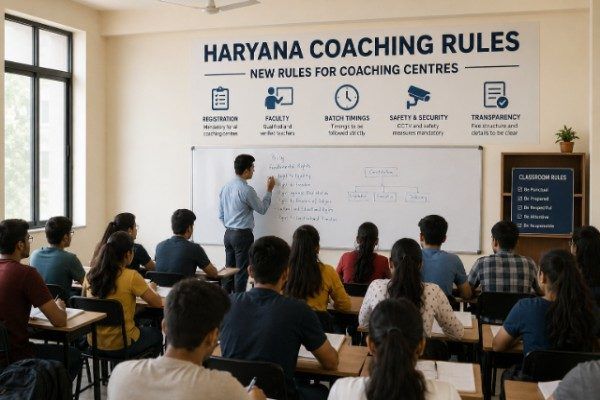
Haryana has tightened the regulatory framework governing private coaching institutes, with the state government now formally prohibiting coaching classes for school-going students during their regular school hours.
The move is aimed at strengthening students’ participation in formal schooling and addressing the growing practice of “dummy schools”, where students remain formally enrolled in schools but spend much of their academic time attending coaching classes.
The Haryana Private Coaching Institutes (Registration and Regulation) Rules, 2026, notified on August 24, bring both existing and new coaching institutes under a mandatory registration system while prescribing requirements relating to fees, infrastructure, staff, student records and institutional disclosures.
For students and parents, the new rules could significantly change how coaching and regular schooling operate alongside each other in the state.
No Coaching During Regular School Hours
The most prominent provision of the new Haryana coaching rules is a clear restriction on coaching classes during school or institutional working hours.
Private coaching institutes will have to submit an affidavit confirming that they will not conduct classes for students during their regular school hours.
The provision is intended to ensure that students enrolled in schools continue to attend their regular classes rather than spending school hours at private coaching centres.
The policy also aligns with the Centre’s broader 2024 guidelines for regulation of coaching centres, which called for coaching classes not to interfere with students’ regular attendance at schools and other educational institutions.
Why the focus on school hours?
The restriction is closely connected to concerns over the dummy school model.
Under this arrangement, students may formally remain enrolled in a school but devote much of their time to coaching for competitive examinations. The Haryana government’s latest rules seek to reinforce the principle that school enrolment should involve actual participation in classroom education.
The government has therefore placed the responsibility not only on schools and students but also on coaching institutes that provide such classes.
Registration Now Mandatory for Coaching Institutes
The new framework makes registration compulsory for private coaching institutes operating in Haryana.
This requirement applies to existing as well as new coaching centres.
Institutes have to apply through the designated online system and pay a ₹10,000 registration fee. The registration certificate will remain valid for three years, after which renewal will be required.
The authorities are expected to scrutinise applications within 30 days.
For renewal, the applicable fee has been set at ₹5,000, according to the notified regulatory framework.
The mandatory registration system gives the state a formal mechanism to identify coaching providers and monitor their operations.
What Information Will Coaching Centres Have to Disclose?
The rules go beyond registration.
Coaching institutes will have to provide information about their academic and operational arrangements, including:
- Courses offered
- Curriculum
- Course duration
- Fee structure
- Number of students
- Batch size
- Classroom capacity
- Qualifications of teaching staff
- Details of counselling and non-teaching staff
- Basic facilities available at the institute
- Staff verification details
Institutes are also expected to maintain prescribed records and provide information to the authorities when required.
The objective is to bring greater transparency and accountability to the private coaching sector, which has expanded rapidly in response to demand for board examinations and competitive entrance tests.
Infrastructure and Safety Requirements Tightened
The new Haryana coaching rules also place emphasis on the physical infrastructure of coaching centres.
Institutes will have to provide or disclose information about facilities such as:
- Adequate classroom space
- Furniture and lighting
- Drinking water
- Separate toilets
- Fire-safety arrangements
- First-aid or medical assistance
- Parking facilities, where applicable
- Library or reading room
- Wi-Fi facilities
- Smart boards
- Computer laboratories
- Hostel and canteen facilities, where applicable
Information regarding the building itself will also have to be furnished, including whether the premises are owned, leased or rented.
Institutes must provide relevant fire-safety and structural-stability certificates and information concerning barrier-free access for students with disabilities.
Teacher Qualifications and Staff Verification Under Watch
The rules also seek greater scrutiny of people working at coaching institutes.
Coaching centres will have to disclose the qualifications of their teaching personnel and provide information about counselling and other staff.
They will also have to furnish details concerning verification of the character and antecedents of staff members.
This represents a broader shift away from treating coaching institutes simply as private tuition providers towards regulating them as institutions with defined responsibilities towards students and parents.
Coaching Institutes Cannot Mislead Students Through Their Branding
Another notable provision concerns how registered institutes present themselves to students and parents.
A registered coaching institute can use the term “registered coaching institute” on signboards or in prospectuses.
However, it cannot describe itself as “recognised” or “approved” merely because it has obtained registration.
The distinction is important because registration under a regulatory framework does not necessarily mean that the government endorses the academic claims or results advertised by an institute.
Penalties for Violating the Rules
The new framework also establishes financial penalties for violations.
A coaching institute can face a ₹25,000 fine for the first violation.
A subsequent violation can attract a penalty of ₹1 lakh.
If the violation continues despite the penalties, the institute’s registration can ultimately be cancelled.
The penalty structure gives the rules an enforcement mechanism rather than leaving compliance entirely dependent on voluntary action.
Why Haryana Is Regulating Coaching Institutes Now
The move comes amid growing national concern over the expansion of private coaching and the academic pressure faced by students.
Coaching centres have become an important part of the education ecosystem, particularly for students preparing for competitive examinations. At the same time, governments have raised concerns about unregulated operations, excessive fees, misleading claims, infrastructure and student safety.
The Ministry of Education circulated its Guidelines for Regulation of Coaching Centers to states and Union Territories in January 2024. Those guidelines addressed registration, infrastructure, fees, student welfare, grievance redressal and the need to prevent coaching classes from interfering with students’ regular school attendance.
Because education is a subject on the Concurrent List, states have the responsibility to create appropriate legal and regulatory frameworks for implementation.
Haryana’s latest rules represent a state-level move to put those principles into a formal regulatory structure.
What the New Rules Mean for Students
For school-going students, the most immediate change is straightforward: coaching institutes cannot schedule their classes during regular school hours.
This could affect students who previously attended coaching centres during the day while remaining enrolled in schools.
The policy could also encourage a clearer separation between:
Regular school education → School hours
Private coaching → Outside school hours
The government’s stated objective is to ensure that coaching does not replace classroom education for students who are officially enrolled in schools.
What It Means for Parents
Parents may also need to reassess coaching arrangements.
Instead of choosing a coaching programme primarily on the basis of daytime availability, families will have to consider whether coaching schedules can operate outside the student’s regular school hours.
The new registration system may also make it easier for parents to identify whether a coaching centre is operating within the regulatory framework.
However, registration alone should not be interpreted as a guarantee of academic outcomes. Parents will still need to consider factors such as teaching quality, course structure, fees, student workload and the institute’s actual compliance with the rules.
A Challenge for the Coaching Industry
For coaching institutes, the new framework means significantly greater administrative responsibility.
They will have to register, disclose information, maintain records, meet prescribed infrastructure requirements and comply with restrictions on school-hour classes.
Institutes that previously relied heavily on school-going students attending daytime batches may need to restructure their schedules.
The regulations could therefore push the coaching industry towards more formal operations and greater transparency.
Will the Rules Eliminate Dummy Schools?
The ban on coaching during school hours is clearly aimed at the dummy-school ecosystem, but its effectiveness will depend heavily on enforcement.
A regulation can prevent a coaching centre from formally conducting classes during school hours, but ensuring that students actually attend their schools will require coordination among schools, parents, coaching institutes and education authorities.
Regular attendance monitoring and effective inspection will therefore be important if the policy is to achieve its larger objective.
The rules address one important part of the problem, but eliminating dummy-school practices will require consistent implementation on the ground.
Haryana’s Coaching Rules: Key Provisions at a Glance
| Provision | What the new rules say |
|---|---|
| School-hour coaching | Coaching classes for school/institution students cannot be conducted during regular study or working hours |
| Registration | Mandatory for existing and new private coaching institutes |
| Registration fee | ₹10,000 |
| Validity | Three years |
| Renewal fee | ₹5,000 |
| Application scrutiny | To be completed within 30 days |
| First violation | ₹25,000 penalty |
| Subsequent violation | ₹1 lakh penalty |
| Continued violation | Registration can be cancelled |
| Staff disclosure | Qualifications and verification details required |
| Infrastructure | Safety and basic student facilities must be disclosed |
| Public representation | Registered institutes cannot falsely describe themselves as “recognised” or “approved” |
A Bigger Shift in India’s Coaching Culture
Haryana’s move is part of a larger national conversation about the role of coaching in school education.
Competitive examinations have created enormous demand for private coaching, but the growing dependence on coaching has also raised questions about classroom learning, student workload, educational inequality and the commercialisation of academic preparation.
The central coaching-centre guidelines already recognise the need to prevent coaching from disrupting regular schooling. Haryana’s decision to give that principle a formal legal and regulatory framework could therefore become significant beyond the state itself.
The larger question is whether regulation can strike the right balance: allowing students access to supplementary academic support while ensuring that private coaching does not effectively replace school education.
The Bottom Line
Haryana’s new coaching rules send a clear message: school-going students are expected to remain in school during school hours, while private coaching must operate around—not instead of—the formal education system.
By making registration mandatory, introducing disclosure requirements, strengthening infrastructure norms and imposing penalties, the state has moved towards a more accountable coaching ecosystem.
The ban on coaching during school hours is likely to attract the most attention because of its connection with dummy schools. But the significance of the rules extends further.
They represent an attempt to bring an increasingly influential part of the education sector under formal oversight.
For students, the immediate change is a restriction on daytime coaching. For parents, it means greater scrutiny of coaching arrangements. For institutes, it marks a new era of registration, compliance and accountability.
Whether the rules ultimately reduce dummy schooling and improve students’ engagement with regular classrooms will depend on one crucial factor: how consistently they are enforced.