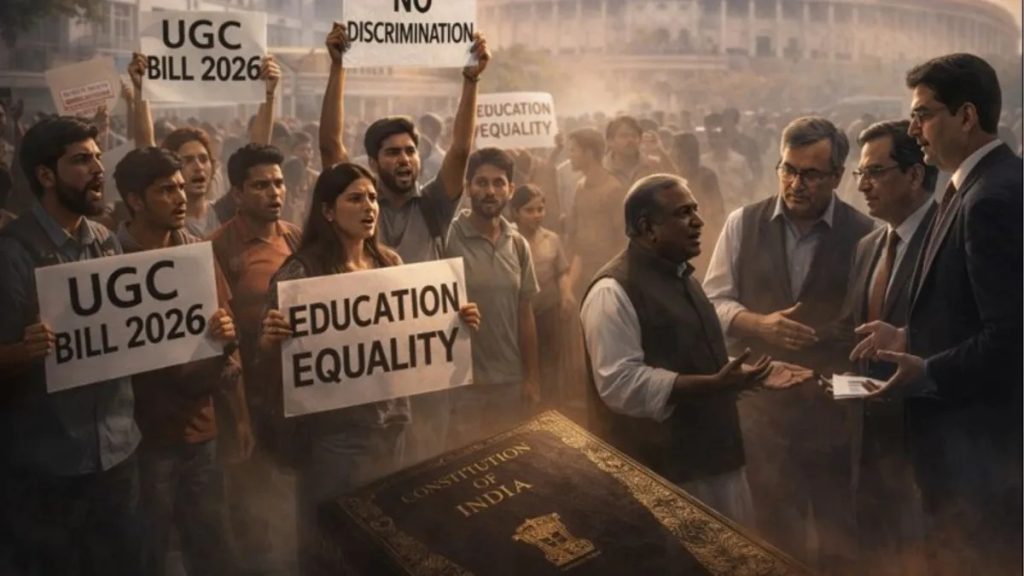
In January 2026, the University Grants Commission (UGC) notified the Promotion of Equity in Higher Education Institutions Regulations, 2026, aimed at strengthening anti-discrimination mechanisms across Indian universities and colleges. While the regulations were framed as a major step toward promoting inclusive and bias-free campus environments, they have triggered intense backlash from various student groups, academics and public commentators.
What was intended as a reform for equity and social justice has quickly become a nationwide flashpoint — sparking protests, legal petitions and a wider public discourse on fairness, procedural safeguards and the future of higher education policy in India.
What the UGC Equity Regulations 2026 Say
The core objective of the new regulations is to institutionalize mechanisms that prevent and address discrimination based on caste, gender, religion, disability, race and place of birth within higher education institutions. Key provisions include:
- Mandatory Equal Opportunity Centres (EOC) in every university and college to handle complaints, provide counseling and awareness programs.
- Equity Committees with prescribed representation — including Scheduled Castes (SC), Scheduled Tribes (ST), Other Backward Classes (OBC), women and persons with disabilities — to inquire into grievances.
- Equity Squads and Ambassadors to monitor campus environments and respond to incidents.
- 24×7 Helplines and Fast Track Redressal timelines (e.g., initial review in 24 hours, report within 15 working days).
- Penalties for institutional non-compliance, including potential loss of recognition or funding.
The UGC’s own data shows a significant increase in caste-based discrimination complaints in recent years — rising from 173 in 2017-18 to over 378 in 2023-24 — prompting calls for stronger campus protections.
Why Students and Critics Are Protesting
Despite stated intentions, the regulations have triggered widespread dissent. Major grievances include the following:
1. Perceived Bias Against General Category Students
Protesters, particularly from general or unreserved categories, argue that the regulations appear to focus disproportionately on discrimination against reserved categories while lacking explicit safeguards for other students. They contend that:
- The Equity Committee structure does not guarantee representation for general category students.
- The definitions of discrimination — including “implicit discrimination” — are broad and may be subjective, increasing the risk of false or arbitrary complaints.
2. Lack of Procedural Safeguards
One of the central points of criticism is that the final notified regulations omitted penalties for false or malicious complaints, which appeared in earlier drafts. Opponents argue this could create a framework where allegations carry consequences even before guilt is established.
Student groups have described the system as potentially leading to reverse discrimination or reputational harm for those wrongly accused.
3. Campus Climate Concerns
Critics also warn that the introduction of equity squads and monitoring teams could foster a culture of surveillance rather than trust, chilling normal academic and social interactions.
Some protesters have likened the environment to “constant monitoring,” raising fears of stifling free speech and everyday discourse on campuses.
Protests, Resignations and Legal Pushback
The opposition has gone beyond social media debates.
- Student demonstrations have taken place at UGC headquarters and in several states, including Uttar Pradesh.
- A Public Interest Litigation (PIL) challenging the regulations’ constitutionality is underway, with petitions arguing the rules create untenable presumptions and lack procedural fairness.
- In a dramatic protest, Bareilly City Magistrate Alankar Agnihotri resigned, citing the regulations as discriminatory against general category students.
- Other local political figures and student leaders have also voiced dissent.
These developments reflect the broader political and social tensions ignited by the policy, extending the debate into public discourse beyond campuses.
Government Response and Official Position
Union Education Minister Dharmendra Pradhan has defended the new regulations, assuring the public that they will be implemented fairly and that no one will be allowed to misuse the framework. He emphasized that the process operates within the Constitution and under judicial oversight.
The government maintains that the regulations are necessary to address long-standing systemic issues in higher education and to build safer, more inclusive institutions.
Balancing Equity and Procedural Fairness: The Way Forward
The UGC Equity Regulations 2026 spotlight the difficult balance between ensuring protections for vulnerable groups and maintaining procedural fairness for all students. While intent and statutory goals are broadly supported by advocates of equity, the current structure — particularly the absence of clear safeguards against misuse and subjective definitions — has fueled distrust among significant sections of the student population.
Whether through legislative refinement, judicial interpretation or stakeholder consultation, many analysts argue that a revised framework that preserves both equity goals and due process protections will be key to achieving stable acceptance and effective implementation.