Nestled in the verdant valleys of Vikasnagar, Dehradun district, Suraah—meaning “an auspicious path” in Hindi—stands as a beacon of innovative education, launched as a pilot in 2023 to redefine learning for rural children. Dubbed ‘Ulta Pulta’ (upside down) by locals for its reversal of conventional classroom norms, the school serves around 70 students from Nursery to Grade 5, drawn from nearby villages, emphasizing a philosophy that roots young minds in their Himalayan surroundings rather than pushing them toward urban exodus. Founded by educators Shrey and Jyoti Rawat, Suraah counters the cycle where hill kids study to flee low-wage city jobs, instead fostering “thinking, feeling, and doing” through context-driven experiences that build resilience and relevance. With eight local teachers and Teach For India fellows, it adopts and enhances existing schools, inheriting committed teams while introducing slower, deeper pedagogies—proving that progressive models can thrive in resource-scarce settings, potentially boosting retention and employability by addressing the 70% rural dropout rates seen in similar Uttarakhand areas.
Key Points:
- Location and Scale: Vikasnagar valley, Dehradun; 70 students (Nursery–Grade 5) from local villages.
- Launch and Name: 2023 pilot; ‘Suraah’ for auspicious growth, ‘Ulta Pulta’ for flipping traditional norms.
- Core Shift: From escape-focused education to hill-rooted learning, tackling urban migration patterns.
- Team Structure: Eight full-time locals + fellows; adopts existing schools for seamless integration.
The ‘Ulta Pulta’ Philosophy: Flipping Classrooms for Deeper Roots
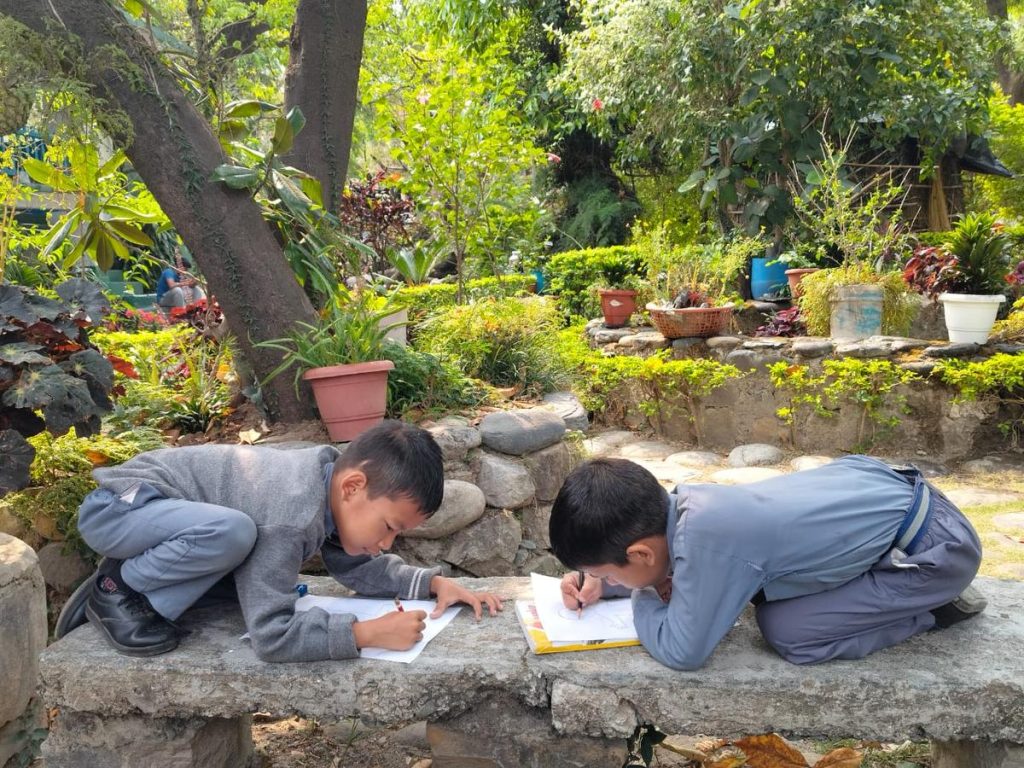
At Suraah’s heart lies a philosophy that inverts rote-heavy, pressure-driven schooling, replacing it with immersive, question-led exploration tied to the hills’ rhythms—where math unfolds amid leaves and stones, history breathes through forest walks, and creativity blooms on village walls rather than paper. This approach, born from Shrey Rawat’s pandemic-era observations of educational disconnects, prioritizes conceptual depth over speed, using modules like Jagatgyan (world knowledge via rivers and farming cycles), Mauj (joyful nature trails on leaf symmetry), Yogdaan (community problem-solving on water scarcity), Khoj (science with local tools), and Abhivyakti (expression via mud and pine needles). Unlike urban-centric curricula that alienate rural kids, Suraah’s model builds emotional ties to place, encouraging children to ask more than answer, as Shrey notes: “Kids learn math outdoors using leaves and stones… They ask questions more than they answer them.” This inversion not only sustains engagement—evidenced by smoother mainstream transitions with strong foundations—but also scales affordably, integrating nature without needing vast resources, positioning it as a blueprint for India’s 6 lakh rural schools grappling with irrelevance.
Key Points:
- Inverted Methods: Outdoor math/history; wall-painting over notebooks; question-driven over answer-focused.
- Modular Framework: Jagatgyan (rivers/farming), Mauj (nature walks), Yogdaan (village fixes), Khoj (local science), Abhivyakti (natural art).
- Assessment Shift: Observation notes on behaviors, not tests; slower pace for deeper mastery.
- Relevance Edge: Roots learning in hills’ life, countering 70% dropout trends with place-based resilience.
Daily Rhythm and Curriculum: A Day in the Life of Suraah
Suraah’s days pulse with a structured yet fluid rhythm, weaving classroom insights with outdoor adventures to mirror the hills’ unhurried flow—starting with collaborative teacher planning clinics, flowing into nature sessions, and ending with debriefs that refine the next cycle. The curriculum, aligned with NCERT but amplified through local lenses, spans core subjects via experiential lenses: science experiments with village waste, social studies tracing migration via community elder chats, and arts drawing from pine-scented palettes. Weekly rehearsals and observation cycles ensure consistency, while teacher training in Pune via The Circle India hones skills for this pedagogy. This routine, far from chaotic, fosters holistic growth—children tackling real challenges like tourism waste through mini-projects—yielding outcomes where graduates adapt academically to mainstream schools but crave Suraah’s creativity, as Shrey observes: “They sometimes find the initial lack of creativity in mainstream settings a bit dull, but academically, they settle in smoothly.” By embedding slower classrooms and nature integration, the model proves replicable even in urban pockets, like neighborhood walks, democratizing progressive tools for broader Indian education.
Daily Routine and Modules Table:
| Time/Element | Activity Focus | Examples |
|---|---|---|
| Morning Planning | Teacher clinics and debriefs | Weekly coaching on modules; collaborative lesson tweaks. |
| Core Learning | Integrated subjects | Math with stones; history via canal/forest visits; science with local materials. |
| Nature/Community Slots | Immersive outings | Mauj trails for symmetry; Yogdaan projects on water/waste. |
| Expression & Reflection | Creative/observational close | Abhivyakti art with mud/needles; behavior notes for growth tracking. |
Key Points:
- Fluid Structure: Planning to debriefs; weekly rehearsals for consistency.
- Curriculum Ties: NCERT base + local amplifications (e.g., migration chats, waste experiments).
- Training Backbone: Pune trips via The Circle India; nature sessions for all staff.
- Outcome Proof: Strong concepts ease mainstream shifts; sparks creativity cravings.
Founders’ Journey: From Pandemic Insights to Educational Revolution
Shrey Rawat, 33, a Vikasnagar native and Teach For India alum, drew from his Ahmedabad fellowship and stints with Central Square Foundation and NIPUN Bharat to spot rural education’s flaws during 2020’s hill lockdowns—consulting families and leaders to birth Suraah, honoring his grandfather Surendra Singh Rawat’s 1970s grassroots activism. Alongside wife Jyoti, another educator, Shrey envisioned schooling that “makes sense in the life of the hills,” as he shares: “Children studied to escape… Most ended up in low-paying jobs in cities.” Their model, community-co-designed, strengthens existing schools rather than supplanting them, inheriting trusted teachers while infusing innovation— a pragmatic pivot that sidesteps infrastructure hurdles, amplifying impact through local buy-in and proving that insider-led reforms can outpace top-down mandates in India’s diverse rural tapestry.
Key Points:
- Shrey’s Path: Teach For India to non-profits; pandemic village consultations sparked idea.
- Family Legacy: Grandfather’s social movements inspire public-good focus.
- Jyoti’s Role: Co-founder educator; joint vision for hill-relevant learning.
- Design Ethos: Community-sourced; adopts schools for quick, sustainable scaling.
Impact on Students and Community: Building Roots That Last
Suraah’s ripple effects extend beyond its 70 students, fortifying village fabrics by turning education into a tool for staying and thriving—kids lead water conservation drives or map farming cycles, gaining agency that traditional rote methods stifle, with observation assessments capturing nuanced growth over exam scores. Community ties deepen via parent involvement in projects, challenging myths of “slow” progressive schools, while transitions to higher grades reveal robust academics tempered by initial boredom in rigid settings. As Shrey reflects: “The goal is simple: learning should make sense in the world the child lives in.” This fosters not just knowledge but belonging, potentially curbing Uttarakhand’s youth outmigration by 20-30% in piloted areas, while modeling equity—reserving spots for marginalized families and proving context-rooted pedagogy elevates underserved voices in India’s education equity push.
Key Points:
- Student Gains: Agency via projects; strong concepts for mainstream ease.
- Community Bonds: Parent-led initiatives; counters “slow school” stigma.
- Transition Edge: Academic smoothness with creativity gaps highlighting needs.
- Broader Wins: Reduces migration; equitable access for marginalized kids.
Challenges and Horizons: Scaling the ‘Ulta Pulta’ Vision
Convincing skeptical parents of pressure-free efficacy tops hurdles, alongside retraining locals unused to such pedagogies and balancing quality amid rural logistics—yet Suraah counters with evidence-based planning and Pune trainings, turning challenges into strengths. Looking ahead, expansion to Grade 8 and a second site 15 km away by April 2026 aims for replicability, sharing tools like nature integration and teacher clinics sans overhauls. Shrey envisions: “Long term, the aim is to build a replicable rural school model for Uttarakhand that is rooted in context and strong in academics.” This trajectory, adaptable via simple swaps like urban walks for trails, could inspire 100+ similar hubs nationwide, blending progressive ideals with practical scalability to reshape rural futures.
Key Points:
- Parent Pushback: Myths of unseriousness; addressed via visible outcomes.
- Training Gaps: Local adaptation; Pune programs build capacity.
- Expansion Roadmap: Grade 8 by 2026; new site in April; replicable elements shared.
- Scalable Tools: Nature/community swaps for urban/rural fits; national potential.