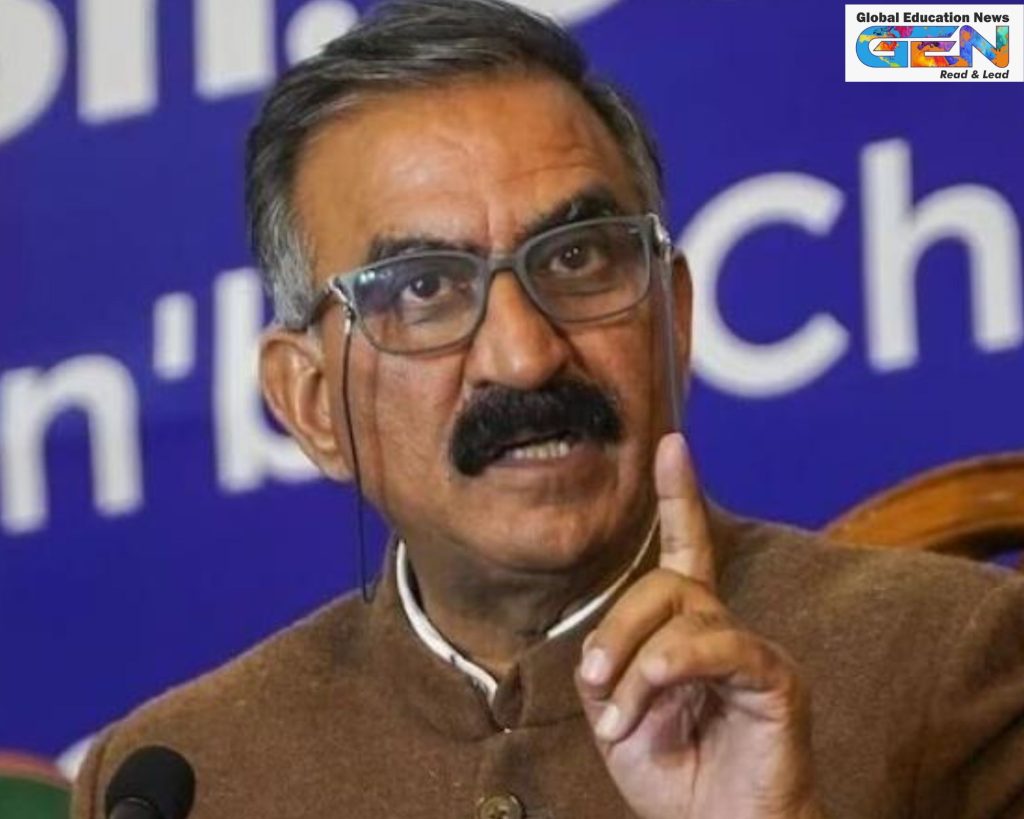
As Himachal Pradesh gears up for a transformative 2026 academic year, Chief Minister Sukhvinder Singh Sukhu has unveiled a sweeping education policy overhaul designed to elevate government schools to national standards. Announced on December 30, 2025, during a review meeting, the reforms include transitioning select government schools to the Central Board of Secondary Education (CBSE) curriculum, appointing specialized instructors for English and Mathematics, and introducing multi-subject options to foster student interests. This isn’t mere tinkering—it’s a strategic pivot to bridge the quality gap between public and private institutions, aligning with NEP 2020’s emphasis on choice, competency, and equity. With Himachal’s 8,000+ government schools serving 5 lakh+ students, these changes could redefine access to holistic learning, especially in rural pockets where enrolment dips 10-15% annually (per 2025 UDISE data). As Sukhu emphasized, “The work on the Rajiv Gandhi Day Boarding School is progressing rapidly and classes will begin from next year.” This analysis breaks down the key announcements, timelines, and transformative potential of Himachal’s education renaissance.
Policy Overhaul: CBSE Shift and Multi-Subject Flexibility
At the reform’s core is a bold embrace of CBSE standards for government schools, starting with a pilot to enhance curriculum rigor and national alignment. Amlehar school has already been granted CBSE affiliation, marking the first step in a broader transition.
- CBSE Curriculum Adoption: Government schools will progressively shift to CBSE, introducing standardized syllabi that emphasize critical thinking and skill-building over rote learning. This addresses the 20% performance gap between state and CBSE boards in Class 10 results (2025 data).
- Multi-Subject Introduction: Four selected schools, including Amlehar, will offer diverse subjects from the next academic year, allowing students to choose based on interests—e.g., arts, sciences, or vocational tracks. Sukhu highlighted: “Multiple subjects will be introduced in four selected schools of the state, including Amlehar, so that children can choose subjects of their interest.”
- Rajiv Gandhi Day Boarding School: Construction is advancing swiftly, with classes slated to commence in 2026. This flagship facility will provide extended learning hours, nutrition, and extracurriculars, targeting 500-1,000 students initially.
These changes aim to boost retention (currently 85% in primary) and prepare students for competitive exams, per NEP’s multidisciplinary ethos.
| Reform | Scope | Timeline | Expected Benefits |
|---|---|---|---|
| CBSE Shift | Pilot schools like Amlehar | 2026 rollout | Standardized quality; 15-20% score uplift. |
| Multi-Subject Options | 4 schools (Amlehar included) | Next academic year | Personalized learning; interest-driven retention. |
| Day Boarding School | Rajiv Gandhi facility | Classes from 2026 | Extended hours; holistic development for 500+ kids. |
Recruitment Drive: Special Instructors for English and Math
To support the CBSE transition, the government will recruit specialized instructors for English and Mathematics, addressing chronic shortages in these foundational subjects.
- Recruitment Focus: Dedicated roles in CBSE-affiliated government schools to enhance language and quantitative skills—critical for 40% of Class 5 students struggling with basic math (ASER 2025).
- Process and Scale: “The recruitment process to appoint these instructors will begin soon,” Sukhu confirmed. Initial hires target 200-300 positions, with training via SCERT Himachal.
- Impact on Teachers: Existing faculty get upskilling, easing workload and boosting confidence in CBSE delivery.
This human capital infusion could narrow the 25% urban-rural proficiency divide, per state education metrics.
Broader Vision: Aligning with NEP and State Priorities
Sukhu’s reforms dovetail with NEP 2020’s push for flexible curricula and teacher empowerment, while tackling Himachal’s unique challenges like migration and gender gaps (girls’ enrolment at 48%).
- NEP Synergies: Multi-subject choices embody NEP’s credit-based flexibility; instructor recruitment supports the 1:30 teacher-student ratio.
- State-Specific Tweaks: Focus on hill-state needs—e.g., digital tools for remote schools and eco-curricula for disaster-prone areas.
- Funding and Scale: ₹500 crore allocation in FY26 budget; pilot success to expand to 20 schools by 2027.
Challenges: Infrastructure lags in 30% remote schools; teacher retention amid 10% vacancies. Sukhu’s optimism: “These steps will ensure quality education reaches every child.”
Implications: A Brighter Horizon for Himachal’s Learners
For 5 lakh+ students, these changes promise choice over conformity—potentially lifting pass rates by 10-15% and college readiness. Teachers gain support, reducing burnout (20% rise in 2025 surveys). Nationally, Himachal’s model could inspire hill states like Uttarakhand.
Yet, execution’s the elixir: Timely hires and seamless CBSE integration are key. As 2026 unfolds, Sukhu’s vision could turn policy into progress.