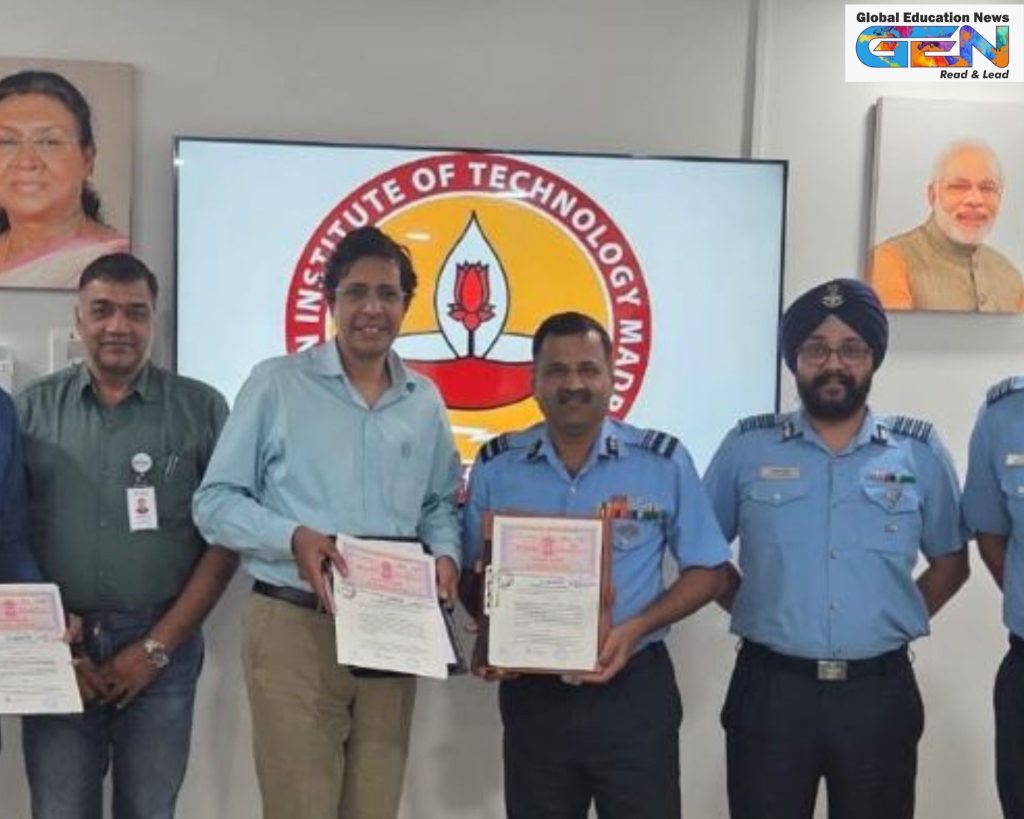
As of December 30, 2025, the Indian Air Force (IAF) has forged a strategic alliance with IIT Madras to pioneer an indigenous digital communication system tailored for airborne platforms, a move that underscores India’s deepening commitment to technological sovereignty in defence. Signed on December 29 through a Memorandum of Understanding (MoU) between the IAF’s Software Development Institute and IIT Madras, this collaboration harnesses the institute’s prowess in communication systems and cybersecurity alongside the air force’s operational acumen. In an era where network-centric warfare demands seamless, secure data flows amid dynamic skies, the initiative targets high-speed networking and robust encryption to shield aircraft from cyber threats. Aligned with Atmanirbhar Bharat, it addresses India’s heavy reliance on imported defence equipment, potentially revolutionizing missions from reconnaissance to command coordination. This partnership not only amplifies IIT Madras’s growing defence R&D footprint but also exemplifies academia’s pivot to national priorities. This analysis dissects the MoU’s architecture, technological pillars, anticipated dividends, and far-reaching echoes, illuminating how such synergies could propel India toward self-reliant skies.
Background: Bridging Academia and Air Power in India’s Defence Innovation Drive
India’s defence sector, valued at ₹6.8 lakh crore in FY25, grapples with 60-70% import dependence in critical subsystems like communication tech—vulnerabilities exposed in exercises like Tarang Shakti 2024. The IAF, operating 2,000+ aircraft, seeks resilient networks for real-time intel sharing, a gap widened by geopolitical supply disruptions.
- Strategic Context: Post-Galwan, initiatives like the Critical Minerals Mission (2023) and Defence Corridors have spotlighted indigenous R&D; IIT Madras, with its aerospace legacy (e.g., hypersonic wind tunnels), emerges as a natural ally.
- IIT’s Defence Footprint: The institute’s collaborations—spanning AI for drones with DRDO and materials for LCA Tejas—position it as a hub, with 15% research funding now defence-linked.
- MoU Catalyst: Born from joint consultations, it operationalizes NEP 2020’s academia-industry nexus, targeting prototypes for IAF’s multi-platform ops.
This backdrop frames the MoU as a tactical fusion, not fleeting flirtation, in India’s ascent to a $1 trillion defence economy by 2030.
Partnership Details: Key Players and Framework
The MoU, inked at IIT Madras, formalizes a collaborative ecosystem blending theoretical innovation with battlefield validation, with milestones tied to phased deliverables.
| Stakeholder | Role | Key Representative |
|---|---|---|
| Indian Air Force (Software Development Institute) | Operational domain expertise; testing and integration of prototypes. | Air Vice Marshal R Guruhari (Commandant) |
| IIT Madras | R&D in algorithms, cybersecurity, and system design. | Professor V Kamakoti (Director) |
| Pravartak Technologies Foundation | Tech transfer and commercialization bridge. | Dr M J Shankar Raman (CEO) |
- Scope and Duration: Multi-year (details pending); focuses on design, prototyping, and deployment readiness.
- Governance: Joint steering committee; IP co-owned, with IAF priority access.
- Funding Model: IAF seed capital; IIT grants via DST/DRDO; potential PLI extensions.
This triad ensures agility, from lab sketches to live flights.
Objectives: Securing Skies Through Self-Reliance
The partnership’s north star: Engineer a system resilient to motion, jamming, and hacks, enabling “information dominance” in contested airspace.
- Core Goals:
- Develop scalable, secure networks for aircraft-sensor-command linkages.
- Integrate with legacy systems (e.g., Su-30MKI, Rafale) for plug-and-play upgrades.
- Foster long-term sovereignty, cutting import costs (₹5,000 crore annually for comms).
- Operational Edge: Real-time data exchange under duress—vital for swarm ops or border patrols.
- Broader Alignment: Supports IAF’s 2047 vision of 10,000+ sorties with indigenous tech.
As Guruhari noted: “This collaboration… delivers practical solutions for airborne platforms.”
Technologies Involved: From Encryption to Edge Networking
Leveraging IIT’s labs (e.g., RF and Microwave group), the focus fuses cutting-edge comms with defence-grade hardening.
- Encryption Suite: Quantum-resistant algorithms; end-to-end protection against intercepts.
- Networking Backbone: High-throughput protocols for dynamic topologies; AI-driven bandwidth allocation.
- Cyber Defenses: Intrusion detection; anti-jamming via frequency hopping.
- Integration Tech: Modular APIs for multi-platform compatibility; low-SWaP (size, weight, power) designs.
Prototypes eyed for 2027 trials, blending IIT’s simulations with IAF’s wind-tunnel validations.
Benefits: Amplifying Air Power and Academia’s Reach
The MoU promises a multiplier effect, from tactical gains to ecosystem blooms.
| Benefit Category | Specific Gains | Strategic Value |
|---|---|---|
| Operational | Secure, low-latency comms for missions; 20-30% faster decision cycles. | Enhanced situational awareness; reduced collateral risks. |
| Economic | ₹2,000-3,000 crore savings by 2030; MSME spin-offs in coastal hubs. | Atmanirbhar boost; export potential to QUAD allies. |
| Academic | IIT Madras’s defence portfolio expands (15% research now military-linked). | Talent pipeline: 500+ internships; NEP-aligned interdisciplinary labs. |
| National | Diversified supply chains; tech sovereignty in cyber-air domain. | Viksit Bharat enabler; counter to export controls. |
Kamakoti emphasized: “IIT Madras would contribute expertise… to meet the operational needs of the Air Force.”
Key Facts and Dates: Milestones on the Horizon
- MoU Signing: December 29, 2025.
- Prototyping Phase: Q2 2026-Q4 2027.
- Testing Trials: 2028 IAF exercises.
- Scale-Up: 2030 full integration in 500+ platforms.
These anchors ensure momentum in a sector where delays cost ₹1,000 crore yearly.
Implications: Elevating India’s Defence R&D Ecosystem
This pact ripples beyond Madras skies: It catalyzes a “defence innovation corridor” in Tamil Nadu, with 20% GDP uplift projected for aero clusters. Nationally, it complements iDEX (2023) and DRDO’s 75% indigenization target, drawing parallels to Boeing-ISRO tie-ups. Challenges like talent retention (30% IIT grads emigrate) loom, but incentives via ANRF could stem the tide.
Globally, it positions India as a QUAD tech player, eyeing exports to Vietnam and Philippines.
Future Plans: Prototypes to Payloads
- Short-Term: Joint workshops (Q1 2026); algorithm proofs-of-concept.
- Mid-Term: Airborne demos (2027); certification under MIL-STD.
- Long-Term: Ecosystem scaling; spin-offs in civilian drones (e.g., for disaster response).
As Guruhari affirmed: “A significant step toward self-reliance in critical defense technologies.”