New Delhi — For generations of Indian civil-services aspirants, the initials UPSC have represented one of the country’s most demanding examinations. October 1, 2026, marks a century of institutional history..
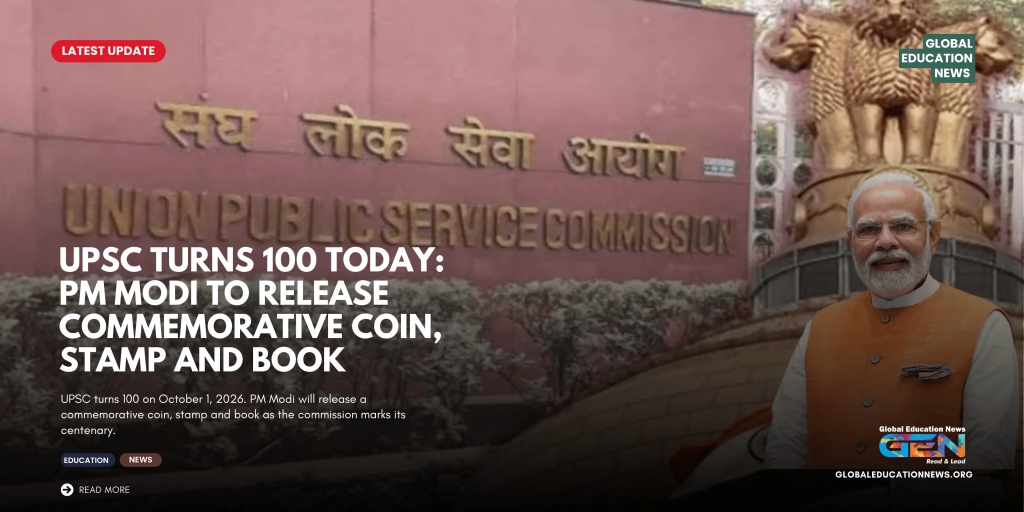
The Union Public Service Commission (UPSC) complete 100 years since the establishment of the first Public Service Commission in India today. Prime Minister Narendra Modi is scheduled to attend the centenary programme at Bharat Mandapam, New Delhi, where he will release a UPSC Centenary Commemorative Coin, a commemorative stamp and a book titled 100 Landmark Judgements – Shaping the Policies of UPSC and Public Service Commissions in India.
The event will bring together UPSC officials, State Public Service Commission members, senior government officers, academics and other stakeholders as the commission closes a year-long centenary programme that began in October 2025.
But behind the ceremony lies a much longer story: the transformation of a colonial-era Public Service Commission into a constitutional institution that now plays a central role in recruitment to India’s Union and All India Services.
UPSC at 100: From 1926 Public Service Commission to Constitutional Body
The institution that Indians now know as UPSC did not begin with its present name.
The first Public Service Commission was established on October 1, 1926, following provisions of the Government of India Act, 1919, and recommendations of the Lee Commission. Sir Ross Barker became its first chairman. Its initial role was largely advisory.
The Government of India Act, 1935 subsequently provided for a Federal Public Service Commission. After the Constitution came into force on January 26, 1950, the Federal Public Service Commission became the Union Public Service Commission, acquiring constitutional status.
That institutional journey is one reason the centenary is more than an anniversary on the calendar.
It traces the evolution of public-service recruitment through three very different phases — colonial administration, the transition to independence and the constitutional framework of the Republic.
A century of changing public-service recruitment
The UPSC’s constitutional role is principally connected with recruitment and related personnel matters for Union services.
Under Article 320 of the Constitution, its functions include conducting examinations for appointments to Union services and posts, direct recruitment through interviews and advising the government on specified service matters.
For aspirants, that constitutional role eventually became most visible through examinations such as the Civil Services Examination, which remains one of India’s most closely followed competitive examinations.
What will be the Programmes on October 1?
The October 1 programme at Bharat Mandapam will mark the culmination of the year-long UPSC centenary celebrations.
According to the Prime Minister’s Office, the programme will begin at 11 am, with Prime Minister Modi addressing the gathering. The commemorative coin and stamp will be released alongside the book documenting 100 landmark judgments connected with UPSC and Public Service Commissions in India.
The celebrations are part of a two-day programme scheduled for September 30 and October 1. The first day includes “Shatabdi Samaroh – Manthan”, featuring addresses and panel discussions on themes related to public service.
The guest list reflects the wider reach of the institution: chairpersons and members of State Public Service Commissions, senior government officials, academics and UPSC personnel are expected to participate.
Why the UPSC Centenary Matters to Aspirants
For students preparing for the UPSC Civil Services Examination, the anniversary is likely to have a significance beyond the commemorative programme.
The commission has spent the centenary year looking both backward and forward. When the celebrations began in 2025, UPSC Chairman Ajay Kumar highlighted themes including merit, public service, modernisation and stronger engagement with young people.
The commission also launched “My UPSC Interview: From Dream to Reality”, a portal designed to collect experiences and defining moments from candidates who went through the interview process.
The initiative offers a glimpse into a broader question facing the institution as it enters its second century: how can an organisation with a century-old legacy remain accessible and relevant to a new generation of candidates?
UPSC’s Next Century Is About More Than Examinations
The centenary programme has also highlighted initiatives intended to extend the commission’s institutional role beyond the examination calendar.
One proposal is a Centre of Excellence that would serve as a repository of best practices involving UPSC and State Public Service Commissions. The initiative is intended to encourage the sharing of experience and institutional knowledge across public-service recruitment bodies.
The commission has also highlighted Pratibha Setu, a platform intended to connect candidates who reached the UPSC interview stage but did not make the final selection with potential opportunities in other organisations.
Another issue identified during the centenary discussions has been the uneven awareness of public-service examinations across the country. State PSC representatives have pointed to the need for greater outreach, guidance and mentoring in aspirational and underrepresented districts.
That is a particularly relevant challenge for an examination whose applicant pool stretches far beyond India’s major metropolitan centres.
From Colonial Recruitment to a Constitutional Institution
The history of UPSC also mirrors a much larger transformation in India.
When the Public Service Commission was established in 1926, India was still under British rule. The institution operated within a colonial administrative structure. Its later transformation into the Federal Public Service Commission, and eventually the constitutionally recognised UPSC, accompanied the country’s own transition toward self-government and democracy.
The commission’s headquarters at Dholpur House in New Delhi have consequently become closely associated with one of the country’s most recognisable public-service institutions.
For today’s aspirants, however, that history can sometimes disappear beneath the pressure of prelims, mains and interviews.
The centenary offers a pause.
It places the examination in the context of the institution behind it — an institution whose name has remained familiar even as India’s administrative system, population, technology and expectations of government have changed dramatically.
UPSC 100 Years: What Comes Next?
The October 1 ceremony will formally close the year-long centenary celebrations, but it also opens a new question: what should UPSC look like in its second century?
The commission’s own centenary initiatives point toward several themes — digital transformation, wider outreach, institutional learning, candidate engagement and stronger use of public-service talent.
The challenge will be balancing those changes with the institutional principles that have defined public-service recruitment for decades.
For millions of students who dream of entering India’s civil services, the UPSC story is ultimately not about a coin, a stamp or a centenary logo.
It is about the system through which candidates compete for the opportunity to serve in public institutions.
A hundred years after the first Public Service Commission was established, that system is entering its next chapter.