Date: November 18, 2026
Place: Cambridge, United Kingdom
Education News: English Language, Vocabulary and Artificial Intelligence
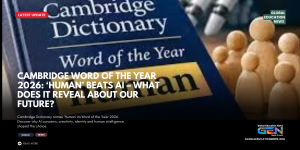
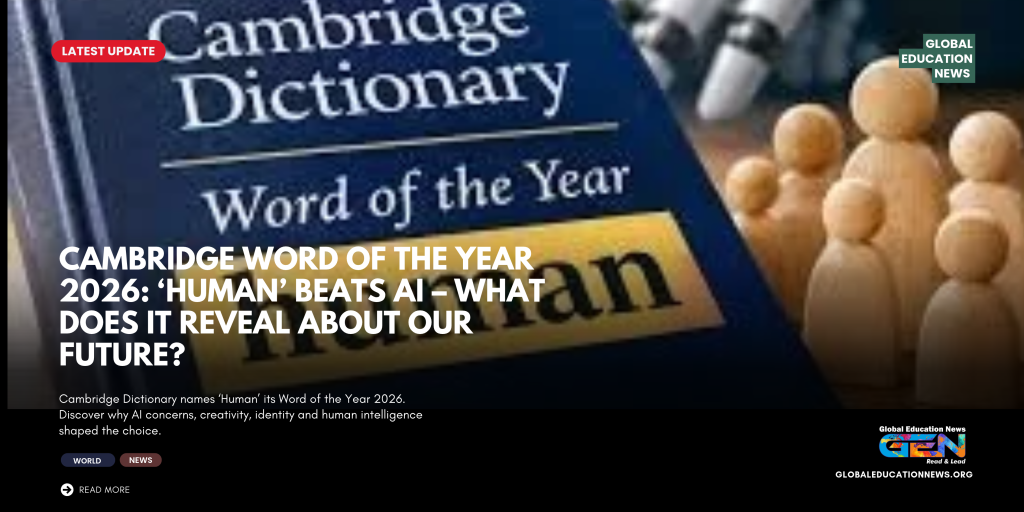
Cambridge, Education News: The Cambridge Dictionary has named ‘Human’ as its Word of the Year 2026, highlighting growing global discussions about artificial intelligence (AI), human identity and the qualities that distinguish people from machines. The announcement comes at a time when AI is transforming education, employment, creative industries and everyday communication.
The selection raises an important question: as machines become increasingly capable of performing tasks once associated with human intelligence, what makes people unique? According to Cambridge Dictionary, the choice reflects renewed interest in human creativity, emotions, judgement, compassion and the ability to make independent decisions.
The announcement also reflects a wider debate about how society should use AI while protecting the qualities and contributions that make human life meaningful.
What Is Cambridge Dictionary’s Word of the Year 2026?
The word selected for 2026 is ‘Human’.
Cambridge Dictionary defines the word in terms of the qualities, faults and feelings associated with people, distinguishing them from gods, animals and machines.
Although ‘human’ is not a newly created expression, its selection reflects how its meaning has become especially relevant in the age of artificial intelligence.
The growing use of expressions such as ‘human-written’, ‘human-generated’ and ‘human-made’ shows how people increasingly distinguish work created by individuals from content produced using AI tools.
Why Did Cambridge Choose ‘Human’ as Its Word of the Year?
The decision reflects several major developments shaping public discussions in 2026.
1. Growing Influence of Artificial Intelligence
AI systems are increasingly being used for writing, research, education, communication and creative work. Their expanding capabilities have raised questions about the future relationship between people and machines.
2. Concerns About Human Creativity
Artists, writers and other creative professionals are discussing how AI-generated content may affect original work, authorship and creative ownership.
3. Questions About Human Intelligence
As AI systems perform increasingly complex tasks, researchers and philosophers are examining the differences between human and artificial intelligence.
4. Changing Workplace Expectations
Automation is changing how organisations approach employment and professional skills. Human judgement, communication, empathy and responsibility remain important qualities in many roles.
5. The Importance of Human Relationships
The growing use of digital tools has also encouraged conversations about personal relationships, emotional connections and the importance of direct human interaction.
What Does the Word ‘Human’ Mean in the Age of AI?
Traditionally, the word has been used to distinguish people from animals and other forms of life. Today, it is increasingly discussed in contrast with artificial intelligence and machines.
The debate is no longer limited to whether computers can complete particular tasks. It also concerns whether technology can genuinely understand emotions, demonstrate compassion or make decisions with the same context and responsibility as people.
The selection of ‘Human’ therefore represents more than a vocabulary trend. It captures a wider cultural discussion about identity, creativity and the future of technology.
How Is Artificial Intelligence Changing Education and Learning?
The choice of ‘Human’ has particular relevance for students, teachers and educational institutions.
AI tools are increasingly being used to explain difficult concepts, support research, assist with writing and provide personalised learning experiences. However, their growing use also raises questions about independent thinking and the development of essential academic skills.
Some important considerations for education include:
- Critical thinking: Students need to evaluate information rather than accept every AI-generated answer.
- Originality: Independent ideas and personal understanding remain important in academic work.
- Communication: Human interaction, discussion and collaboration are essential parts of learning.
- Digital responsibility: Students need to understand the limitations of AI-generated information.
- Teacher guidance: Educators continue to play an important role in mentoring, motivation and understanding individual learning needs.
The broader lesson is that technology can support education, but meaningful learning also depends on curiosity, judgement and human understanding.
Which Other Words Were Contenders for Cambridge Word of the Year 2026?
Cambridge Dictionary also considered several other expressions that reflect changing technology, culture and everyday life.
| Word | Meaning |
|---|---|
| Human | Relating to the qualities, feelings and characteristics of people |
| Agent | An AI system capable of carrying out tasks with a degree of independence |
| Analogue | Relating to activities or systems that are not digital |
| Wholesome | Something that improves life physically, morally or emotionally |
| Chic | Stylish and fashionable |
The shortlisted words reflect different aspects of modern society, from artificial intelligence and digital technology to lifestyle and culture.
What New Words and Expressions Are Reflecting Digital Culture in 2026?
The dictionary has also highlighted expressions that have gained attention through online culture and changing social behaviour.
Some notable examples include:
- Aura farming: Behaving in a way intended to create an impressive or admired personality.
- Air jail: A method of holding an animal off the ground to discourage unwanted behaviour.
- Looksmaxxing: An online expression describing attempts to improve one’s physical appearance.
- FOBO: An abbreviation for the fear of becoming obsolete, particularly because of technological change.
- Weather whiplash: A sudden change between contrasting or extreme weather conditions.
These expressions show how language continues to evolve alongside social media, technology and changing lifestyles.
What Does Cambridge’s Choice Mean for the Future of AI?
The selection of ‘Human’ points towards an important challenge for the coming years: ensuring that technological progress improves people’s lives rather than reducing the value of human contribution.
AI may help people work more efficiently, access information and solve complex problems. At the same time, questions about creativity, privacy, employment, accountability and the responsible use of technology will remain important.
For students and young professionals, the changing environment makes it valuable to develop both digital knowledge and human-centred abilities such as communication, adaptability, critical thinking and ethical judgement.
The future of AI will not be shaped by technology alone. The decisions made by people, institutions and governments will also determine how it affects society.