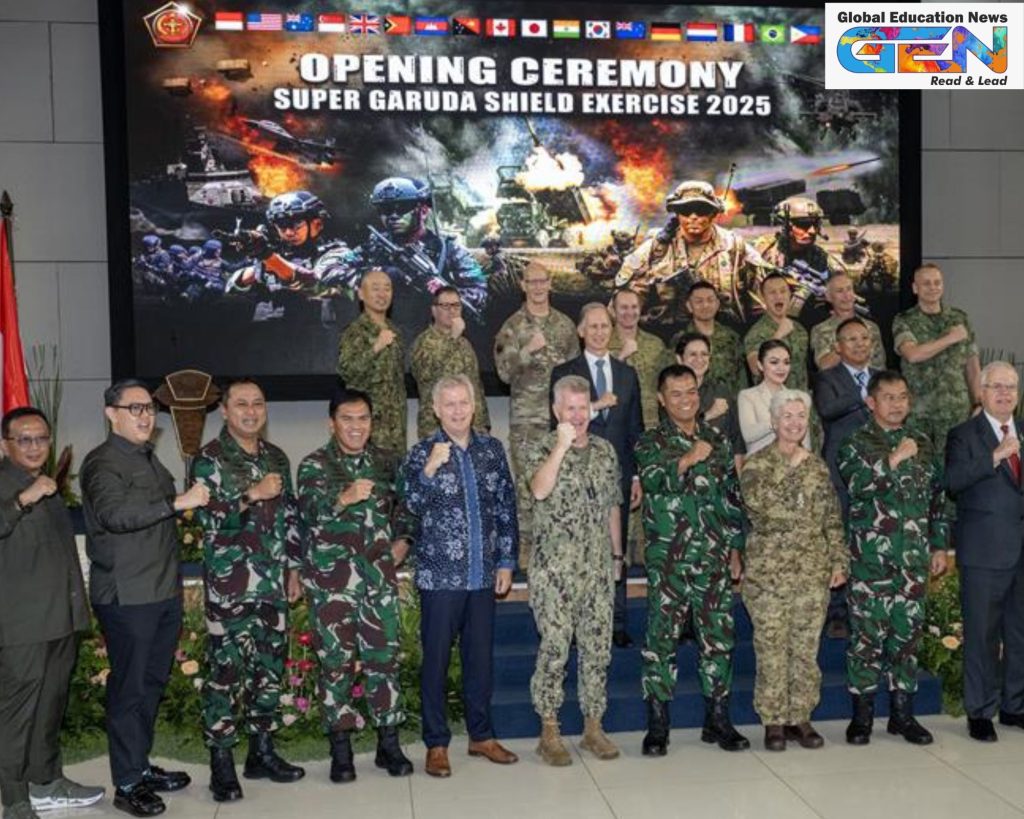
On August 25, 2025, Indonesia and the United States launched Super Garuda Shield 2025, the largest multinational military exercise in Southeast Asia, involving over 6,500 troops from 13 nations. Held across Jakarta, South Sumatra, and the Riau archipelago, this 11-day drill (August 25–September 4) aims to enhance interoperability, strengthen regional ties, and deter aggression in the Indo-Pacific, where tensions, particularly in the South China Sea, are escalating. Co-hosted by the Indonesian National Armed Forces (TNI) and U.S. Indo-Pacific Command (USINDOPACOM), the exercise underscores a collective commitment to sovereignty and stability. Here’s an in-depth look at its scope, significance, and geopolitical implications.
Key Points:
- Super Garuda Shield 2025 involves 6,500+ troops from 13 nations, the largest iteration since 2009.
- Focuses on joint combat, interoperability, and deterrence amid rising Indo-Pacific tensions.
- Held in Jakarta, South Sumatra, and Riau archipelago until September 4, 2025.
What is Super Garuda Shield 2025?
Super Garuda Shield, launched in 2009 as a bilateral US-Indonesia exercise, expanded in 2022 to include multiple nations, reflecting the growing need for regional defense cooperation. The 2025 edition, the largest to date, involves 4,100 Indonesian and 1,300 American troops, alongside forces from Australia, Japan, Singapore, the UK, France, Canada, Germany, the Netherlands, New Zealand, Brazil, and South Korea, with observers from Cambodia, India, Papua New Guinea, and Thailand.
The exercise includes:
- Joint Combat Training: Airborne operations, amphibious assaults, jungle warfare, and combined arms live-fire exercises, including High Mobility Artillery Rocket System (HIMARS) deployments.
- Interoperability Focus: Multinational staff planning, cyber defense drills, and medical operations under simulated battlefield conditions.
- Civic Engagement: Engineering projects and cultural exchanges to build trust with local communities.
Conducted across diverse terrains in Jakarta, Baturaja (South Sumatra), and Dabo Singkep (Riau), the drills enhance operational readiness and cultural awareness for overseas contingencies.
Key Points:
- Involves 4,100 Indonesian and 1,300 US troops, plus 11 other nations.
- Features joint combat, cyber defense, and civic action across multiple domains.
- Held across Jakarta, South Sumatra, and Riau for 11 days.
Strategic Significance: Countering Regional Tensions
Super Garuda Shield 2025 is a strategic response to rising tensions in the Indo-Pacific, particularly China’s assertiveness in the South China Sea, where its coastguard and militia activities have unnerved Indonesia. While the US and allies like Australia emphasize deterrence, the exercise is not explicitly aimed at Beijing, reflecting Indonesia’s non-aligned stance. Admiral Samuel J. Paparo, USINDOPACOM Commander, stated, “It represents deterring anyone that would hope to change the facts on the ground using violence,” highlighting collective sovereignty and trust-building.
Indonesia’s Deputy Commander, General Tandyo Budi Revita, called it “a platform of trust, a bridge of friendship,” emphasizing regional unity against complex challenges like maritime disputes and cyber threats. The exercise strengthens the US-Indonesia Comprehensive Strategic Partnership and signals a “network of partnerships” to maintain a free and open Indo-Pacific.
Key Points:
- Addresses South China Sea tensions without directly targeting China.
- Promotes deterrence, sovereignty, and trust among 13 nations.
- Reinforces US-Indonesia strategic partnership and regional stability.
Geopolitical Context: Indonesia’s Balancing Act
Indonesia navigates a delicate balance in the Indo-Pacific’s great power rivalry. Despite concerns over Chinese encroachment in its exclusive economic zone, Jakarta maintains robust economic ties with Beijing, with $127 billion in trade and $8.5 billion in Chinese investments in 2024. Super Garuda Shield reflects Indonesia’s “dual-track diplomacy,” engaging Western allies while avoiding confrontation with China. The Lowy Institute notes Indonesia conducted 115 bilateral and multilateral exercises in 2023-24, including with China and Russia, showcasing its non-aligned strategy.
China has criticized the drills as a US-led attempt to form an “Asian NATO,” but Indonesia’s commitment to purchasing US and French arms and expanding Western interoperability underscores its defense diversification. Researchers Muhammad Zulfikar Rakhmat and Yeta Purnama argue, “Indonesia’s refusal to choose sides is its strongest asset,” allowing it to bolster security without aligning with any bloc.
Key Points:
- Indonesia balances US defense ties with $127 billion in China trade.
- Conducted 115 exercises in 2023-24, including with China and Russia.
- Non-alignment strengthens Indonesia’s strategic flexibility.
Exercise Highlights: Building Interoperability and Readiness
Super Garuda Shield 2025 is a multidomain exercise designed to enhance military capabilities across air, land, sea, cyber, space, and information domains. Key activities include:
- Maritime Operations: The Indonesian Navy welcomed USS John Finn (DDG-113), and Japan’s JS Osumi (LST-4001) joined for amphibious drills, a first for Japan in the exercise.
- Land and Air Operations: Airborne operations by Japan’s 1st Airborne Brigade, urban warfare, and HIMARS rapid infiltration missions.
- Cyber and Staff Training: Multinational planning and cyber defense drills to counter modern threats.
- Civic Projects: Engineering and medical initiatives to support local communities, fostering goodwill.
These activities build interoperability, ensuring partner nations can operate seamlessly in crises, from humanitarian missions to conflict scenarios.
Key Points:
- Features maritime, airborne, and cyber operations across diverse terrains.
- Japan’s JS Osumi marks a milestone in amphibious participation.
- Civic projects enhance community trust alongside military readiness.
Challenges and Criticisms: Navigating Regional Sensitivities
The expanded scope of Super Garuda Shield has drawn scrutiny from China, which views it as a US effort to counter its influence. Beijing’s accusations of an “Asian NATO” reflect concerns over encirclement, especially as the US strengthens alliances like the Quad and AUKUS. Indonesia counters this by emphasizing the exercise’s focus on interoperability, not confrontation, and maintaining economic ties with China.
Logistical challenges include coordinating 6,500 troops across multiple locations and ensuring cultural alignment among diverse forces. The US’s push for allies to “take threats from China seriously” risks alienating Indonesia’s non-aligned stance, requiring careful diplomatic navigation.
Key Points:
- China criticizes drills as a US-led “Asian NATO” effort.
- Indonesia emphasizes interoperability over confrontation.
- Coordinating 6,500 troops poses logistical and cultural challenges.
Broader Regional Impact: A Signal of Unity
Super Garuda Shield 2025 aligns with other Indo-Pacific exercises like Pacific Vanguard in Guam, involving Australia, Japan, South Korea, and New Zealand, reinforcing a collective deterrence network. The inclusion of transatlantic allies like Germany and France signals global interest in Indo-Pacific stability, while observers like India and Papua New Guinea highlight the exercise’s regional draw.
The drills prepare forces for contingencies like maritime disputes or natural disasters, enhancing rapid response capabilities. For Indonesia, hosting the largest-ever Super Garuda Shield elevates its role as a regional security leader while maintaining strategic autonomy.
Key Points:
- Complements exercises like Pacific Vanguard, strengthening regional networks.
- Global participation (Germany, France) underscores Indo-Pacific importance.
- Elevates Indonesia’s leadership while preparing for diverse contingencies.