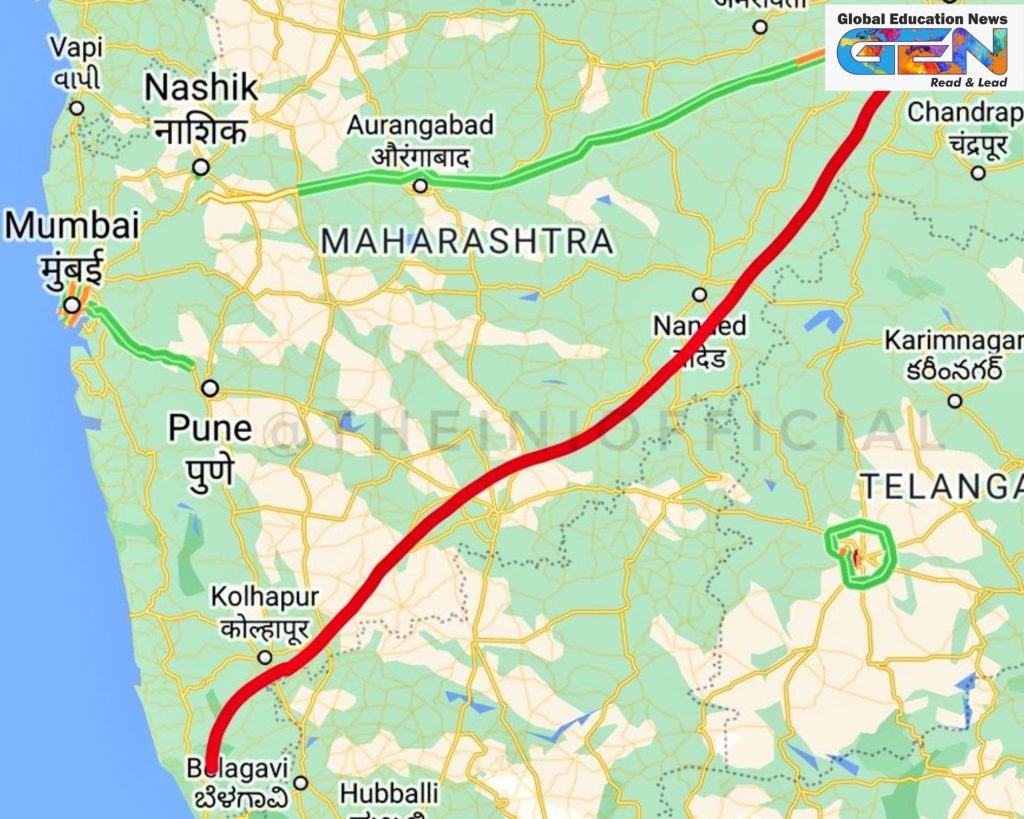
Approved on June 24, 2025, by the Maharashtra Cabinet under Chief Minister Devendra Fadnavis, the Shaktipeeth Expressway is an 802-km, six-lane, access-controlled greenfield corridor stretching from Pawnar (Wardha) to Patradevi (Sindhudurg) on the Maharashtra-Goa border. With a budget of ₹20,787 crore for planning and land acquisition (including a ₹12,000 crore HUDCO loan), the project’s total cost is estimated at ₹84,000–86,300 crore. Managed by the Maharashtra State Road Development Corporation (MSRDC), it aims to slash travel time between Nagpur and Goa from 18–21 hours to 8–10 hours, linking 12 districts: Wardha, Yavatmal, Hingoli, Nanded, Parbhani, Beed, Latur, Dharashiv, Solapur, Sangli, Kolhapur, and Sindhudurg.
The expressway, modeled after the Samruddhi Mahamarg, will connect 18 pilgrimage sites, including Shakti Peethas (Mahur, Tuljapur, Kolhapur, Patradevi), Jyotirlingas (Aundha Nagnath, Parli Vaijnath), and spiritual hubs like Pandharpur, Ambajogai, and Narsobachi Wadi, boosting religious tourism and rural economies. CM Fadnavis touts it as a “game-changer” for Marathwada and Konkan, fostering economic integration with ports and airports.
Funding and Implementation: A Financial Tightrope
The ₹20,787 crore allocation covers land acquisition for 7,500–8,200 hectares, with ₹12,000 crore from HUDCO and the rest from state funds. The Engineering, Procurement, and Construction (EPC) model ensures a single contractor handles design to construction. However, the Maharashtra Finance Department, led by Deputy CM Ajit Pawar, warns that the off-budget loan, combined with MSRDC’s existing ₹24,190 crore debt, could push the state’s projected ₹9.32 lakh crore debt by March 2026 and ₹1.54 lakh crore interest payments in FY26, risking financial strain. Critics, including Congress MLC Satej Patil, argue the project could lead to “financial bankruptcy”.
Farmer Protests: A Battle Over Land
The project faces fierce opposition from farmers across the 12 districts, particularly in Kolhapur, Sangli, and Yavatmal, over the acquisition of 8,100–8,200 hectares of mostly private agricultural land. Farmer leader Raju Shetti and the Shaktipeeth Highway Virodhi Sheti Bachao Samiti have led protests, including a Rasta-roko in Kavalapur, Sangli, on June 27, 2025, and a dharna at the Sangli collectorate. Farmers burned land acquisition notices in Kolhapur in 2024, accusing the government of favoring corporate interests and offering inadequate compensation under an amended 2013 Land Acquisition Act. Shetti argues that upgrading the existing Nagpur-Ratnagiri highway would suffice, questioning the need for a new corridor when flights to Goa cost ₹6,000–7,000.
Despite opposition, some farmers in Kolhapur’s Bhudargad, Radhanagari, Ajra, Hatkanangale, and Shirol talukas support the project, lured by 5x market price compensation and development packages, as per X posts. Fadnavis insists the government will engage with farmers to address concerns, denying forced acquisition.
Environmental Concerns: Navigating the Western Ghats
The expressway’s route through the Western Ghats, a UNESCO World Heritage Site, has sparked environmental concerns over deforestation, wildlife displacement, and water resource damage. In August 2024, the MSRDC withdrew its environmental clearance application from the Ministry of Environment, Forest, and Climate Change after protests, particularly in Kolhapur, where farmers feared flooding risks. A fresh clearance was granted in 2025 for stretches with less resistance, with land measurement set to conclude by August 2025. The government revised the alignment in some districts to mitigate opposition, but activists remain wary of ecological impacts.
Socio-Economic Impact: Promise vs. Peril
The expressway promises to boost religious tourism and connectivity, linking 18 spiritual sites and fostering economic growth in underdeveloped regions like Marathwada and Vidarbha. It will integrate with the Konkan Expressway at Patradevi, enhancing access to Goa and ports. However, the displacement of farmers threatens livelihoods, with critics like Satej Patil arguing that the state’s financial crunch—struggling to fund education, health, and water—makes the project unsustainable. The Cabinet’s simultaneous approval of increased tribal student allowances (e.g., ₹1,400/month at divisional level, up from ₹800) signals a balancing act to address social welfare.
Recent Developments and Future Outlook
Revived in January 2025 after a 2024 pause due to election-related protests, the project gained momentum with the June 24, 2025, Cabinet approval. The MSRDC completed land surveys in February 2024, and the alignment was finalized via a government resolution. With ₹20,787 crore secured and environmental clearances partially obtained, construction is set to advance, though protests persist. The Finance Department’s concerns and opposition from Maha Vikas Aghadi (MVA), led by figures like Supriya Sule, highlight internal government tensions. X posts reflect mixed sentiment, with some praising the project’s vision and others decrying its financial burden.
What’s Next?
With land measurement targeted for August 2025, the project’s fate hinges on resolving farmer protests and securing the remaining ₹60,000–65,000 crore funding. If successful, the expressway could transform Maharashtra’s tourism and economy, but failure to address opposition risks delays or cancellation, as seen in 2024. Will the Shaktipeeth Expressway unite Maharashtra’s spiritual heritage or deepen its socio-economic divides? Stay tuned to msrdc.org and news outlets for updates!