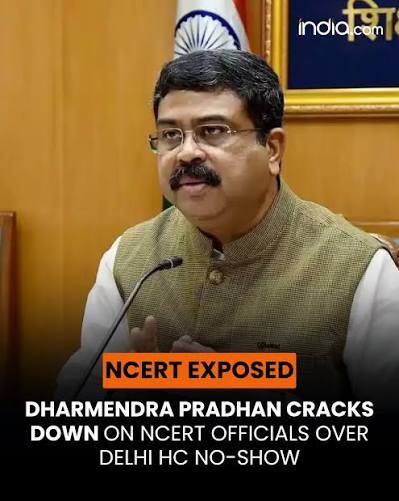
The National Council of Educational Research and Training (NCERT) has come under scrutiny after it failed to defend its decision to blacklist a paper supplier before the Delhi High Court. Taking serious note of the incident, Union Education Minister Dharmendra Pradhan has ordered an inquiry into the role of NCERT officials and directed that accountability be fixed for the administrative and legal lapse.
The episode has triggered wider questions about governance, legal preparedness, and transparency in the procurement process for NCERT textbooks, which are used by millions of students across India.
What Is the Case About?
The dispute centres on Bafna Global Venture Private Limited, a paper supplier that was blacklisted by NCERT for two years through an order issued on June 22, 2026. The company challenged the decision in the Delhi High Court on June 24, arguing that the blacklisting was unjustified.
However, during the court hearing:
- No representative from NCERT appeared before the court.
- The Delhi High Court granted the company interim protection from coercive action.
- The court also restrained NCERT from invoking the company’s bank guarantee of more than ₹6 crore until further orders.
Why Did the Education Minister Intervene?
Following reports of NCERT’s absence during the court proceedings, Education Minister Dharmendra Pradhan ordered a detailed probe.
The Minister Has Directed
- An inquiry into the role of officials responsible for the legal lapse.
- Fixing accountability for failure to represent NCERT before the High Court.
- Strict action against officers found negligent.
- A review of administrative and legal procedures to prevent similar incidents in future.
According to official sources, the Ministry has reiterated a zero-tolerance policy towards administrative negligence, especially in matters affecting textbook production and public education.
The Procurement Questions Under Review
Apart from the legal lapse, the Ministry has asked NCERT to examine several aspects of the procurement process.
Issues Being Investigated
- How the supplier was selected despite allegations that it did not meet all eligibility conditions.
- Whether contractual obligations for paper supply were fulfilled on time.
- Why delays occurred in the supply of paper needed for textbook printing.
- Why NCERT failed to effectively defend its decision before the Delhi High Court.
These questions are expected to form the basis of the departmental inquiry.
Supplier’s Defence
During the court proceedings, the supplier argued that delays in paper production were caused by factors beyond its control.
According to the company’s submissions:
- The shortage of hydrogen peroxide, a bleaching agent used in paper manufacturing, disrupted production.
- The shortage was linked to international supply chain disruptions arising from the conflict involving Iran, affecting the availability of key industrial chemicals.
The court has not ruled on the merits of these claims, and the matter remains under judicial consideration.
Why the Case Matters for School Education
NCERT is responsible for publishing textbooks used by CBSE schools and many state education systems. Any disruption in paper procurement or textbook printing can directly affect the timely availability of learning materials.
Potential Implications
- Delays in textbook printing and distribution.
- Administrative uncertainty in procurement processes.
- Increased scrutiny of public procurement practices.
- Greater emphasis on legal compliance in government institutions.
- Need for stronger coordination between procurement and legal departments.
Education experts note that efficient procurement and timely legal responses are essential to ensuring uninterrupted textbook supply for students nationwide.
Strengthening Institutional Accountability
The incident has highlighted the importance of robust governance mechanisms within public educational institutions.
Experts suggest that agencies involved in large-scale procurement should:
- Maintain stronger legal coordination.
- Ensure timely representation in judicial proceedings.
- Strengthen contract management systems.
- Improve documentation and compliance monitoring.
- Conduct periodic audits of procurement and litigation processes.
Such measures can help safeguard public resources while ensuring continuity in educational services.
Broader Significance
The NCERT case underscores that educational governance extends beyond curriculum development and textbook publishing. Administrative efficiency, transparent procurement, and effective legal representation are equally critical to maintaining public confidence in institutions responsible for delivering educational resources to millions of students.
The inquiry ordered by the Education Ministry is likely to influence future procurement oversight and accountability mechanisms within NCERT and other educational bodies.