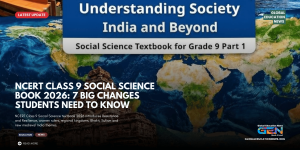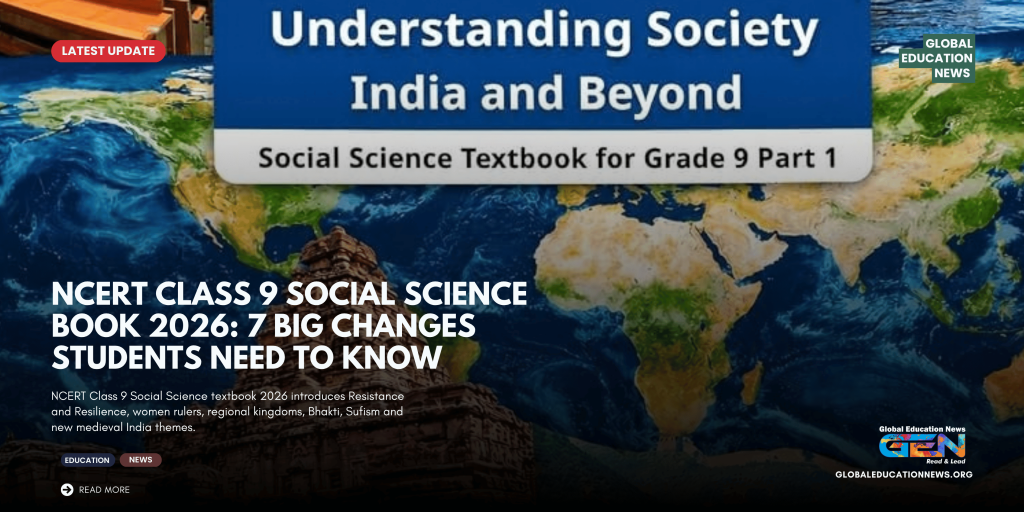
New Delhi — A new chapter in the NCERT Class 9 Social Science textbook 2026 is changing how millions of school students will encounter medieval Indian history. Released on September 29 as part of Understanding Society: India and Beyond — Part 2, the book describes the period from 1000 to 1700 CE through the theme “Resistance and Resilience”, focusing heavily on how regional powers responded to successive invasions and territorial expansion.
The new NCERT Class 9 Social Science book also brings into the classroom accounts of lesser-discussed rulers and resistance movements, including Queen Naiki Devi, Rani Abbakka Chowta, the Ahom kingdom, Vijayanagara, the Marathas, Sikhs and Jats. It also discusses the role of goddesses in the religious traditions associated with warfare, including traditions surrounding Shivaji and other rulers.
But the most consequential change is not a single story or name. It is the way the textbook has reorganised the historical frame.
NCERT Class 9 Social Science: Why ‘Resistance and Resilience’ Matters
The new chapter covers the medieval period largely through the themes of resistance, sovereignty, alliances, warfare and cultural continuity.
The textbook says Indian society faced repeated invasions and wars accompanied by religious discrimination and social distress, while regional powers resisted forces entering their territories. It describes that resistance as both military and cultural.
That approach differs from a history curriculum centred primarily on dynasties, rulers and battles.
Instead, students are introduced to questions of how communities defended political independence, how regional kingdoms formed alliances and how religious and cultural traditions survived periods of conflict.
The textbook’s stated educational objective is also broader. In its foreword, NCERT Director Dinesh Saklani says Social Science at this stage should develop analytical and discursive abilities, encourage critical inquiry and promote intercultural understanding.
That makes the structure of the new chapters significant for teachers as well as students.
What Is New in the NCERT Class 9 History Book?
The revised book replaces the older Class 9 Social Science structure with the new Understanding Society: India and Beyond series. The new textbooks replace four earlier books, including India and the Contemporary World-I and Democratic Politics-I.
The medieval-history section now gives considerable space to regional resistance.
Maharana Pratap, Lachit Borphukan and the Ahom resistance
The chapter discusses Mewar and Maharana Pratap’s resistance to Mughal emperor Akbar.
It then moves to the Ahom kingdom in Assam, highlighting its ability to maintain political independence for centuries and its resistance to Mughal expansion. The Battle of Saraighat and Ahom commander Lachit Borphukan receive specific attention.
The message is clear: the story of resistance is not confined to northern India.
Vijayanagara and the idea of resistance
The Vijayanagara Empire receives its own section, with the textbook stressing that resistance to outside powers extended beyond the northern regions.
The narrative then moves to the Marathas and the concept of Swarajya, described in the textbook as an independent, self-governing territory free from external control.
Women Rulers Get Greater Space in the New NCERT Textbook
One of the more noticeable changes is the inclusion of women whose political and military roles have often received less space in school-level narratives.
Queen Naiki Devi of the Chaulukya kingdom is discussed in the new chapter. According to the textbook, she defeated Muhammad Ghuri at Kasahrada near Mount Abu in 1178.
The book also discusses Rani Abbakka Chowta of Ullal, another regional ruler associated with resistance against European forces.
These additions broaden the geographical and gender lens through which students encounter medieval Indian history.
Rather than presenting political power solely through major imperial centres, the revised narrative gives more room to regional kingdoms and rulers who fought to protect their territories.
‘Swords of Goddesses’: What the New Book Says
One of the most widely reported sections concerns the relationship between warfare and goddess traditions.
The textbook says worship of goddesses had a long tradition in India and that rulers and princes invoked forms of Shakti such as Kali, Durga and Bhavani as protectors during conflict.
It then refers to traditions involving several rulers.
The book says Annamaraja of Bastar is believed to have received a sword from Manikyadevi, while Vijayanagara’s Kumara Kampana is described as traditionally believed to have used a goddess-given sword during his campaign against the Sultanate forces at Madurai. Shivaji is also described in connection with the traditional belief that he received a sword from Tulja Bhavani.
The wording matters: the textbook uses terms such as “believed” and “traditionally believed” for these accounts, distinguishing traditional narratives from straightforward claims of documented historical fact.
From Delhi Sultanate to Mughal India: A Different Emphasis
The new textbook does not remove the Delhi Sultanate or Mughal period. Instead, it changes the emphasis placed on them.
The Delhi Sultanate section is relatively brief and highlights local resistance. The Mughal section receives more space but continues to focus heavily on resistance rather than cooperation.
There are exceptions.
The book mentions cooperative relationships between the Kachwahas of Amber and the Mughals, acknowledging political collaboration between regional rulers and the Mughal state. It also discusses Maharana Pratap’s resistance and the different political circumstances surrounding Mewar.
The chapter therefore contains both conflict and cooperation, although current reporting has noted that resistance receives considerably greater narrative emphasis.
Temples, Bhakti and Sufism Also Enter the Conversation
The new NCERT Class 9 Social Science book also addresses religious and cultural change.
It refers to several instances involving temple destruction and mosque construction, including the history of the Kashi Vishwanath temple and later reconstruction under Ahilyabai Holkar.
The Bhakti tradition is presented as an important part of religious resilience. The textbook connects Bhakti practices with periods when temple construction was restricted or temples were destroyed, while also discussing Chaitanya Mahaprabhu and devotional practices in Bengal.
Sufism is discussed separately, with the book describing it as a comparatively liberal dimension of Islam and noting its role in the spread of the faith.
This combination gives students a narrative that moves beyond battles and rulers into questions of worship, social life and cultural change.
What Competitor Coverage Highlights — and What It Misses
Current coverage has largely split into two approaches.
The Indian Express focuses on the textbook’s shift towards “Resistance and Resilience”, the treatment of medieval history and the references to goddess traditions.
India Today gives greater attention to the structural changes: the new resistance chapter, the movement of India and the World to Class 10, women rulers and changes intended to make the curriculum more appropriate to students’ age and learning needs.
The New Indian Express concentrates on the goddess-related accounts and the broader description of religious traditions in warfare.
Economic Times highlights another dimension: the revised textbook also introduces concepts such as Ram Rajya, Rajdharma, the Mahabharata, Upanishadic ideas and the Sengol, alongside Maharana Pratap’s resistance and contemporary economic themes such as taxation, insurance and entrepreneurship.
Taken together, the coverage points to a larger story: this is not simply a chapter rewritten around a few historical figures. It is part of a broader restructuring of the Class 9 Social Science curriculum under the new curriculum framework.
What Students and Teachers Need to Know
For students entering Class 9, the practical change is straightforward: the new NCERT Social Science textbook should become the reference point for the 2026–27 curriculum wherever the revised book has been adopted.
For teachers, the challenge is more substantial.
The revised chapters ask students to move between political history, religious traditions, regional identities and cultural change. That requires more than memorising names and dates.
Students may encounter:
- Resistance and Resilience, 1000–1700 CE
- Regional kingdoms and political resistance
- Queen Naiki Devi and Rani Abbakka Chowta
- Maharana Pratap and Mewar
- Ahom resistance and Lachit Borphukan
- Vijayanagara and Kumara Kampana
- Maratha ideas of Swarajya
- Sikh and Jat resistance
- Bhakti and Sufi traditions
- Temple destruction and reconstruction
- Traditional accounts involving goddesses and rulers
The result is a textbook that asks students to see medieval India through several overlapping lenses — political power, territorial conflict, religious traditions, regional resistance and cultural continuity.
The Bigger Question Behind the New NCERT Class 9 Book
Textbooks do more than prepare students for examinations. They establish the framework through which young readers first organise complicated historical periods.
The new NCERT Class 9 Social Science textbook 2026 places resistance and resilience at the centre of its account of medieval India. It gives greater visibility to regional kingdoms and women rulers, while also incorporating religious traditions and cultural movements into the narrative.
For students, the immediate task will be to understand the new chapters on their own terms.
For teachers and education observers, the more interesting question will be how this revised narrative is interpreted in classrooms — and how effectively students are encouraged to distinguish between documented historical events, traditional accounts, political interpretation and cultural memory.
That distinction could matter as much as the new names and chapters themselves.