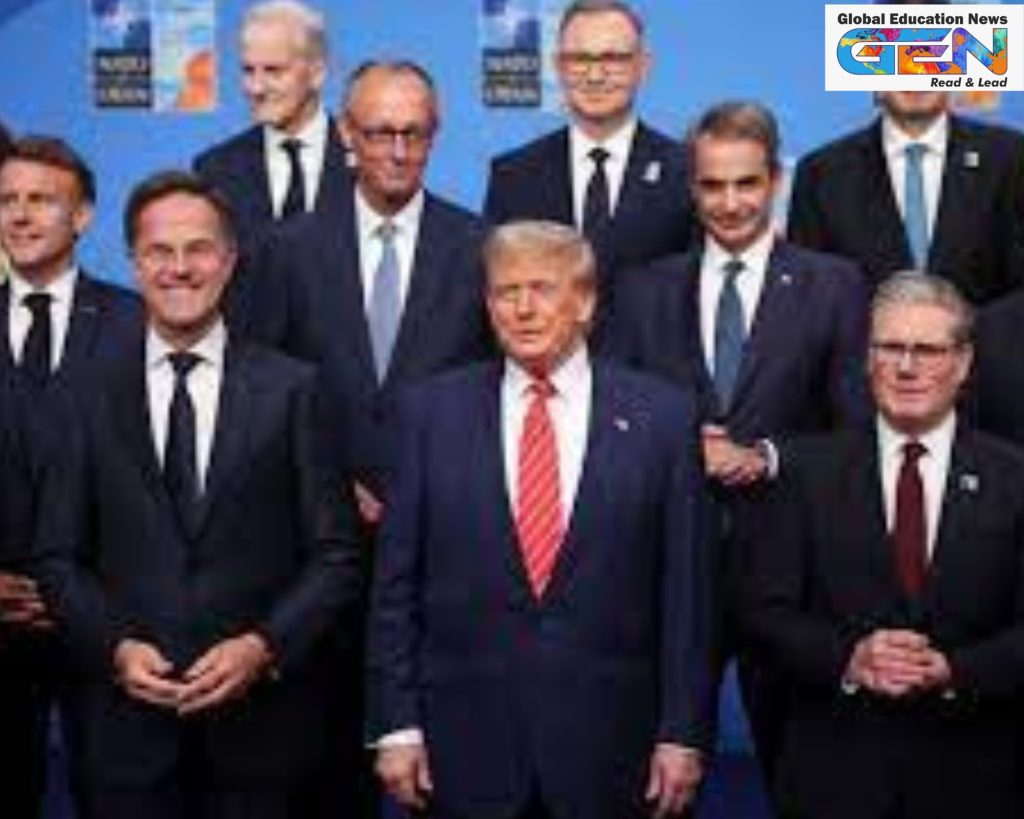
On June 25, 2025, NATO’s 32 member states agreed at the Hague Summit to increase defense and security spending to 5% of GDP by 2035, more than doubling the previous 2% target set in 2014. The decision, formalized in the Hague Declaration, responds to U.S. President Donald Trump’s persistent demands for allies to share the burden of collective defense, which he hailed as a “monumental win for the United States, Europe, and Western civilization”. The pledge includes 3.5% for core defense (troops, weapons) and 1.5% for security-related investments (cybersecurity, infrastructure), with annual plans and a 2029 review to track progress. This move reaffirms NATO’s “ironclad commitment” to Article 5, the principle that an attack on one member is an attack on all, despite Trump’s earlier ambiguous remarks questioning its scope.
Context: From 2% to 5% Amid Global Tensions
The 2% GDP target, established post-Russia’s 2014 Crimea annexation, was met by only 23 of 32 members by 2024, with Spain lagging at 1.24%. The new 5% goal, driven by NATO Secretary General Mark Rutte and Trump’s pressure, aims to counter “profound security threats,” particularly from Russia and terrorism. The Hague Declaration highlights Russia’s “long-term threat to Euro-Atlantic security” but omits explicit condemnation of its Ukraine invasion, a concession to Trump’s push for a Ukraine ceasefire. Recent U.S. and Israeli strikes on Iran’s nuclear sites, including Natanz and Fordow, and Iran’s subsequent suspension of IAEA cooperation, underscore the volatile backdrop, with Rutte praising Trump’s “decisive action” in Iran.
Trump’s Role and Article 5 Controversy
Trump, attending his first NATO summit since 2019, called the 5% target a “big success” and softened his prior skepticism, stating, “I stand with [Article 5], that’s why I’m here”. En route to The Hague, he had raised eyebrows by suggesting “numerous definitions of Article 5,” prompting concerns about U.S. commitment. However, Rutte and leaders like Poland’s Andrzej Duda and Finland’s Alexander Stubb dismissed doubts, emphasizing “absolute clarity” on Article 5. Trump’s rapport with Rutte, who called him “Daddy” in a playful exchange, helped secure the deal, with Rutte’s pre-summit negotiations ensuring a streamlined summit to avoid rifts.
Spain’s Resistance and Flexible Terms
Spain, the lowest spender at 1.24% of GDP in 2024, resisted the 5% target, with PM Pedro Sánchez arguing that 2.1% meets NATO’s capability goals without cutting social programs. Facing Trump’s threat of trade sanctions—“Spain will pay twice as much”—NATO adjusted the declaration’s language from “we commit” to “allies commit,” granting Spain flexibility. Rutte’s letter to Sánchez affirmed Spain’s “sovereign path” to meet capability targets, easing tensions. Other skeptics, like Belgium and Slovakia, agreed to the 3.5% core target as “realistic” by 2035.
Implications: Strength or Strain?
- Strengthened Alliance: The 5% pledge, if met, would boost NATO’s spending to $2.4 trillion, reducing the U.S. share from 68.7% to 53.8%, addressing Trump’s “unfair share” concerns. Eastern European nations like Poland (4.7% GDP) and Estonia (3.7%) already lead, driven by Russia’s proximity.
- Economic Challenges: Countries like the UK, France, and Germany face budget strains, with the UK projecting £30bn in extra spending post-2027. Critics warn the 1.5% “security” category risks “creative accounting”.
- Geopolitical Risks: The pledge may deter Russia but could spark an arms race or provoke preemptive actions. Iran’s IAEA suspension, following U.S. strikes, adds Middle East volatility, with Gulf states fearing escalation.
- Ukraine and Beyond: The declaration supports Ukraine but avoids its “irreversible” NATO path, reflecting Trump’s ceasefire focus.
Critical Perspective: Strategic or Sabotage?
While Trump celebrates the 5% target, skeptics like Ruth Deyermond argue it’s “designed to be unachievable,” potentially giving Trump a pretext to weaken NATO if allies fall short. Only nine countries globally spent 5% or more in 2023, mostly war-torn or authoritarian states, suggesting a “war footing” for NATO. The vague 1.5% security spending category—covering bridges to cybersecurity—may dilute accountability. Conversely, supporters like Estonia’s Kristen Michal see it as a signal to Russia, especially after recent attacks on Ukraine killed 20 on June 24.
Tips for Staying Informed
- Monitor Progress: Check nato.int for annual spending plans and 2029 review updates.
- Track Diplomacy: Follow pib.gov.in or reuters.com for U.S.-Iran and Ukraine developments.
- Engage Critically: Use X to gauge sentiment but verify claims against primary sources like nato.int.
- Understand Budgets: Research NATO members’ GDP data on sipri.org to assess feasibility.
What’s Next?
The Hague Declaration commits NATO to submit annual plans, with a 2029 review to adjust based on threats. Trump’s push for a Ukraine ceasefire, discussed with Volodymyr Zelenskyy, remains “more difficult” than anticipated, with promises of more air defenses. Iran’s nuclear defiance and Spain’s opt-out signal ongoing challenges. By 2035, NATO’s success hinges on balancing economic realities with strategic unity—will it strengthen the West or strain its alliances?
Is NATO Ready for the Future? Stay tuned to nato.int and global news for updates on this transformative pledge!