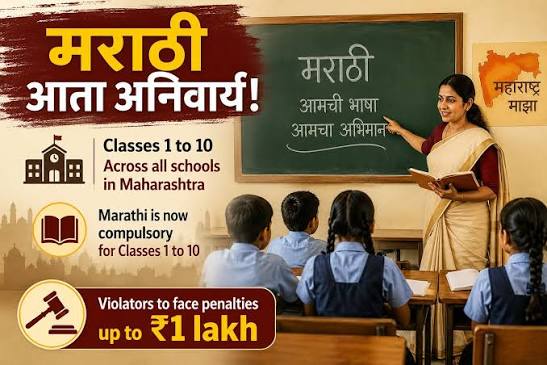
The Maharashtra government has announced stringent enforcement of the Maharashtra Compulsory Teaching and Learning of Marathi Language in Schools Act, 2020, making it clear that every school in the state must teach Marathi as a compulsory subject from Classes 1 to 10, irrespective of the education board or medium of instruction.
Speaking in the Maharashtra Legislative Assembly, School Education Minister Dadaji Bhuse said the government would take strict action against institutions that violate the law. Schools that fail to implement the mandate may face financial penalties and, in cases of continued non-compliance, cancellation of their official recognition.
Marathi Mandatory Across All Schools
The minister reiterated that the language policy applies uniformly to:
- State Board schools
- CBSE-affiliated schools
- ICSE schools
- International schools
- Schools of all mediums, including English-medium institutions
Every school is required not only to teach Marathi but also to conduct examinations in the subject for students from Class 1 to Class 10.
Legal Backing: The 2020 Marathi Language Act
The government’s action is based on the Maharashtra Compulsory Teaching and Learning of Marathi Language in Schools Act, 2020, enacted to ensure that students studying in Maharashtra develop proficiency in the state’s official language.
The legislation was introduced to preserve Maharashtra’s linguistic and cultural heritage while ensuring that children, regardless of the board they study under, are familiar with Marathi.
Strict Penalties for Non-Compliance
To ensure effective implementation, the Education Department has announced a robust enforcement mechanism.
Schools violating the law may face:
- Monetary penalties of up to ₹1 lakh for initial non-compliance.
- Regular inspections by education officials.
- Verification of Marathi teaching standards.
- Review of Marathi examination records.
- Cancellation of school recognition if violations continue even after penalties.
The minister emphasized that the government is committed to ensuring that every eligible school complies with the legal requirement.
Mandatory Appointment of Qualified Marathi Teachers
The government has also directed schools to appoint qualified Marathi language teachers.
Education officials will verify whether schools:
- Have appointed eligible Marathi teachers.
- Are conducting Marathi classes regularly.
- Are assessing students through Marathi examinations.
- Are complying with curriculum requirements.
Inspection teams will monitor implementation during routine visits to schools across the state.
Why the Government is Strengthening Enforcement
The renewed focus on Marathi language education reflects the state’s broader objective of preserving and promoting its linguistic identity.
According to the government, compulsory Marathi education seeks to:
- Promote the state’s official language.
- Strengthen cultural awareness among students.
- Ensure uniform implementation of existing legislation.
- Improve language proficiency among children studying under different educational boards.
- Foster greater appreciation of Maharashtra’s literary and historical heritage.
Implementation Through Regular Monitoring
Instead of relying solely on directives, the Education Department plans to actively monitor compliance.
Officials will conduct inspections to assess:
- Availability of Marathi teachers.
- Classroom teaching practices.
- Student attendance in Marathi classes.
- Examination records and assessment processes.
- Adherence to prescribed curriculum standards.
This monitoring mechanism is intended to ensure that the mandate is implemented consistently across both public and private educational institutions.
Impact on Schools and Students
The enforcement of compulsory Marathi teaching is expected to affect thousands of schools affiliated with different education boards operating in Maharashtra.
For students, the policy aims to ensure that they acquire basic proficiency in the state’s official language regardless of their primary medium of instruction.
For schools, the directive underscores the importance of maintaining compliance with statutory education requirements while ensuring adequate staffing and curriculum implementation.
Balancing Language Promotion and Educational Diversity
Maharashtra’s decision reflects an ongoing effort to balance multilingual education with the preservation of regional languages.
While students continue to study multiple languages under existing curricular frameworks, the government has made it clear that Marathi occupies a mandatory place in the state’s education system. Officials maintain that the policy supports both cultural preservation and educational inclusivity by ensuring that students living and studying in Maharashtra are familiar with the regional language.