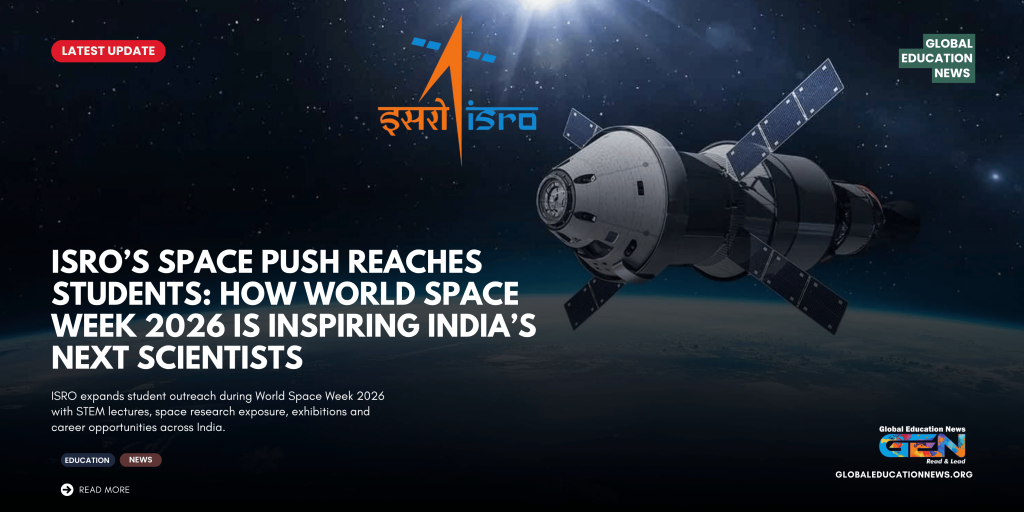
October 9, 2026 | New Delhi | Education News: India’s space programme is increasingly looking beyond rockets and satellites to its most important long-term resource—students and young researchers.
During World Space Week 2026, the Indian Space Research Organisation (ISRO) has expanded its space-science outreach through student lectures, research exposure, interactive sessions, exhibitions and direct interaction with scientists across different parts of the country.
The latest initiatives include programmes in Kerala and the Andaman and Nicobar Islands, giving school, undergraduate and postgraduate students opportunities to learn about space science, spacecraft technology, astronomy, space weather and India’s future space missions.
The 2026 World Space Week is being observed from October 4 to 10 under the theme “Rocket Revolution”, highlighting how new launch technologies, reusable systems and lower launch costs could change access to space.
For students, however, the bigger message is about something closer to home: how today’s classroom learners can become tomorrow’s scientists, engineers, researchers and space entrepreneurs.
ISRO World Space Week 2026: What Is Happening?
ISRO-linked institutions are conducting a range of educational and public-outreach activities during World Space Week.
In Kerala, the Vikram Sarabhai Space Centre (VSSC), Liquid Propulsion Systems Centre (LPSC), ISRO Inertial Systems Unit (IISU) and Indian Institute of Space Science and Technology (IIST) have joined hands for the celebrations.
Their programme includes:
- Interactive lectures for school students
- Online and on-campus sessions
- Student video activities
- Space-technology discussions
- Research and laboratory exposure
- Career guidance
- Public lectures
- Interaction with ISRO scientists and experts
The Kerala programme will culminate in a public outreach event on October 10 at the Kerala State Science and Technology Museum in Thiruvananthapuram.
Why Is ISRO Focusing More on Students?
India’s space programme is entering a period of rapid expansion.
The country is pursuing ambitious programmes involving human spaceflight, lunar exploration, space stations, satellite technology, launch vehicles, Earth observation and commercial space activities.
Such programmes require a much larger pipeline of trained professionals.
That means space education cannot begin only at the university or research level.
Curiosity has to begin much earlier.
ISRO’s own outreach framework identifies students, academicians and other stakeholders as important parts of its public-engagement strategy. Its programmes include exhibitions, educational activities, competitions and specialised student initiatives.
The objective is therefore not simply to explain what a rocket does.
It is to show students where science education can lead.
Port Blair Space Outreach: Over 200 Students and Faculty Participate
One of the latest examples comes from Port Blair in the Andaman and Nicobar Islands.
ISRO and the Indian Institute of Geomagnetism (IIG) conducted a two-day space-science outreach programme on October 6 and 7, 2026.
More than 200 people participated, including approximately:
- 180 undergraduate and postgraduate students
- Around 20 faculty members
- Students and faculty from several local academic institutions
The programme brought space scientists and students together through lectures, discussions and an exhibition.
The event covered subjects extending well beyond rockets.
Students were introduced to:
- India’s space-science exploration programme
- Solar physics
- Geomagnetism
- Space weather
- Comparative planetology
- Exoplanets
- Astrobiology
Interactive sessions also allowed students to directly engage with experts.
Why Is Space Weather Being Taught to Students?
Space weather is becoming increasingly important as society becomes more dependent on satellites and space-based infrastructure.
Changes in solar activity can affect the environment around Earth and potentially influence satellites, communications, navigation systems and other technologies.
Introducing students to space weather therefore demonstrates how astronomy connects with engineering, physics, communication and everyday technology.
This interdisciplinary approach is particularly valuable because modern space missions require expertise from many fields.
What Is the “Rocket Revolution” Theme of World Space Week 2026?
The theme of World Space Week 2026 is “Rocket Revolution.”
It focuses on major changes in launch technology and the possibility of making access to space more frequent and affordable.
The theme highlights developments such as:
- Reusable launch vehicles
- Lower launch costs
- Higher launch frequency
- New launch technologies
- Greater participation by commercial companies
- Increasing academic involvement in the space sector
For students, this means that the space industry is becoming broader than traditional government space agencies.
There are opportunities across engineering, software, artificial intelligence, materials science, electronics, robotics, data analysis, astronomy and entrepreneurship.
IIST Gives Students a Direct Look at Space Careers
Student outreach is also taking place through the Indian Institute of Space Science and Technology (IIST).
On October 1, IIST hosted a Science and Technology Exposure Visit for students and volunteers from the Galileo Science Club in Tamil Nadu.
The programme brought together 169 participants.
Students visited research laboratories and interacted with faculty members and research scholars.
They were also introduced to:
- Academic programmes
- Admission opportunities
- Space-sector careers
- Research opportunities
- The institute’s educational environment
This is an important part of space outreach because students can see how classroom subjects connect to actual research and engineering work.
From Physics Class to Space Research: How the Connection Works
A student interested in space does not necessarily have to become an astronaut.
The modern space sector needs specialists across many disciplines.
| School/College Subject | Possible Space-Sector Connection |
|---|---|
| Physics | Space science, propulsion, astronomy |
| Mathematics | Orbital mechanics, modelling, navigation |
| Computer Science | Mission software, data processing, AI |
| Electronics | Satellite systems, communication |
| Mechanical Engineering | Structures, propulsion, spacecraft systems |
| Electrical Engineering | Power systems and control |
| Chemistry | Propellants, materials and planetary science |
| Biology | Astrobiology and human spaceflight |
| Geology | Planetary exploration |
| Data Science | Satellite and Earth-observation data |
| AI/ML | Autonomous systems and scientific analysis |
This is why space outreach can have an impact far beyond the space sector itself.
It encourages students to understand that STEM subjects are connected rather than isolated school subjects.
“Your SPACE”: Students Get a Platform to Think About Local Problems
The Kerala World Space Week programme also includes a student activity called “Your SPACE.”
Participating schools are invited to present ideas on:
“Space Technology for Sustainable Local Development.”
The activity asks students to think about how space technology can help address problems closer to their own communities.
That could encourage students to explore areas such as:
- Weather monitoring
- Disaster management
- Agriculture
- Water management
- Mapping
- Environmental monitoring
- Communication
- Navigation
The approach changes the role of students from passive listeners to problem-solvers.
Why Student Participation Matters for India’s Space Future
India’s space ambitions require a skilled workforce.
The country’s space ecosystem now includes government institutions, universities, startups, research laboratories and private companies.
Student participation can therefore help create a broader talent pipeline.
Recent government information has also highlighted the expansion of student involvement in satellite and payload development. Since 2024, student competitions have included model rockets and CanSat-type satellite projects, while IN-SPACe has authorised student-designed satellites and payloads.
This indicates a larger transition:
Students are increasingly moving from learning about space to participating in space-related projects.
What Opportunities Can Students Find in India’s Space Sector?
The expansion of India’s space ecosystem means that students can eventually explore careers in several areas.
Space Science
Students interested in physics and astronomy can pursue research involving planets, stars, galaxies, solar physics and space environments.
Aerospace Engineering
Engineers are required to design and test launch vehicles, spacecraft, propulsion systems and structural components.
Computer Science and AI
Modern missions increasingly depend on software, automation, simulation, data processing and intelligent systems.
Satellite Technology
Satellites require expertise in electronics, communications, power systems, control systems and software.
Earth Observation
Satellite data can support agriculture, climate studies, urban planning, disaster management and environmental monitoring.
Space Entrepreneurship
India’s growing private space sector is creating opportunities beyond traditional government employment.
This makes space education relevant to students with very different academic interests.
ISRO Outreach Is Reaching Beyond Major Cities
One of the notable aspects of the current outreach programme is its geographic spread.
The Port Blair programme demonstrates that space-science education is not being limited to major metropolitan research centres.
ISRO’s official outreach material also describes programmes designed to reach students in different regions, including activities involving schools and students from rural and underserved backgrounds.
This matters because access to specialised science exposure can vary significantly depending on where a student lives.
A student in an island territory or smaller town may not have the same opportunities to meet scientists or visit research institutions as a student in a major technology hub.
Outreach programmes can help narrow that gap.
How World Space Week Can Change STEM Education
World Space Week is more than an annual celebration.
For schools, it can become a starting point for project-based learning.
Teachers can use space missions to introduce:
- Physics
- Mathematics
- Coding
- Geography
- Environmental science
- Astronomy
- Engineering
- Communication
- Data science
A satellite mission can therefore become a real-world classroom.
Students can ask:
How does a spacecraft stay in orbit?
How do satellites send information to Earth?
How can satellite data help farmers?
How does a rocket escape Earth’s gravity?
What happens when solar activity affects space infrastructure?
These questions naturally connect different areas of STEM education.
India’s Space Education Push Is Also About Future Jobs
The expansion of the space sector means the country will need people with specialised and interdisciplinary skills.
But future space jobs will not be limited to traditional aerospace engineers.
The sector will increasingly need professionals who understand combinations such as:
AI + space
Data science + Earth observation
Electronics + satellites
Robotics + planetary exploration
Biology + human spaceflight
Entrepreneurship + space technology
This is why student outreach can have long-term economic significance.
The students attending today’s lectures could become the researchers and engineers working on India’s next generation of missions.
ISRO World Space Week 2026: Key Facts
| Fact | Details |
|---|---|
| World Space Week | October 4–10, 2026 |
| 2026 theme | Rocket Revolution |
| Kerala institutions involved | VSSC, LPSC, IISU and IIST |
| Kerala public outreach | October 10, Thiruvananthapuram |
| Port Blair programme | October 6–7, 2026 |
| Port Blair participation | 200+ |
| Student participants in Port Blair | About 180 UG/PG students |
| Faculty participants | About 20 |
| IIST exposure visit | October 1 |
| IIST participants | 169 |
| Major topics | Space science, solar physics, geomagnetism, exoplanets, astrobiology |
| Student activity | “Your SPACE” |
| Focus | Space technology for sustainable local development |
The Port Blair figures and programme details were confirmed by ISRO’s October 8, 2026 announcement.
What Does ISRO’s Student Outreach Mean for Schools?
For schools, the message is clear: space science can be brought into everyday learning.
Students do not have to wait until they enter an aerospace programme to start exploring space technology.
They can begin through:
- Science projects
- Astronomy clubs
- Model-building activities
- Coding
- Robotics
- Space-related competitions
- Research projects
- Science exhibitions
- Online lectures
- STEM programmes
ISRO’s outreach ecosystem already includes several programmes intended to encourage student curiosity and participation.
ISRO and World Space Week 2026: FAQ
What is World Space Week 2026?
World Space Week is observed from October 4 to October 10 every year. In 2026, its theme is “Rocket Revolution,” focusing on developments transforming access to space.
What is ISRO doing during World Space Week 2026?
ISRO and its associated institutions are organising student lectures, interactive sessions, exhibitions, exposure visits and public outreach programmes across different parts of India.
How many students participated in the Port Blair ISRO outreach programme?
More than 180 undergraduate and postgraduate students participated, alongside around 20 faculty members, taking total participation above 200.
What subjects were covered in the Port Blair programme?
The programme included India’s space-science exploration programme, solar physics, geomagnetism, space weather, comparative planetology, exoplanets and astrobiology.
What is the “Your SPACE” student activity?
It is a Kerala World Space Week activity in which schools present ideas on “Space Technology for Sustainable Local Development.”
When is the Kerala World Space Week public outreach programme?
The programme is scheduled for October 10, 2026, from 10 am to noon at the Kerala State Science and Technology Museum in Thiruvananthapuram. It is open to students, teachers, science enthusiasts and the public.
What careers can students pursue in India’s space sector?
Students can eventually pursue careers in aerospace engineering, space science, astronomy, satellite technology, electronics, computer science, AI, robotics, Earth observation, data science and space entrepreneurship.
The Bigger Picture: India Wants Students to Be Part of Its Space Story
The most important part of ISRO’s World Space Week 2026 outreach may not be the exhibitions or lectures themselves.
It is the message behind them.
India’s space programme needs its next generation now.
As missions become more complex and the space ecosystem expands beyond traditional government institutions, India will need students who can combine scientific knowledge with engineering, computing, AI, mathematics and problem-solving.
The outreach programmes in Kerala and the Andaman and Nicobar Islands show how that pipeline can begin: with curiosity, direct interaction with scientists and exposure to real space research.
World Space Week 2026’s “Rocket Revolution” therefore has a second meaning for Indian students.
The revolution is not only happening in launch technology.
It is also happening in the way young people are being introduced to space science, STEM education and India’s future space economy.
Global Education News will continue tracking India’s space education, STEM initiatives, student opportunities and developments shaping the country’s next generation of scientists and innovators.