Date: November 23, 2026
Place: Itanagar, Arunachal Pradesh
Education News: National Affairs and Disaster Management
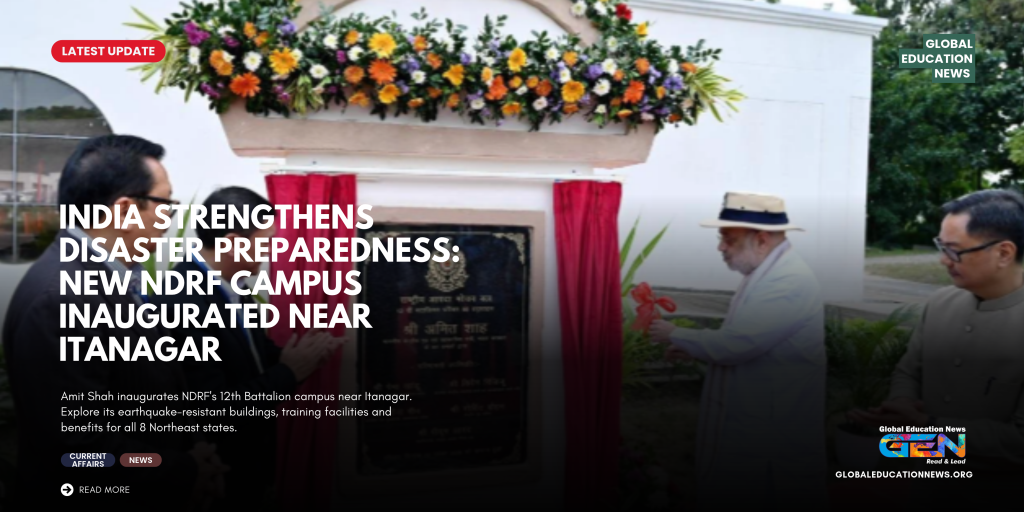
Itanagar, Education News: India’s disaster management infrastructure has received a major boost with the inauguration of the 12th Battalion campus of the National Disaster Response Force (NDRF) at Hollongi, near Itanagar, Arunachal Pradesh. Union Home Minister Amit Shah inaugurated the new facility on November 22, 2026, highlighting its role in strengthening disaster preparedness across the Northeast.
The campus will serve as a disaster-response centre for Arunachal Pradesh, the wider Northeast and neighbouring regions. One of its major responsibilities will be to provide specialised training to State Disaster Response Force (SDRF) personnel from all eight Northeastern states.
Built with earthquake-resistant infrastructure, the campus also includes an Olympic-size swimming pool and a diving tank for specialised training. The swimming pool will be available free of charge to athletes and swimming enthusiasts from Itanagar and across Arunachal Pradesh.
Why Is the New NDRF 12th Battalion Campus Important for Northeast India?
The Northeast is vulnerable to several natural hazards, including earthquakes, floods, landslides and other emergencies. Difficult terrain and connectivity challenges can also make disaster response more demanding.
The new NDRF campus is intended to strengthen the region’s ability to prepare for and respond to such emergencies.
Its importance extends beyond the deployment of rescue personnel. The facility will support training, coordination and operational preparedness among disaster response teams from different Northeastern states.
The campus is expected to provide three major benefits:
- Faster disaster response: Strengthening the regional presence of NDRF personnel.
- Specialised training: Supporting the development of trained disaster response teams across the Northeast.
- Better coordination: Helping state-level response forces improve their preparedness and cooperation during emergencies.
The facility will also support disaster response in several adjoining regions, making it an important addition to India’s emergency management network.
NDRF Campus in Itanagar: What Facilities Have Been Developed?
The newly inaugurated campus has been designed to support the operational and training requirements of the 12th Battalion.
According to the details shared during the inauguration, all buildings on the campus have been constructed according to earthquake-resistant standards.
| Facility | Purpose |
|---|---|
| Earthquake-resistant buildings | Safer infrastructure in a disaster-prone region |
| Olympic-size swimming pool | Swimming and specialised training |
| Diving tank | Water-related training requirements |
| Battalion campus | Operational and administrative support |
| Training infrastructure | Capacity building for disaster response personnel |
The swimming pool is also expected to benefit local athletes. It will be opened free of charge to swimming enthusiasts and sportspeople from Itanagar and other parts of Arunachal Pradesh.
How Will the Campus Train SDRF Personnel From All 8 Northeastern States?
One of the most important features of the new facility is its role as a regional training centre.
The campus will conduct training for State Disaster Response Forces from all eight Northeastern states:
- Arunachal Pradesh
- Assam
- Manipur
- Meghalaya
- Mizoram
- Nagaland
- Sikkim
- Tripura
SDRF personnel play an important role in responding to emergencies within their respective states. Training at a common facility can help strengthen coordination and improve familiarity with disaster response procedures.
This is particularly important when major emergencies require teams from multiple states to work together.
The initiative is expected to improve regional preparedness by strengthening the capabilities of state-level response teams alongside the NDRF.
What Is the Role of NDRF in India’s Disaster Management System?
The National Disaster Response Force is a specialised force responsible for responding to major natural and human-made disasters.
Its work includes search and rescue operations, flood response, emergency assistance and support during other disaster situations.
During the inauguration, Amit Shah highlighted the force’s achievements and its growing operational capacity.
The figures shared during the event included:
| NDRF achievement | Reported figure |
|---|---|
| Rescue and relief operations conducted | More than 11,000 |
| Lives saved through operations | Over 1.61 lakh |
| Deployment locations across India | More than 70 |
| Northeastern states covered by the new training initiative | 8 |
These figures underline the scale of the force’s contribution to disaster response and emergency assistance.
How Is India Moving Towards a Zero-Casualty Disaster Management Approach?
A major focus of India’s disaster management strategy is shifting from responding after a disaster to preparing before it happens.
This approach involves several important areas:
- Early warning systems
- Disaster prevention and mitigation
- Risk assessment and preparedness
- Timely evacuation and public alerts
- Coordination between central and state response agencies
- Training and modern rescue equipment
During the inauguration, the Home Minister highlighted the growing role of science and technology in providing advance warnings. He stated that cyclone warnings can now be issued up to seven days in advance, helping authorities prepare and protect lives and property.
The broader objective is to reduce disaster-related casualties through early action, better coordination and stronger response capabilities.
Why Has 2026 Been Declared the Year of Capacity Building for NDRF?
The year 2026 has been designated as the Year of Capacity Building for the NDRF.
The focus is on strengthening three important areas:
- Expansion: Increasing the force’s operational reach and deployment capabilities.
- Resources: Improving access to modern equipment and essential facilities.
- Training: Building the technical and professional capabilities of disaster response personnel.
The new campus in Arunachal Pradesh forms part of this wider focus on improving disaster response infrastructure and regional preparedness.
Who Attended the Inauguration of the NDRF Campus?
Several senior leaders and officials attended the inauguration ceremony in Itanagar.
The prominent attendees included:
- Amit Shah, Union Home Minister
- Pema Khandu, Chief Minister of Arunachal Pradesh
- Kiren Rijiju, Union Minister
- Chowna Mein, Deputy Chief Minister of Arunachal Pradesh
- Govind Mohan, Union Home Secretary
- Mahesh Dikshit, Intelligence Bureau Director
- Piyush Anand, Director General of NDRF
The event highlighted cooperation between the central government, the Arunachal Pradesh government and disaster management authorities.
Frequently Asked Questions (FAQs)
1. Where was the NDRF 12th Battalion campus inaugurated?
The campus was inaugurated at Hollongi, near Itanagar, in Arunachal Pradesh, on November 22, 2026.
2. Who inaugurated the new NDRF campus?
Union Home Minister Amit Shah inaugurated the 12th Battalion campus of the National Disaster Response Force.
3. What is the main purpose of the new NDRF campus?
The campus will strengthen disaster response capabilities in Arunachal Pradesh, the Northeast and neighbouring regions. It will also provide specialised training to SDRF personnel from all eight Northeastern states.
4. Which eight states will benefit from the training facility?
The training initiative covers Arunachal Pradesh, Assam, Manipur, Meghalaya, Mizoram, Nagaland, Sikkim and Tripura.
5. What special facilities are available at the NDRF campus?
The campus includes earthquake-resistant buildings, an Olympic-size swimming pool and a diving tank.
6. Will the swimming pool be open to the public?
Yes. The Olympic-size swimming pool will be available free of charge to swimming athletes and enthusiasts from Itanagar and across Arunachal Pradesh.
7. How many lives has the NDRF reportedly saved?
The figures highlighted during the inauguration stated that the NDRF has saved more than 1.61 lakh lives through over 11,000 rescue and relief operations.
8. Why is 2026 important for the NDRF?
The year 2026 has been declared the Year of Capacity Building for the NDRF, with an emphasis on expansion, modern resources and specialised training.
Conclusion: A Stronger Disaster Response Network for Northeast India
The inauguration of the NDRF’s 12th Battalion campus marks an important step towards strengthening disaster preparedness in Arunachal Pradesh and the wider Northeast.
Beyond its role as a regional response centre, the facility will support specialised training for SDRF personnel from all eight Northeastern states. Its earthquake-resistant infrastructure, training facilities and public swimming pool also give the campus a wider regional significance.
As India continues to strengthen its disaster management system, better infrastructure, early warning capabilities and trained response teams will remain essential for protecting communities.
Global Education News will continue covering major developments in national infrastructure, government initiatives, disaster management and public policy.